


Textured Oil Landscape Painting
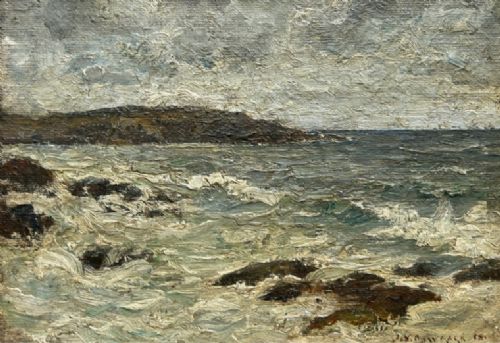
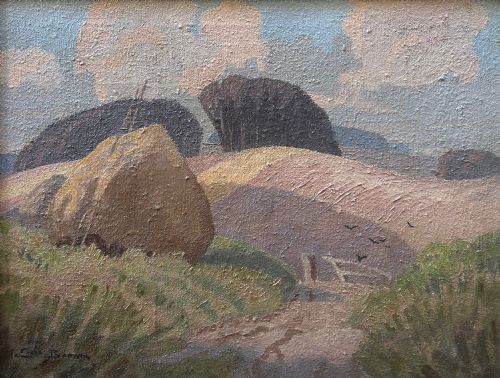
These textured oil landscape painting examples capture light and pigment with tangible weight, offering a tactile depth that draws the eye straight into the canvas.
Textured Oil Landscape Painting
When you search for a textured oil landscape painting, you encounter works built with thick pigment across the mid-century modern, post-impressionist, and modernist British movements. These pieces span from the 1920s through the 1960s, recording coastal views, haystacks, estuaries, and urban scenes.
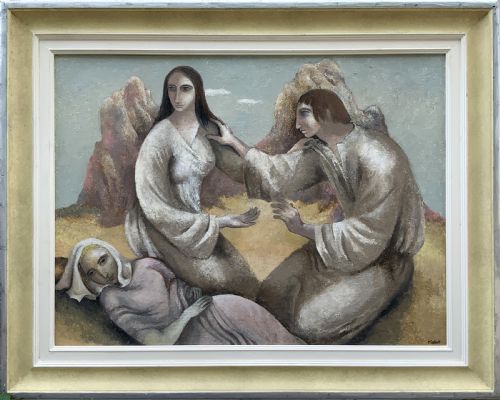
You are most likely to meet mid-century examples executed on board or canvas, housed in wood frames with occasional gesso detailing. The subject matter ranges from figurative rural settings to industrial constructivist factory scenes and abstract cityscapes.
Materials and construction
Artists built these compositions primarily using oil paint applied thickly onto wooden boards, prepared canvas, or stretched canvas supports. The physical body of the paint forms ridges and peaks that catch the room's light.
Support frames in wood and decorative gesso surrounds complete the physical structure of the works, framing the heavy pigment layers applied by brush or palette knife.
One barn scene hides a modernist French twist inside a strictly figurative composition.
Judging quality and execution
The distinction between ordinary and exceptional works lies in the handling of the medium and the sureness of the composition. Stronger pieces display purposeful brushwork or palette knife application that builds form rather than mere surface clutter.
Context also matters, as documented signatures and traceable provenance elevate a piece beyond anonymous studio output. The relationship between the painted surface and its original framing further defines the integrity of the object.
Eric Brown·Christine Nesbit·Erich Mercker·Helen Layfield Bradley
The Textured Oil Landscape Painting Glossary
- Impasto
- Paint applied thickly to a canvas or board so that it stands out from the surface. This technique allows brush or palette knife marks to retain their three-dimensional form.
- Board
- A rigid flat panel used as a painting support instead of woven fabric. Artists frequently utilised wooden boards during the mid-century period.
- Constructivism
- An artistic approach originating in the twentieth century that emphasises abstract geometric forms and industrial structures. Factory scenes and urban landscapes often reflect this aesthetic.
- Gesso
- A paint mixture consisting of a binder mixed with chalk, gypsum, or pigment used to prepare surfaces. It frequently appears on decorative frames enclosing mid-century works.
- Post-Impressionist
- A movement extending the stylistic approach of impressionism while rejecting its limitations. Artists working in this manner focused on symbolic content and heavy painterly application.
Textured Oil Landscape Painting: Frequently Asked Questions
What periods do these paintings date from?
The available selection primarily spans the twentieth century, with particular concentration in the 1920s, 1950s, and 1960s.
These decades encompass post-impressionist output, mid-century modernism, and constructivist industrial scenes.
How should I hang a heavy impasto painting?
Heavy oil and impasto works require secure wall fixings suited to the combined weight of the thick paint, wooden support, and frame.
Ensure picture hooks are anchored directly into wall studs or use appropriate masonry fixings.
What framing is typically found on these pieces?
Many works retain their original wood frames, occasionally featuring gesso mouldings that complement the mid-century aesthetic.
Original framing provides historical context for how the painting was exhibited during its period of creation.
How do I care for textured oil paintings?
Keep the painted surface free from dust using a soft, dry brush, taking care around raised impasto ridges.
Position the work away from direct sunlight and dramatic fluctuations in temperature or humidity.