
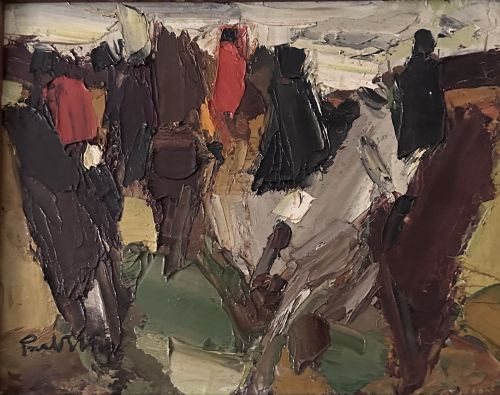


Textured Brown Wall Art
Textured brown wall art brings deep earthy tones and tactile surfaces into a room, offering rich visual weight for a living space or study.
Textured Brown Wall Art
Textured brown wall art encompasses oil paintings and acrylic works created across the early to mid-twentieth century, capturing subjects from industrial scenes to cityscapes. These pieces rely on heavy pigment application and earthy palettes to create tangible depth on canvas or board.
The versions most commonly met on this page date from the 1950s and 1960s, alongside earlier twentieth-century examples. They range from abstract portraits and still lifes to modernist factory views and impressionist studies.
How they were made
Artists built these surfaces using oil paint or acrylic applied thickly to canvas, wood board, or linen supports. The inclusion of impasto techniques creates raised ridges and physical dimension across the brown and neutral colour fields.
Many works retain their original wood frames or gilt wood surrounds, housing the painted surface securely while complementing the darker tones of the composition.
Several rabbits and a horse race quietly keep watch among the industrial factories and abstract cityscapes.
What varies in quality
Quality rests in the handling of the medium and the deliberate construction of the surface texture. Stronger examples demonstrate confident brushwork and varied impasto that give the brown pigments real depth and movement.
The integrity of the support material and the suitability of the frame also set works apart. Well-preserved canvas or board combined with a sympathetic period frame elevates the overall presence of the piece on the wall.
Antonio Ferri·Ernst Louizor
The Textured Brown Wall Art Glossary
- Impasto
- Paint applied thickly to a canvas or board so that it stands out from the surface. This technique leaves visible brush or palette knife marks that catch the light.
- Constructivism
- An artistic style originating in the early twentieth century that emphasises geometric forms and industrial themes. Works in this vein often depict machinery, factories, or structured urban environments.
- Impressionism
- A style focused on capturing the visual impression of a moment through light and ordinary subject matter. It values open composition and visible brushstrokes over strict academic finish.
- Canvas
- A closely woven fabric used as a surface for oil or acrylic painting. It is typically stretched tightly across a wooden frame before work begins.
Textured Brown Wall Art: Frequently Asked Questions
What periods do these pieces come from?
The pieces span the early to mid-twentieth century, with dates concentrated in the 1920s, 1950s, and 1960s.
This era encompasses various modernist and impressionist movements that embraced textured applications of paint.
What materials are used in these works?
Artworks are executed primarily in oil paint or acrylic on supports such as canvas, wood board, and linen.
Many listings also retain their original wood or gilt wood frames.
How do I hang textured wall art?
Ensure the wall hooks or fixings are securely anchored to support the weight of the framed painting and its wooden backing.
Position the piece where ambient room light can cross the surface and highlight the thick impasto details.
What subjects appear in these paintings?
Subjects include abstract portraits, still lifes of animals and objects, urban cityscapes, and industrial factory scenes.
These diverse subjects reflect the varied interests of mid-century painters working in expressionist and impressionist modes.