
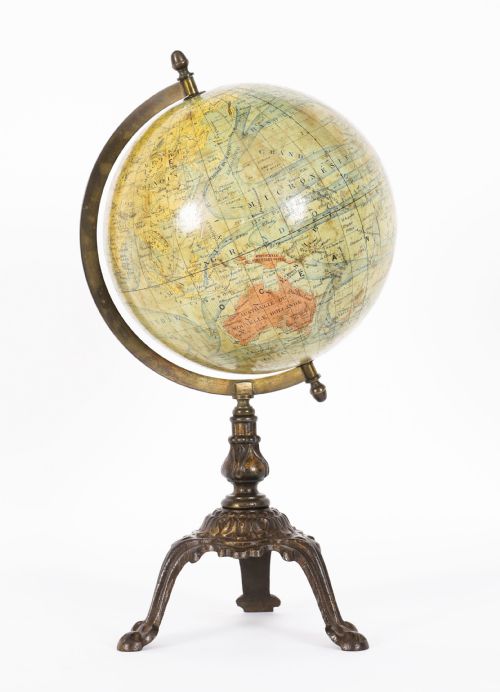
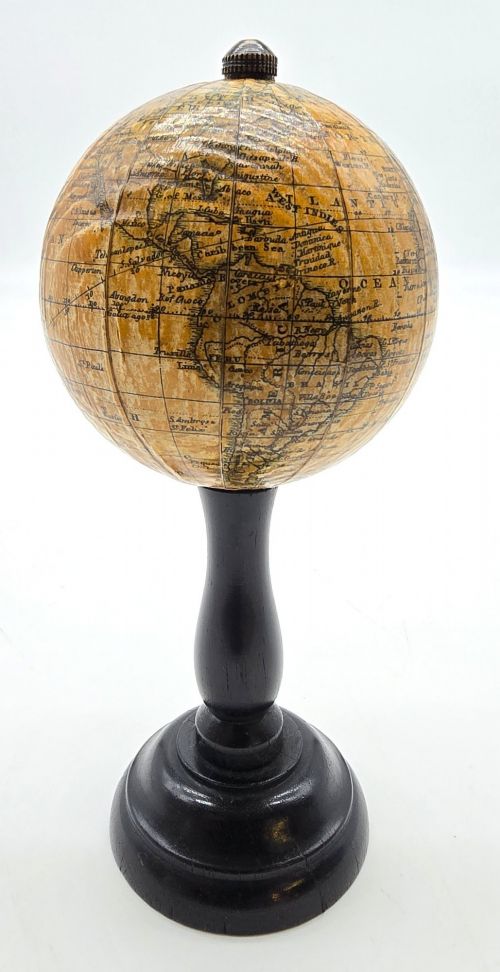


Terrestrial Globe on Stand
A terrestrial globe on stand brings the geography of past centuries into a room, mounted securely upon timber or metal.
Terrestrial Globe on Stand
When you search for a terrestrial globe on stand, you look for a detailed model of the Earth supported by a dedicated base, ranging from small miniature desk examples to large library and floor-standing pieces. The selection includes compact desktop versions alongside imposing floor-standing editions.
The objects span multiple periods, with examples originating from the eighteenth century, the Victorian era, the Edwardian period, and the interwar years through to the mid-twentieth century. French, German, and British makers feature prominently among the geographical spheres available.
Forms vary from table globes resting on turned wooden feet to massive library globes supported by substantial mahogany or ebonised frames. Miniature versions sit on simple wooden or brass mounts designed for small spaces.
Materials and construction methods
Paper gores are printed with map details and carefully applied over a spherical plaster or paper-mache core to form the Earth. These spheres rotate within a brass meridian ring or a simple metal axis.
Stands utilise solid timbers such as mahogany and ebonised wood, alongside cast iron and brass for structural support. Turned wooden pillars and heavy tripod bases hold the weight of the larger library globes.
Some miniature globes are small enough to sit comfortably in the palm of a hand yet still name distant continents.
Assessing craftsmanship and condition
Quality rests upon the crispness of the cartographic engraving and the accuracy of the historical boundaries printed on the paper gores. Finer spheres exhibit hand-coloured details and clear, legible typography.
The integrity of the stand matters greatly, with superior pieces showing well-turned solid wood, original brass components, and stable mountings that hold the globe firmly without sagging.
G & J Cary·J. Forest·Malby's·Raths Physikalischer·Geographia·Lebegue & Cie·Jordglob Sweden·M.Vivien·Phillips
The Terrestrial Globe on Stand Glossary
- Gore
- A tapering strip of printed paper pasted onto a sphere to form the map of the Earth. These printed segments require precise alignment during application.
- Meridian ring
- The brass or metal ring surrounding the globe that holds it in place and allows rotation. It often bears degree markings for navigational measurement.
- Table globe
- A compact geographical sphere designed to sit upon a desk, table, or cabinet. These smaller items provide detailed cartography for close study.
- Library globe
- A large floor-standing model traditionally kept in a study or library for scholarly reference. These impressive pieces rest on substantial wooden frames.
- Celestial globe
- A companion sphere mapping the stars and constellations rather than the Earth. These pieces often match terrestrial globes in size and stand design.
Terrestrial Globe on Stand: Frequently Asked Questions
How do I date a terrestrial globe on stand?
Examine the political boundaries, capital cities, and railway lines printed on the paper gores. Cartographers frequently updated these details to reflect historical events and shifting empires.
The style of the wooden or metal stand also provides strong chronological clues, matching the furniture aesthetics of periods like the Victorian era or the 1930s.
Where should I place a floor-standing globe?
Position your floor-standing globe in a study, library, or living room away from direct sunlight and damp conditions. Strong light fades the delicate paper gores and yellows the varnish over time.
Keep the piece clear of active heat sources such as radiators to prevent the wood of the stand from warping and the plaster core from cracking.
What is the difference between desk and library globes?
Desk globes are smaller versions intended for close-up viewing on tables or writing surfaces. They occupy minimal space while offering a detailed view of world geography.
Library globes are much larger floor-standing instruments designed as architectural furniture pieces for studies and grand rooms, often supported by heavy turned wooden stands.
Are replacement parts common for antique globes?
Original components remain scarce, so finding exact matching replacement stands or meridian rings is exceptionally difficult. Most antique pieces survive best when their original stands and spheres stay together.
Minor structural repairs to wooden bases are possible by skilled conservators, but alterations to the printed paper gores diminish historical integrity.