
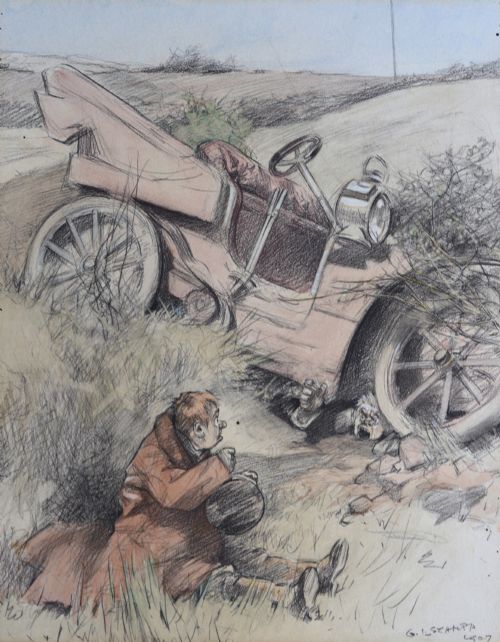


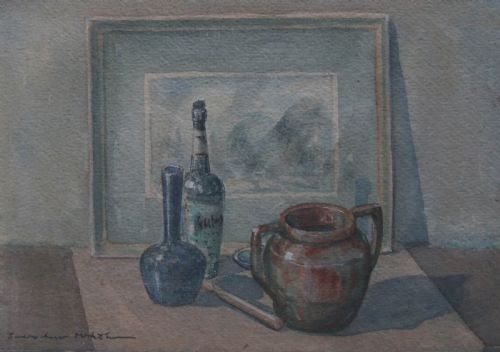


Terracotta Watercolour Picture
These terracotta watercolour picture works bring together delicate pigment and paper to capture coastal scenes, pastoral landscapes, and still life compositions.
Terracotta Watercolour Picture
A terracotta watercolour picture combines traditional water-based media on paper to depict architectural views, rural villages, and maritime scenes. These works capture specific topographical details and atmospheric lighting across various British and European locations.
The selections available here range from Victorian pastoral compositions and Edwardian coastal views to later Art Deco and mid-century landscapes. Buyers encounter framed fine art and wall art originating from distinct historical periods spanning the nineteenth and twentieth centuries.
Many examples document specific sites such as Whitby fishing dockyards, Venetian canals, and Staffordshire countryside lanes. These paintings offer a tangible record of historical landscapes executed by named artists and regional practitioners.
Materials and execution
Artists executed these works on paper supports, applying watercolour pigment alongside bodycolour, ink, and pencil details. The combination of these media allowed creators to build both translucent washes and precise linear definition.
The surviving pieces are housed within protective glass and wooden frames that preserve the fragile paper supports. These framing methods safeguard the pigment layers from environmental moisture and physical damage.
Listings feature paper supports combined with watercolour, ink, and pencil across Victorian, Edwardian, Art Deco, and Modern British periods.
Evaluating quality and condition
The strength of the composition and the clarity of the brushwork distinguish finer works from standard topographical sketches. Skilled handling of pigment creates convincing depth in architectural stonework and coastal atmospheres.
Preservation of the paper support and the vibrancy of the original watercolour pigment influence the overall integrity of the piece. Subtle tonal gradations remain intact on works that have avoided excessive light exposure.
George Lorain Stampa·Alfred George Morgan·Samuel Timmins·Arthur Tucker·Fred Waugh·James Thomas Watts·Grace Hastie·Ralph Todd·David Law·George Stanfield Walters·Peter Toft·Benjamin D. Sigmund·James Kerr McArthur·Tom Dudley·J.D. Walker·T. Williams·John Thirttle
The Terracotta Watercolour Picture Glossary
- Watercolour pigment
- Finely ground colour particles suspended in a water-soluble binder. This medium allows artists to achieve transparent washes and delicate tonal transitions on paper.
- Topographical
- Representing specific real-world locations accurately. These paintings document recognizable towns, harbours, and architectural landmarks.
- Pastoral
- Depicting rural life and idealized countryside scenery. Such works focus on rustic cottages, agricultural fields, and quiet village streets.
- Marine painting
- Artwork focusing primarily on the sea, ships, and coastal dockyards. These pieces often record maritime activity and harbour architecture.
- Support
- The physical material upon which the artwork is painted. In these instances, the primary support consists of paper.
Terracotta Watercolour Picture: Frequently Asked Questions
How should I hang a watercolour picture?
Display these works away from direct sunlight to prevent the watercolour pigments from fading over time. Maintaining stable indoor humidity protects the paper support and the wooden frame.
Ensure the picture is securely mounted behind glass with a proper mount board separating the paper from the glazing. This prevents condensation damage.
What periods do these paintings represent?
The selections encompass nineteenth-century pieces alongside Edwardian, Victorian, Art Deco, and mid-century works. Each era brings distinct subject matter, ranging from traditional maritime views to modern British landscapes.
Dates are established through artist signatures, inscriptions, and stylistic conventions associated with specific decades.
Are these paintings original artworks?
The listings consist of original hand-painted works executed directly on paper. Artists utilised watercolour, ink, and pencil to create unique compositions rather than mass-produced prints.
Signatures, dates, and inscriptions on the paintings or mounts frequently confirm their original status.
Where do the depicted locations come from?
The artwork subjects range from English villages and Yorkshire coastal towns to Venetian canals and Spanish landscapes. Artists travelled extensively to record recognizable topographical landmarks.
Titles and inscriptions often name the exact site, providing historical context for the view.