


Tambour Front Commodes
Tambour front commodes are clever Georgian and Regency bedside cabinets concealing sliding wooden slat doors that keep the bedroom tidy.
Tambour Front Commodes
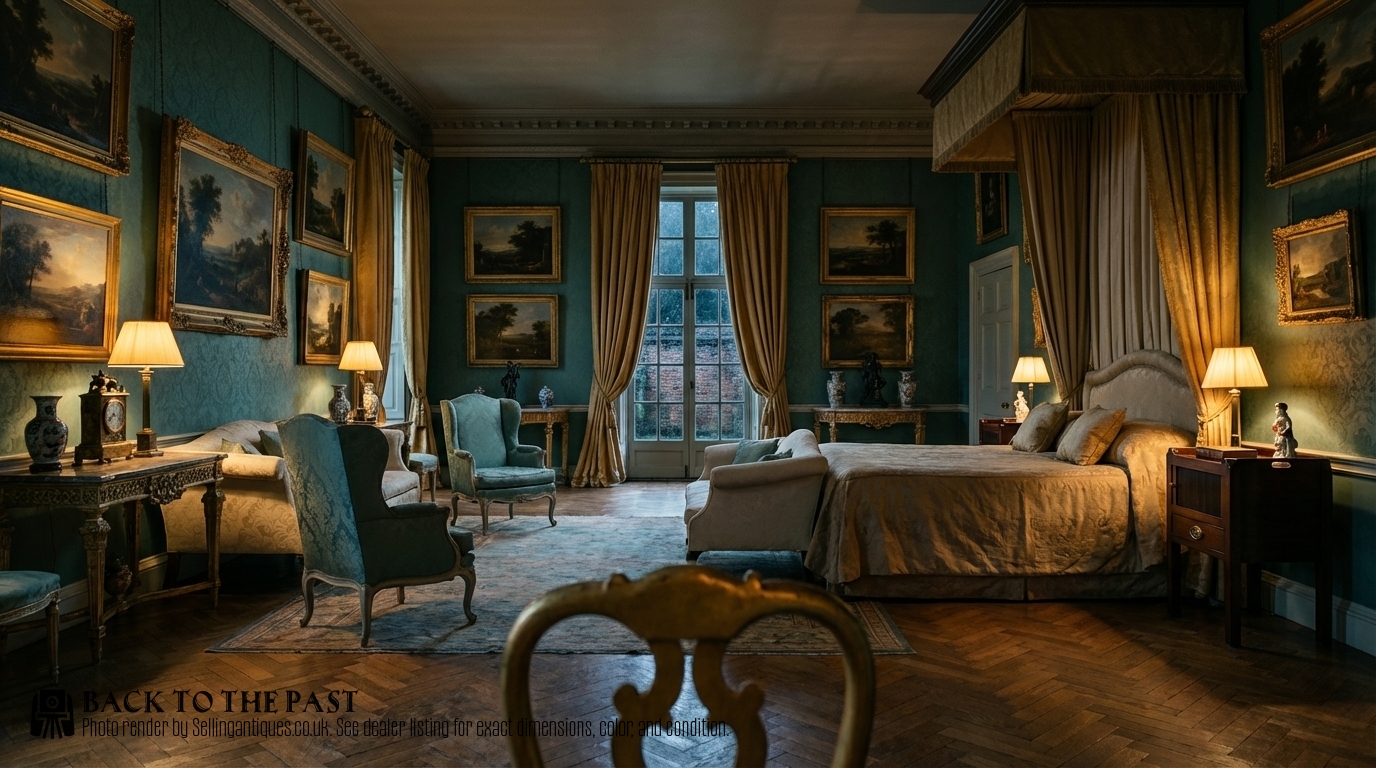
Tambour front commodes are primarily Georgian and Regency bedside pieces designed to hold necessities discreetly behind flexible wooden doors. These cabinets appear as bedside tables, nightstands, and compact cupboards rather than large bedroom chests.
The George III period dominates the selection, bringing refined proportions in mahogany alongside occasional satinwood and boxwood inlay. Most examples date from the late eighteenth century and the opening years of the nineteenth century.
Tray tops and serpentine fronts emerge frequently among the pieces, offering raised edges to secure small items or curved profiles that soften the silhouette. Buyers meet single cabinets, matched pairs, and near pairs across the selection.
How they were made
Cabinet makers constructed these bodies from solid and veneered mahogany, applying boxwood inlay for fine linear detail. The characteristic tambour shutter consists of narrow wooden strips glued to a canvas backing, allowing the curtain to slide smoothly within concealed tracks.
Surfaces often feature fine brass fittings such as pull handles on internal drawers or carrying handles on the sides. Tray tops utilise raised moulded edges or pierced galleries to prevent items from slipping.
Tambour Front Commodes Retail Price Guide 2026
Typical asking prices for tambour front commodes among the pieces listed under this phrase on Sellingantiques today, from the lower quarter to the upper quarter. They describe what is for sale here now, not the wider market.
The site listings span the Georgian, Regency, and 18th Century periods, utilising mahogany, boxwood, satinwood, and canvas.
What varies in quality
The refinement of the timber and the precision of the joinery set the standard for these pieces. Select examples display carefully chosen flame mahogany veneers and crisp boxwood stringing that elevate the cabinet beyond utilitarian furniture.
The operation of the sliding tambour mechanism dictates everyday pleasure in the piece. Smooth movement along the enclosed track reflects meticulous initial construction by the cabinet maker.
The Tambour Front Commodes Glossary
- Tambour
- A flexible shutter formed of narrow vertical strips of wood glued to a canvas backing. This ingenious construction allows the door to slide around a tight curve without swinging outward into the room.
- Serpentine front
- A furniture front curving outward in the centre and inward at the sides. This graceful shape requires advanced woodworking skill to execute properly.
- Tray top
- A tabletop finished with a raised moulded edge or gallery on three or four sides. It serves to keep objects from rolling off the surface.
- Bow front
- A convex curved front that projects outward in a smooth arc. The style appears frequently on Georgian bedside cabinets.
- Nightstand
- A small bedside table or cabinet designed to hold chamber lighting and personal items overnight. The evidence shows these often incorporate tambour doors or enclosed cupboards.
Tambour Front Commodes: Frequently Asked Questions
What is a tambour front commode?
A tambour front commode is a small Georgian or Regency bedside cabinet featuring a sliding door made of vertical wooden slats on canvas. These pieces served as bedside tables and nightstands in traditional bedrooms.
The flexible door rolls smoothly around a track to conceal internal shelves or drawers without taking up floor space when opened.
How do you date these pieces?
Dating relies on stylistic markers associated with the Georgian, George III, and Regency periods alongside timber choices like mahogany and satinwood. Cabinet proportions and edge details offer further clues to the exact era.
Most surviving examples date from the late eighteenth century through to the early nineteenth century.
Where were these placed in a room?
These compact cabinets stood beside the bed to hold nighttime essentials, chamber lighting, and small personal belongings. Their enclosed lower sections kept private items out of sight.
Pairs were often placed on either side of larger beds in grander chambers.
Are pairs common?
Matched pairs and near pairs appear regularly alongside single bedside cabinets in the archive and current listings. Cabinet makers frequently produced them in matching sets for symmetrical bedroom layouts.
Finding a true pair of eighteenth century tambour commodes remains a notable discovery for collectors.