
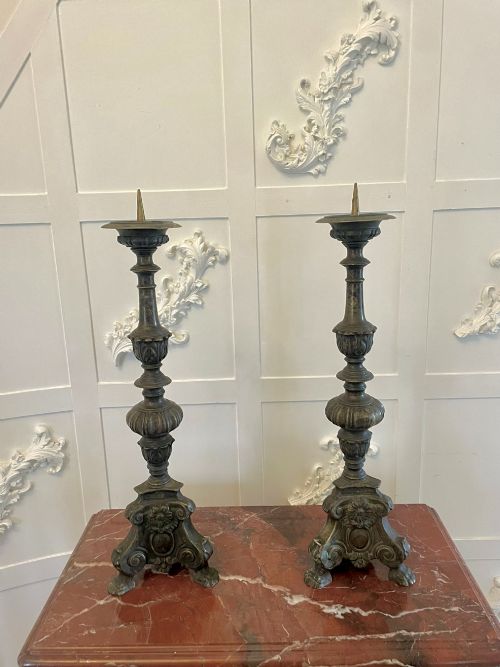


Tall Bronze Candlesticks
Tall bronze candlesticks bring architectural presence and heavy metalwork to a room, ranging from grand Gothic Revival pairs to patinated Regency columns.
Tall Bronze Candlesticks
When you search for tall bronze candlesticks, you encounter heavy lighting accessories and altar pieces shaped from cast metal, patinated bronze, and gilt bronze. The items span the nineteenth century, including Victorian, Regency, and French Restauration periods.
Most examples take the form of paired church candlesticks, pricket stands, and candle holders with substantial vertical weight. You also find related forms such as candelabras, standard lamps, and table lamps sharing the same metalwork vocabulary.
Stylistic influences range widely across the selections, incorporating Gothic Revival, Egyptian Revival, Neoclassical, and Italianate-Baroque designs. Japanese Meiji period pieces also appear, offering distinct regional casting techniques within the same overall height category.
Materials and construction methods
The pieces rely on heavy metal casting, utilising bronze, brass, and ormolu to achieve rigid vertical forms. Foundry work combines patinated surfaces with gilt highlights, particularly on French Restauration and Regency examples.
Seamed construction methods appear on nineteenth century items, where separate cast sections join to build up the tall shafts. Pricket variants incorporate spike fittings to secure large candles directly onto the drip pans.
Church candlesticks occasionally bear melted wax remnants from nineteenth-century services still clinging to their drip pans.
Assessing quality in tall bronze candlesticks
Quality rests primarily in the crispness of the original casting and the depth of the metal finish. Finer pieces retain intricate chased detail across decorative motifs, whereas simpler items show softer edges from worn moulds.
The weight of the metal and the integrity of the joins determine structural stability in pieces built to considerable heights. Original patination and fire-gilt surfaces command greater interest than later stripped or repainted finishes.
The Tall Bronze Candlesticks Glossary
- Pricket
- A candlestick featuring a sharp central spike designed to impale the base of a candle rather than sitting inside a socket. These often appear on church and altar pieces.
- Ormolu
- Finely ground high-carat gold applied to a bronze base using a mercury amalgamation process. This technique creates a durable, rich golden surface seen on grander nineteenth-century examples.
- Patinated Bronze
- Metal darkened or coloured through chemical treatment or natural oxidation. The process highlights relief work and protects the underlying alloy.
- Gothic Revival
- An architectural and decorative style drawing on medieval forms. Pieces in this idiom feature pointed arches, quatrefoils, and heavy structural moulding.
- French Restauration
- A stylistic period bridging neoclassical restraint and early nineteenth-century exuberance. Objects from this era display balanced proportions combined with rich decorative mounts.
Tall Bronze Candlesticks: Frequently Asked Questions
What is a pricket candlestick?
A pricket candlestick uses a metal spike at the top to hold the wax pillar in place instead of a traditional hollow socket. This design is common in ecclesiastical metalwork and large altar pieces.
Such items were built to support heavy candles for long services, requiring a stable base and a secure spike to prevent slipping.
How do I clean a bronze candlestick?
Bronze requires gentle dusting with a dry cloth to protect the underlying patina and metal finish. Avoid harsh commercial polishes that can strip away historic surface treatments.
If the metal is unlacquered brass or gilt bronze, a soft brush helps remove dirt from recessed cast details without scratching the surface.
Are these candlesticks wired for electricity?
Most traditional examples remain in their original candle-holding format, though some pieces in the inventory have been adapted as standard lamps or table lamps. Conversions vary depending on whether the original socket or pricket was altered.
Buyers should examine the description to confirm if wiring has been added or if the piece retains its original lighting function.
How do I identify a Victorian bronze candlestick?
Victorian pieces often display heavier casting and borrow historical motifs from Gothic Revival, Egyptian Revival, or Italianate styles. Look at the weight and the complexity of the base.
Dates around the mid to late nineteenth century frequently accompany seamed bronze construction and darker patinated finishes on these taller forms.