


Tabletop Glass Vitrine
A tabletop glass vitrine turns everyday display into a quiet stage for small treasures, protecting them behind clear panes while keeping every angle in view.
Tabletop Glass Vitrine
A tabletop glass vitrine provides an enclosed space for viewing delicate objects, drawing on forms made for shops, pharmacies, and parlours across the Victorian, Edwardian, and Art Deco eras. These pieces sit on counters, desks, or tables, offering compact display without demanding floor space.
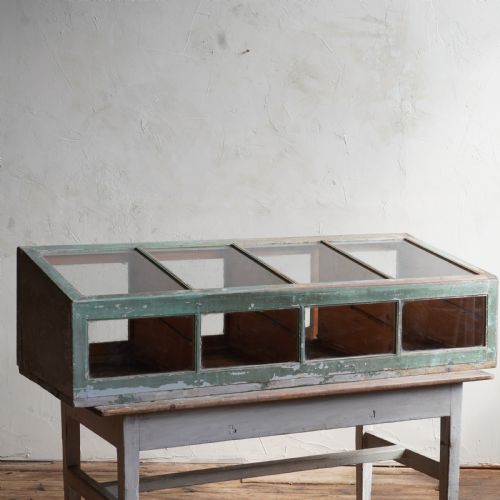
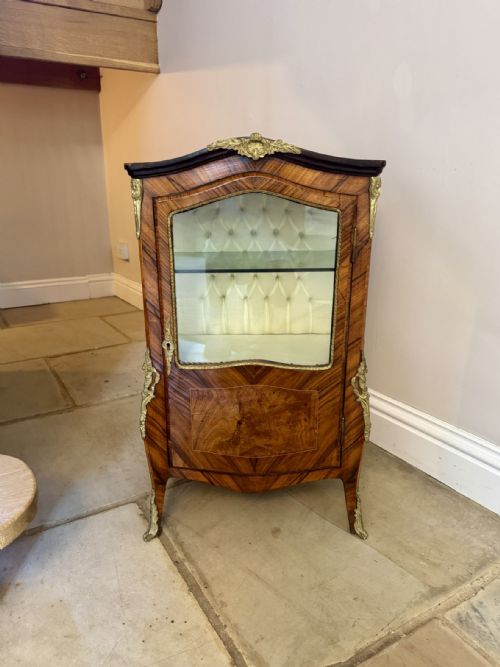
The versions most commonly met here span utility and elegance, ranging from utilitarian shop and apothecary counters with distressed paint or ebonised frames to refined French walnut and kingwood cabinets. Some carry the original signwriting of confectioners like Fry or Terry's of York, marking their history in commercial display.
Materials shift between domestic timbers like mahogany, walnut, and pine, alongside industrial brass frameworks and painted finishes. Styles stretch from Louis XV revival curves and Edwardian commercial builds to clean Art Deco geometry and rustic industrial utility.
How they were made
Makers constructed these cabinets using dense hardwoods such as mahogany, walnut, and kingwood, often framing the glass panes with slender brass channels or painted wood. Joinery was built to withstand daily use in retail settings or domestic drawing rooms, ensuring structural rigidity around delicate glazing.
Surfaces received varied treatments depending on their original function, from ebonised finishes and distressed paint on utilitarian shop fittings to polished French veneers on petite parlour pieces. Glazing was fitted securely into rebated frames, sometimes held with traditional putty or wooden beads.
Materials recorded across these items include mahogany, walnut, kingwood, brass, pine, and glass.
What varies in quality
Quality rests on the harmony of materials and the crispness of the framing, separating utilitarian shop counters from finely veneered domestic display cases. Finer examples employ choice timbers like kingwood and walnut with subtle detailing, whereas commercial pieces rely on robust pine, ebonised wood, or brass to endure heavy handling.
The proportion of glass to frame dictates visual lightness, with slender brass or hardwood structures offering an unobstructed view compared to heavier, purely utilitarian builds. Original elements, such as surviving signwriting for period confectioners, add distinct character that alters the standing of the piece.
The Tabletop Glass Vitrine Glossary
- Vitrine
- A glass-fronted cabinet designed for displaying fine objects or curiosities. It keeps dust at bay while allowing light to pass through from multiple sides.
- Ebonised
- Wood treated with a dark stain or finish to imitate ebony. This technique was popular in nineteenth-century cabinetmaking for a sleek, formal appearance.
- Kingwood
- A richly figured hardwood featuring dark violet and brown stripes, frequently used for veneering fine furniture during the nineteenth and early twentieth centuries.
- Apothecary
- Pertaining to the preparation and sale of medicines. In display cabinets, it denotes a utilitarian structure originally built for chemists' shops.
Tabletop Glass Vitrine: Frequently Asked Questions
What fits inside a tabletop glass vitrine?
These cabinets suit small collections, pocket watches, medals, ceramics, and curiosities that benefit from close inspection and protection from dust.
Because the interior depth is limited by the countertop footprint, larger items are better suited to floor-standing display cases.
How do I date a glass display case?
Dating relies on timber choices, construction techniques, and stylistic clues such as brass framing or painted shop lettering. Victorian and Edwardian examples often feature heavier timbers and hand-finished details, while Art Deco pieces show geometric lines.
Commercial pieces frequently bear traces of period signage or utility finishes that tie them to specific manufacturing decades.
Where should I place a tabletop vitrine?
Place the cabinet on a sturdy chest of drawers, sideboard, or desk where its height allows eye-level viewing of the contents. Avoid areas with direct, harsh sunlight that might fade delicate items kept inside the glass.
Ensure the surface is level so the doors open smoothly and the weight distributes evenly across the frame.
Are shop display cabinets different from domestic ones?
Shop cabinets were built for commercial resilience, often featuring robust pine, ebonised timber, or brass frames designed to handle frequent customer interaction. Some retain original product signwriting from confectioners.
Domestic versions, by contrast, focus on decorative timbers like mahogany, walnut, and kingwood with finer veneering suited to a parlour or drawing room.