

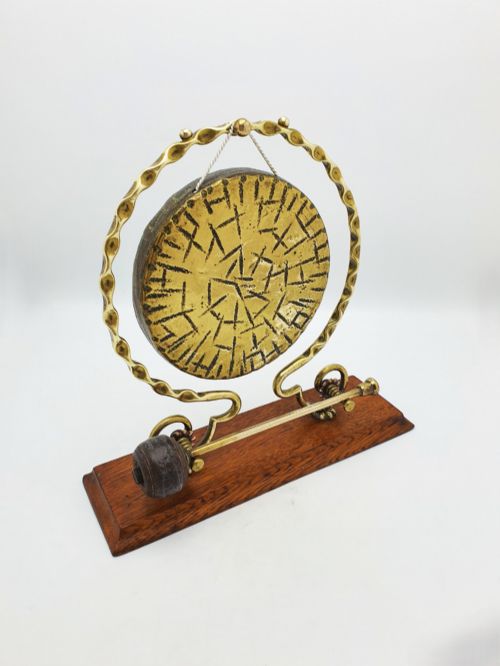


Tabletop Dinner Chime
A tabletop dinner chime brings a sharp, resonant ring to the dining room, combining metal and mounted woodwork.
Tabletop Dinner Chime
A tabletop dinner chime gathers pieces from the nineteenth century, the Edwardian era, and the nineteen-twenties, often designated as dinner gongs or table gongs. Buyers encountering these listings meet forms that span diverse aesthetic movements, including Japonisme, Chinoiserie, Art Nouveau, and Arts and Crafts.
The standard construction pairs a suspended metallic bell or gong with a stable base or frame, usually accompanied by a handheld striker. Surviving examples demonstrate a wide variety of origins, reflecting both domestic British cabinet-making and imported Eastern motifs.
Domestic interpretations lean towards carved oak, bamboo, wrought iron, and cattle horn, whilst foreign influences introduce bronze, brass, and elaborate oriental stands. Each piece serves primarily as a decorative signal for meals, designed to sit neatly upon a sideboard or table.
How they were made
Makers fashioned the supporting structures from seasoned hardwoods like oak, alongside carved bamboo and forged wrought iron. These frames often featured intricate carving, dovetailing, or metalwork to securely suspend the swinging bell.
The striking elements themselves utilise cast brass, bronze, or silver plate, sometimes paired with organic materials such as cattle horn or suspended cord. Artisans tuned these metallic discs or bowls to produce a clear, sustained tone when struck with a mallet.
Tabletop Dinner Chime Retail Price Guide 2026
Typical asking prices for tabletop dinner chime among the pieces listed under this phrase on Sellingantiques today, from the lower quarter to the upper quarter. They describe what is for sale here now, not the wider market.
Listings feature periods spanning the Victorian and Edwardian eras, alongside pieces dated specifically to 1880, 1900, 1910, and 1920.
What varies in quality
Quality rests in the structural integrity of the frame and the resonance of the metal gong itself. Superior examples display crisp, hand-carved detailing on the woodwork and a rich, unblemished finish on the brass or bronze.
The connection between the suspension cord and the frame reveals the care taken in original assembly. Finer pieces maintain balanced proportions between a heavy, well-cast gong and a robust, steady base.
The Tabletop Dinner Chime Glossary
- Dinner gong
- A suspended metal disc or bowl struck with a mallet to announce meals. It forms the central acoustic element of the assembly.
- Striker
- A handheld mallet used to hit the dinner gong. It typically matches the period and material of the surrounding frame.
- Japonisme
- A late nineteenth-century Western artistic style influenced by Japanese art. It frequently appears in the carved stands and oriental motifs of these pieces.
- Silver plate
- A thin layer of silver applied to a base metal object. It provides a bright, reflective finish seen on select nineteenth-century examples.
Tabletop Dinner Chime: Frequently Asked Questions
How do you strike a tabletop dinner chime?
Hold the mallet firmly by the handle and strike the centre of the suspended metal disc with a brisk, controlled motion. Allow the natural resonance to fade before repeating the action.
Avoid using excessive force, as the acoustic quality of the brass or bronze is designed to carry clearly without heavy impact.
What wood was used for the frames?
Makers most commonly utilised oak and bamboo for the supportive structures, occasionally incorporating wrought iron or cattle horn. These materials were chosen for both their durability and their decorative grain.
Carved woodwork often reflects the prevailing style of the period, ranging from rustic Victorian designs to structured Arts and Crafts frames.
Are the strikers original to the gongs?
Many surviving pieces retain their matching handheld strikers, often featuring turned wood or cord-wrapped handles. The presence of a period striker completes the functional setup of the assembly.
Inspect the wear on the striking end to see how frequently the piece was used in past dining rooms.
How do I date an antique dinner chime?
Dating relies on stylistic clues within the woodwork and the specific metal finishing techniques employed. Aesthetic Movement and Art Nouveau pieces point towards the late nineteenth and early twentieth centuries.
Material choices, such as silver plating or oriental carving styles, help narrow the origin down to specific eras like the Edwardian period or the nineteen-twenties.