

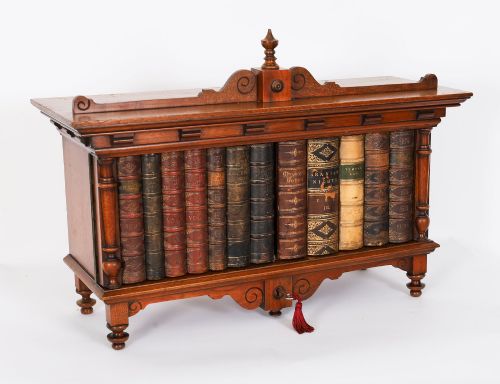


Tabletop Desktop Bookcase
These tabletop desktop bookcase pieces organise writing spaces and display volumes, spanning mahogany carriers and revolving oak stands from the Georgian era to the 1930s.
Tabletop Desktop Bookcase
A tabletop desktop bookcase serves to organise volumes and papers within arm's reach on a desk or counter. When you search for a tabletop desktop bookcase, you encounter forms ranging from simple revolving book stands to sophisticated cartonnieres and display cabinets.
The selection on this page draws primarily from the nineteenth century and the Edwardian period, alongside Georgian and 1930s examples. Pieces appear in mahogany, oak, rosewood, and walnut, frequently adopting Victorian, Regency, or Arts and Crafts styles.
Functional variations include extending book slides, desk tidies, and waterfall fronted open shelves. Buyers find everything from compact book troughs to multi-tiered revolving bookcases designed for daily utility.
Materials and construction
Cabinetmakers utilised dense timbers such as mahogany, rosewood, oak, and walnut to build these compact repositories. Selected woods display rich grain patterns, often enhanced through simple polishing or subtle inlay work.
Metal components provide structural reinforcement and decorative contrast. Brass hinges, handles, and ormolu mounts appear alongside leather accents and glass panels on cabinet doors.
Joinery methods reflect the period of origin, ensuring robust construction for items subjected to regular handling. Carved hardwood details and revolving mechanisms demonstrate mechanical ingenuity suited to desktop use.
Tabletop Desktop Bookcase Retail Price Guide 2026
Typical asking prices for tabletop desktop bookcase among the pieces listed under this phrase on Sellingantiques today, from the lower quarter to the upper quarter. They describe what is for sale here now, not the wider market.
Some Victorian readers clearly enjoyed spinning their books, given the number of revolving tabletop stands.
Factors influencing quality
The choice of timber and the precision of its preparation set the foundation for a superior piece. Finer examples feature well-figured mahogany or rosewood with careful attention paid to grain alignment across visible surfaces.
Hardware selection and execution differentiate standard items from exceptional ones. The crispness of ormolu mounts, the smoothness of revolving actions, and the neatness of inlay work indicate the maker's skill and the workshop's standing.
The Tabletop Desktop Bookcase Glossary
- Book slide
- An extending wooden stand designed to hold a small row of books securely on a desk. They often feature decorative end supports and sliding mechanisms.
- Cartonnier
- A desktop cabinet fitted with multiple horizontal compartments or drawers for storing papers and documents. Originating in France, they frequently incorporate ornate mounts.
- Ormolu
- Gilded bronze or brass applied as a decorative mount on furniture and cabinetwork. It provides bright metallic highlights against dark cabinet timbers.
- Revolving bookcase
- A compact bookcase mounted on a rotating base to allow easy access to volumes from any angle. They appear in table and counter top proportions.
- Book trough
- An open V-shaped or U-shaped rack designed to hold books upright on a flat surface. These vessels offer straightforward access for active reading.
Tabletop Desktop Bookcase: Frequently Asked Questions
What is a tabletop desktop bookcase used for?
These pieces keep working volumes, reference books, and papers organised directly on a desk or tabletop. They provide accessible storage without requiring floor space.
Historically, they served scholars, merchants, and writers who needed immediate access to frequently consulted texts during daily correspondence or study.
How do I date a revolving bookcase?
Dating relies on timber choice, construction style, and hardware details. Victorian and Edwardian examples often employ oak or mahogany with distinct turning and joinery.
Earlier Regency pieces display lighter scaling and refined rosewood veneers, while Arts and Crafts versions emphasise plain oak surfaces and honest construction.
Can these fit on a modern desk?
Most tabletop pieces offer compact dimensions designed for historical desk surfaces, which translates well to modern workspaces. Measuring your available depth ensures proper clearance.
Revolving stands require adequate turning radius around them, while book slides adjust in length to fit available desk space.