

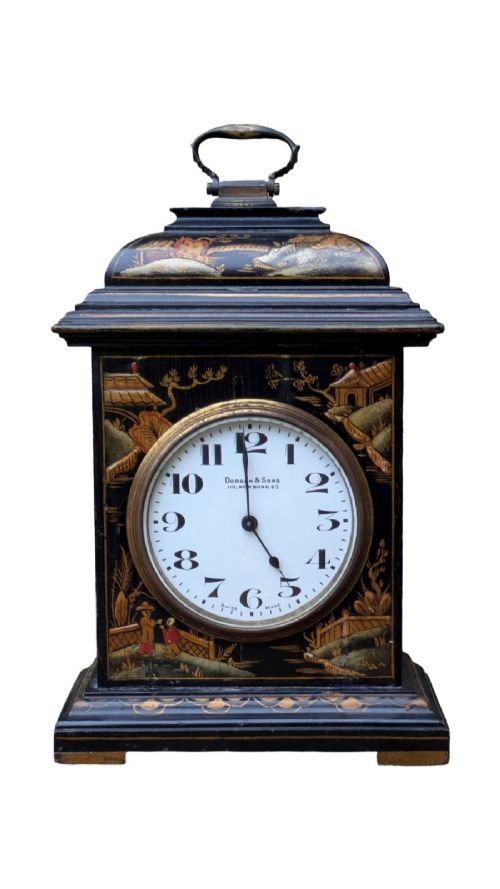
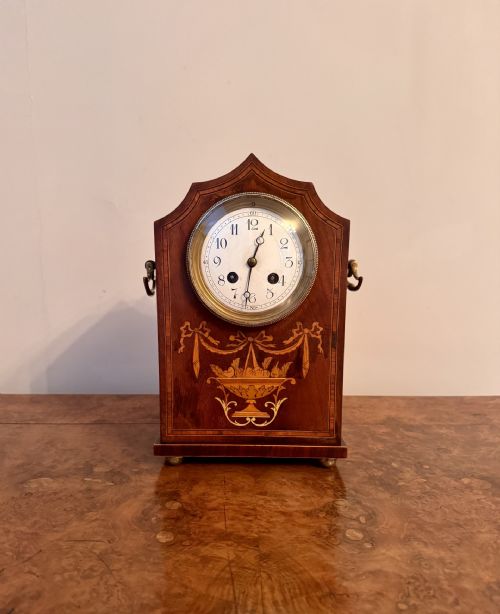
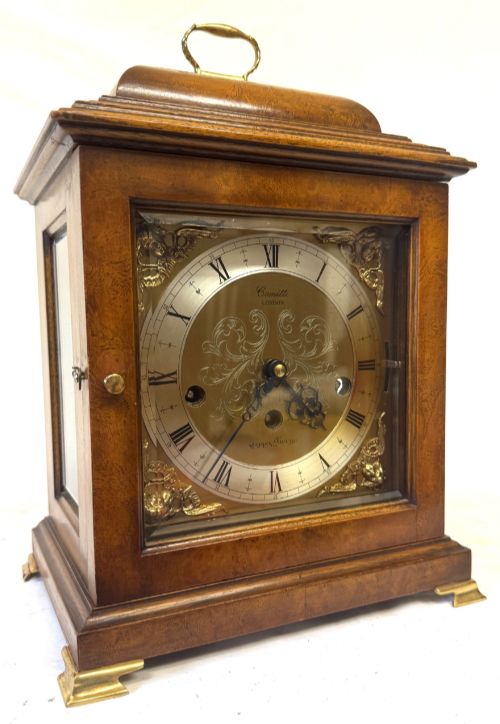
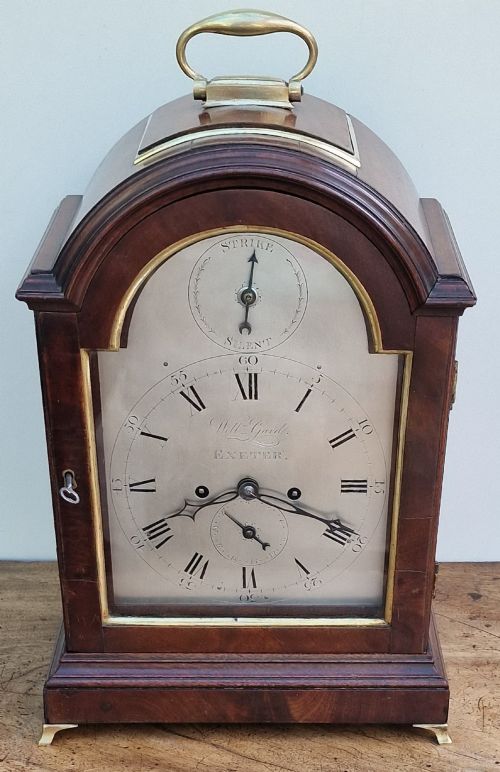

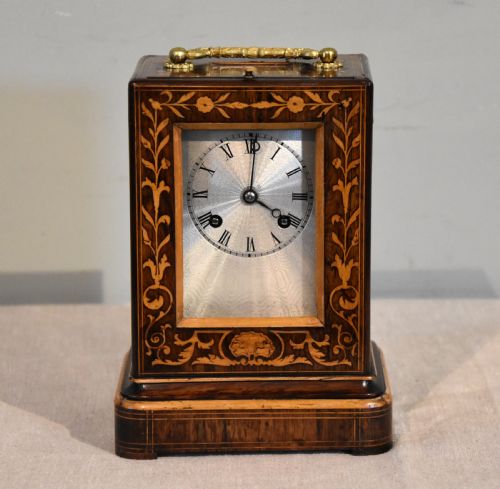
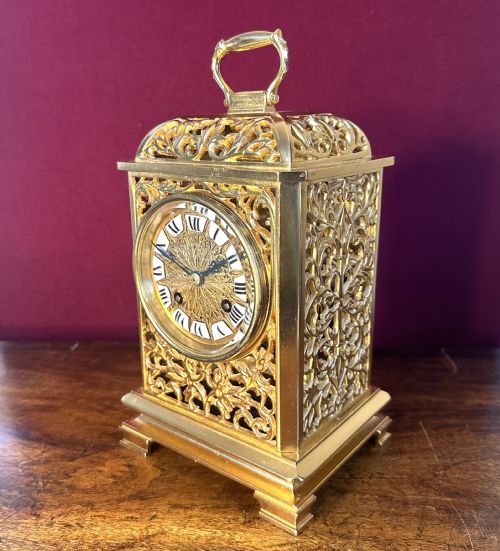


Table Clock with Handle
These table clock with handle selections are portable horological pieces designed for movement between rooms, combining domestic utility with period craftsmanship.
Table Clock with Handle
A table clock with handle encompasses diverse portable timepieces including carriage clocks and bracket clocks designed for mobility around the home. Buyers encounter pieces spanning the eighteenth century through the Edwardian period, housed in timber, brass, and gilt bronze cases.
The carriage clock form dominates the selection, frequently featuring glass panels and brass framework intended for travel and domestic use. Bracket clocks in mahogany and ebonised wood represent the earlier eighteenth-century examples fitted with bells and striking mechanisms.
Georgian and Victorian examples sit alongside Edwardian and 1920s pieces, demonstrating the continuous evolution of portable timekeeping. Each table clock with handle exhibits specific period characteristics, from late Victorian gothic touches to simple brass frames.
Materials and construction
Brass, gilt brass, and bronze form the structural framework for the numerous carriage clocks, often combined with bevelled glass panels to reveal the movement within. Mahogany and ebonised wood define the eighteenth-century bracket clocks, housing complex striking trains and silvered dials.
Enamel dials provide the face for many pieces, whilst subsidiary components incorporate silvered metal and red and gold lacquer. Verge escapements and bell-top cases demonstrate the mechanical precision employed by makers across the 18th century, Victorian, and Edwardian periods.
Table Clock with Handle Retail Price Guide 2026
Typical asking prices for table clock with handle among the pieces listed under this phrase on Sellingantiques today, from the lower quarter to the upper quarter. They describe what is for sale here now, not the wider market.
Listings feature items spanning the 18th Century through the 1920s, constructed predominantly in brass, mahogany, and glass.
Factors of quality
Quality reveals itself in the crispness of the cast brass or bronze case work and the originality of the dial components. Finer examples retain their original verge escapements, striking trains, and delicate silvered or enamelled dials without later replacement parts.
The complexity of the movement, such as repeat striking or Westminster chimes, separates standard domestic pieces from more sophisticated horological works. Superior timber cases display well-figured mahogany and intact lacquer, whilst carriage clocks benefit from heavy, unblemished bevelled glass panels.
Paul Garnier·James Smith·Robert Higgs·Joseph Lum
The Table Clock with Handle Glossary
- Carriage clock
- A portable spring-driven timepiece originally designed for travelling, featuring a carrying handle and glass panels. These pieces emerged in France during the nineteenth century.
- Bracket clock
- A portable table clock historically placed on a wall bracket or table, commonly housed in wood with a striking mechanism. Eighteenth-century examples often feature bell tops and brass carrying handles.
- Verge escapement
- An early type of clock escapement mechanism that controls the release of power in the gear train. It appears in older bracket clocks.
- Silvered dial
- A metal clock face treated with a silver solution to create a reflective, textured finish. These dials display the numerals and maker signatures.
- Bell-top case
- A clock case featuring a curved or domed upper section shaped like a bell. This silhouette is typical of eighteenth-century mahogany bracket clocks.
Table Clock with Handle: Frequently Asked Questions
How do I wind a carriage clock?
Most carriage clocks use a dedicated winding key inserted into arbors located on the underside or backplate of the movement. Turn the key gently clockwise until resistance is met, taking care not to overwind the mainspring.
Ensure the mechanism is kept upright during the process and handle the brass case with care to avoid disturbing the glass panels.
Were these clocks meant for travel?
Carriage clocks were specifically built for travel by coach or train, featuring protective brass frames and robust handles for conveyance. Bracket clocks remained largely stationary on furniture, though their handles permitted movement between rooms.
Travel pieces often included fitted leather outer cases to protect the gilt brass and glass during transit.
How do I identify an 18th century bracket clock?
Eighteenth-century bracket clocks typically feature timber cases made of mahogany or ebonised wood, often with bell-top shapes and brass carrying handles. The dials commonly display silvered brass and detailed signature plates for London makers.
Movements from this era frequently employ verge escapements and intricate striking mechanisms housed behind wooden access doors.
Why do some clocks have repeat striking?
Repeat striking mechanisms allow the owner to sound the last elapsed hour or quarter-hour on demand by pulling a cord or pushing a button. This function proved useful during the night before electric lighting existed.
Clocks with this complication contain additional gear trains within the brass movement to drive the extra hammers and bells.