


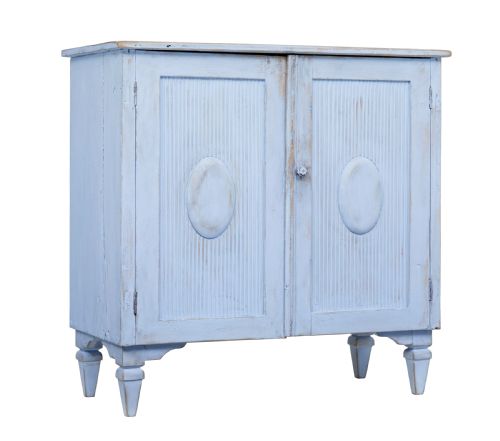


Swedish Style Sideboard
A Swedish style sideboard brings clean Nordic light into a room, offering generous storage through painted pine, birch, and clean neoclassical lines.
Swedish Style Sideboard
When you search for a swedish style sideboard, you encounter practical storage furniture rooted in Scandinavian country and Gustavian traditions. These pieces range from eighteenth-century linen cupboards and commodes to mid nineteenth-century birch buffets and enfilades. The selection spans straightforward pine cupboards and painted softwood cabinets built for everyday domestic utility.
The version you meet most often on this page is the nineteenth-century painted cupboard or commode, often finished in scraped paint showing layers of historic colour. Sideboards and cabinets from this tradition blend storage function with restrained neoclassical symmetry, reflecting Dutch neoclassical and Scandinavian country design influences.
Materials and construction
Makers utilised native softwoods and hardwoods, constructing carcasses primarily from pine and painted softwood alongside figured birch. Surfaces received layered paint finishes, sometimes scraped back to reveal original tones, while hardware incorporated simple brass and iron fittings.
Joinery suited utilitarian domestic demands, combining robust timber framing with panelled doors and drawer construction. Selected pieces feature fitted marble tops, adding a durable working surface to wooden bases.
Miniature dressers appear among the cupboards, offering tidy storage for small treasures.
Quality variations
Quality rests upon the preservation of original painted surfaces and the integrity of the timber framework. Pieces retaining genuine early paint layers stand apart from later repainted examples, holding greater fidelity to their period of origin.
Proportion and decorative restraint dictate distinction within these forms. Finer items exhibit balanced neoclassical proportions and clean hardware placement, whereas simpler utility pieces lean towards rustic Scandinavian country practicality.
The Swedish Style Sideboard Glossary
- Gustavian
- The Swedish neoclassical style spanning the late eighteenth and early nineteenth centuries, characterised by restrained carving, symmetry, and pale painted finishes.
- Enfilade
- A suite of formally aligned cabinets or sideboards designed to stand along a continuous wall.
- Commode
- A low chest of drawers or cabinet built for domestic storage, often featuring decorative painted surfaces.
- Scraped paint
- A conservation term for paint finishes revealed by cautiously removing later overcoats to expose original historic layers.
Swedish Style Sideboard: Frequently Asked Questions
What is a swedish style sideboard?
A swedish style sideboard encompasses painted pine cupboards, birch buffets, and enfilades originating from nineteenth-century Scandinavia. These items serve as practical storage furniture defined by pale finishes and neoclassical restraint.
They function as focal storage units in dining rooms, hallways, and living spaces, offering surface display areas alongside enclosed shelving and drawers.
How do I identify a gustavian piece?
Gustavian pieces display restrained neoclassical lines, straight fluted legs, and subtle carved detailing rooted in late eighteenth-century Swedish design. They often feature light painted surfaces rather than dark polished woods.
Looking closely at the proportions and hardware helps distinguish formal Gustavian cabinetwork from simpler Scandinavian country items.
Are these sideboards made of solid wood?
Construction relies heavily on solid timbers such as pine, softwood, and birch, reflecting the traditional materials available to Scandinavian makers. These woods provided durable structures for everyday domestic cupboards and chests.
Surfaces were then painted and finished to protect the timber and brighten domestic interiors during long northern winters.
How do I care for painted wood?
Painted wooden furniture requires gentle dusting with a dry or slightly damp cloth, avoiding harsh modern chemical cleaners that might soften historic finishes. Keeping pieces away from direct heat sources prevents timber movement and paint cracking.
Maintaining stable room humidity protects both the underlying pine or birch framework and the integrity of the original paint layers.