






Swedish Country Settle
A Swedish country settle offers robust rural seating and clever storage, bringing authentic Scandinavian character into modern hallways and kitchens.

Swedish Country Settle
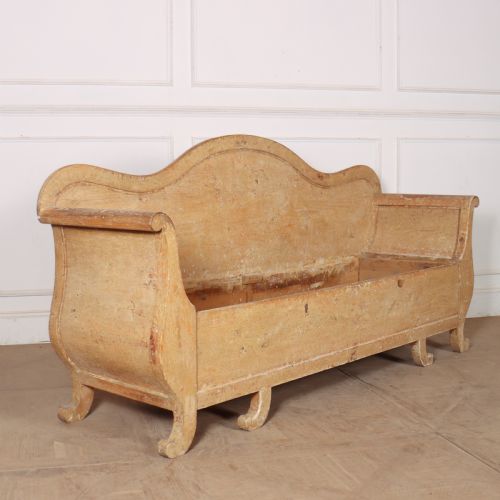
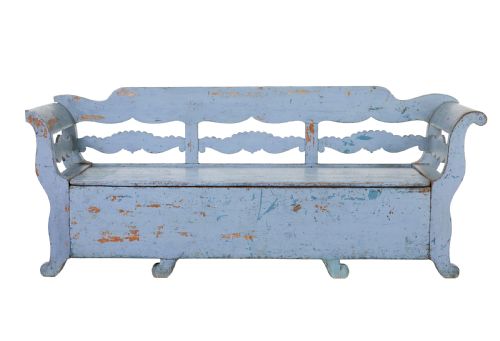
A Swedish country settle is a substantial wooden bench designed for traditional domestic interiors, often incorporating a high back and enclosed storage beneath the seat. These practical pieces served generations in rural households, functioning as seating by day and sometimes additional sleeping quarters or storage chests by night.
The selections available here span the eighteenth and nineteenth centuries, featuring forms categorised as benches, settle benches, and storage benches. Alongside genuine Scandinavian country pieces, you encounter items reflecting Gustavian elegance and Austrian country traditions.
Most examples you meet on this page date from the nineteenth century, rendered in softwood or pine with original painted finishes. Scaled variations include smaller children's beechwood benches alongside large rustic pine seating.
How they were made
Construction relies primarily on pine and softwood, selected for local availability and utilitarian strength, occasionally complemented by beechwood in smaller formats such as children's benches. Carpenters built these settles with robust joinery to withstand daily domestic demands in rural properties.
Surfaces frequently carry paint, ranging from original painted finishes on eighteenth and nineteenth-century pine to later applied schemes. Fabric also appears as an integrated material across certain variations.
Swedish Country Settle Retail Price Guide 2026
Typical asking prices for swedish country settle among the pieces listed under this phrase on Sellingantiques today, from the lower quarter to the upper quarter. They describe what is for sale here now, not the wider market.
Listings feature items from the eighteenth and nineteenth centuries, constructed primarily from pine, painted wood, and softwood with fabric elements.
What varies in quality
Quality separates through the integrity of the original paint surface and the purity of the underlying timber construction. Pieces retaining untouched nineteenth-century or eighteenth-century painted finishes carry greater authenticity than later decorated equivalents.
Proportion and scale also define the standing of a settle, where balanced architectural lines in Gustavian-inspired forms or robust rustic proportions elevate the piece above standard utilitarian joinery.
The Swedish Country Settle Glossary
- Gustavian
- The Swedish neoclassical style spanning the late eighteenth and early nineteenth centuries, characterised by restrained ornamentation and lighter painted surfaces. It draws inspiration from French Louis XVI design but adapts it with Nordic simplicity.
- Settle
- A wooden bench with a high back, solid arms, and enclosed storage beneath the seat, designed to block draughts in farmhouse kitchens. This traditional form provided both seating and a secure chest.
- Pine
- A softwood commonly utilised in northern European vernacular furniture for its workability and availability. It forms the structural core of most rustic Scandinavian seating.
- Softwood
- Timber derived from conifers, predominantly pine in the context of these northern European country pieces. It offers a lighter weight than dense hardwoods while remaining durable for domestic furniture.
Swedish Country Settle: Frequently Asked Questions
How old are these settles?
The pieces listed span from the eighteenth century through the nineteenth century, with specific examples dating around eighteen-eighty.
Most surviving examples encountered in this tradition belong to the nineteenth century, constructed from pine or softwood.
Where were these benches used?
They originated in rural Scandinavian homes, positioned in farm kitchens and hallways where draughts required high-backed wooden barriers.
Their enclosed lower sections doubled as practical storage chests for blankets, textiles, or daily provisions.
How do I identify a Gustavian influence?
Gustavian-inspired pieces reflect the neoclassical aesthetic popularised in Sweden during the reign of Gustav III, featuring cleaner lines and lighter painted decoration.
This style contrasts with heavier rustic country furniture by incorporating more refined proportions and subtle classical detailing.