

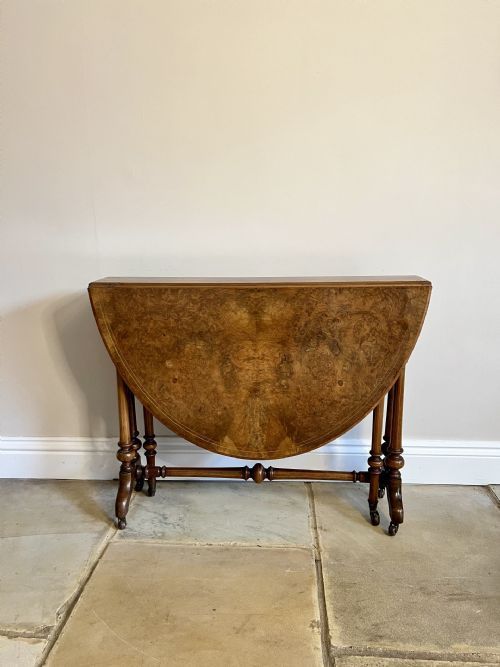


Sutherland Occasional Table
A sutherland occasional table brings folding convenience and rich timber grain to a room without crowding the floor.
Sutherland Occasional Table
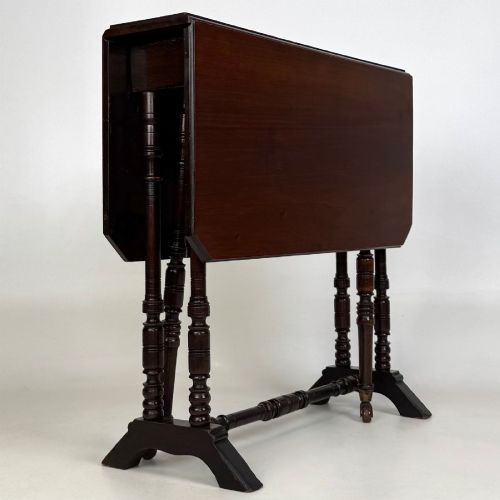
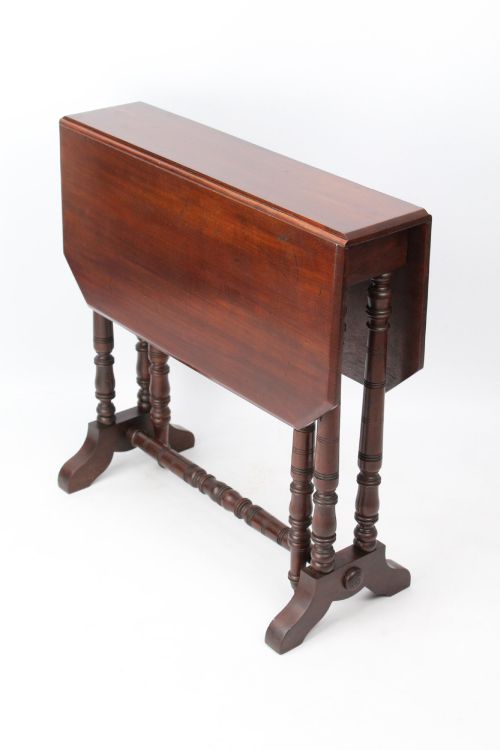
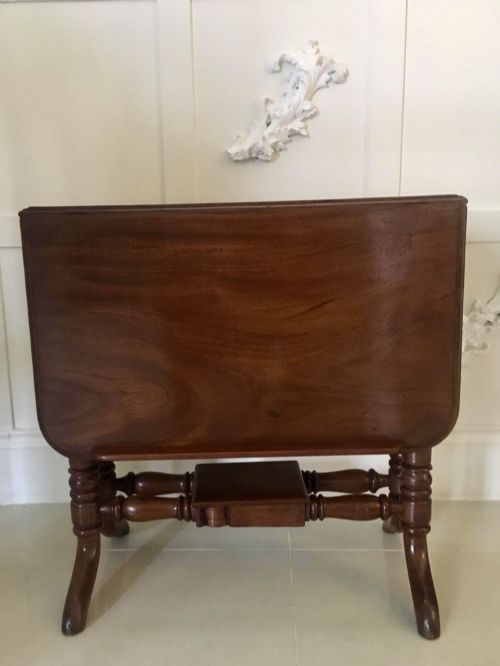
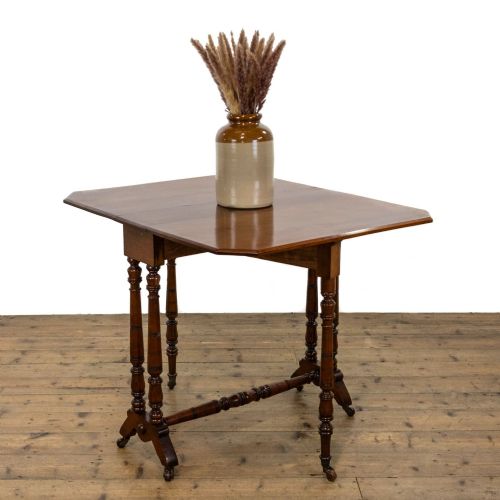
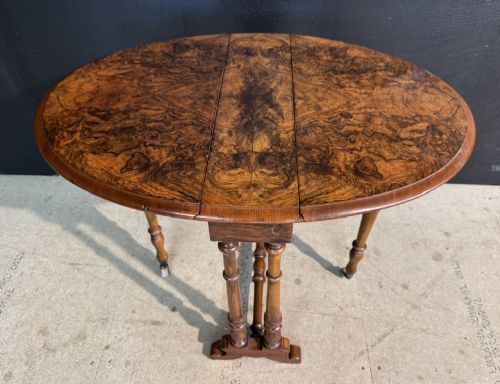
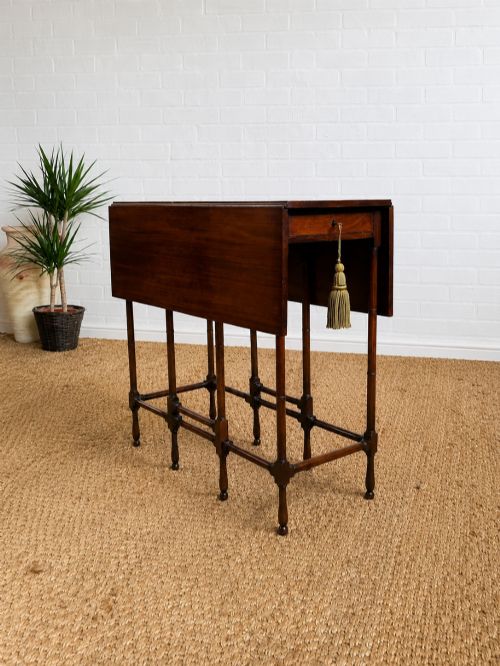
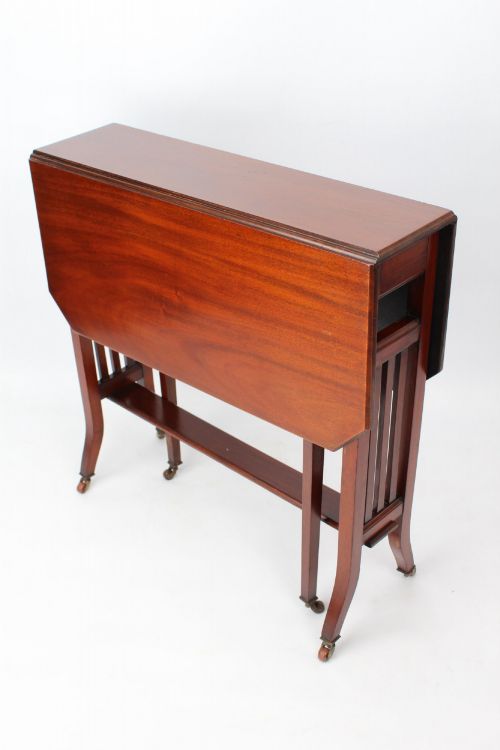
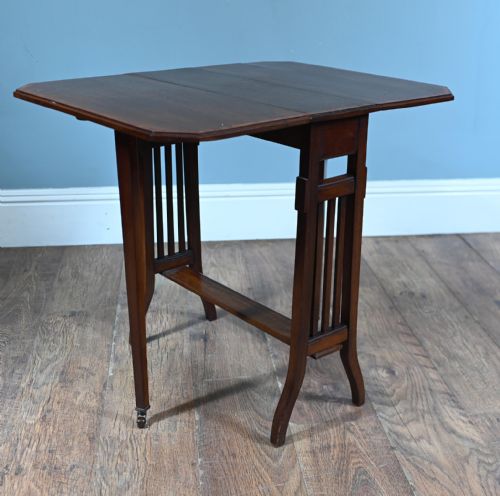
A sutherland occasional table is a narrow drop-leaf table supported by pivoting gate legs that swing out to hold the folding flaps. These pieces appear primarily in Victorian and Edwardian forms, spanning styles from Arts and Crafts and Queen Anne Revival to William IV and the Aesthetic Movement. Most examples function as compact tea tables, side tables, or low coffee tables that fold flat against a wall when not in use.
The proportions are characteristically slender, designed to occupy minimal space while offering an expandable surface. Makers built them in various scales, from standard dining heights down to miniature and baby formats intended for lamps or occasional use. Walnut, burr walnut, and mahogany dominate the selection, often accompanied by satinwood or boxwood inlay and occasional ceramic components.
How they were made
Cabinetmakers constructed these tables using solid hardwoods like mahogany and oak for structural frames, while employing figured burr walnut and rosewood veneers across the folding leaves to display striking grain patterns. Joinery relied on traditional techniques to support the pivoting gate-leg action without straining the hinges. Surfaces frequently featured delicate marquetry, floral inlay, or contrasting stringing in satinwood and boxwood.
Turned timber components provide the vertical support, ranging from bamboo-turned legs and bobbin-turned supports to more conventional column designs. Ebonised finishes and brass castors also appear on specific Victorian and Edwardian iterations. The folding mechanism requires precise alignment so the flaps rest level with the central fixed top when fully extended.
Makers occasionally built miniature and baby versions designed strictly for dolls, small lamps, or very restrained tea parties.
What varies in quality
The standard of timber selection largely defines the upper tier of these pieces, particularly where richly figured burr walnut or select rosewood veneers display depth and symmetry. Craftsmanship shows in the smoothness of the gate-leg movement and the precision with which the folding leaves meet the central top. Finer examples incorporate intricate marquetry, subtle string inlay, or distinctive turning work that elevates the piece beyond standard utility.
Simpler models utilise plain mahogany or oak with straightforward turned supports, catering to everyday domestic use rather than formal display. Structural integrity depends on how well the hinge mechanisms and pivoting legs bear weight over decades of folding and unfolding. The inclusion of documented cabinetmakers or specific regional revival styles also distinguishes certain tables from mass-produced workshop output.
Maple & Co·Jenks & Woods·Liberty
The Sutherland Occasional Table Glossary
- Drop leaf table
- A table with a fixed central section and hinged flaps that fold down at the sides. These flaps are supported when raised by hinged legs or swinging brackets.
- Gate leg
- A hinged leg that swings outward from the table frame to support a drop leaf. This design provides sturdy under-table bracing when open and folds flat when closed.
- Marquetry
- Decorative veneer work arranged in pictorial or geometric patterns using various coloured woods. Craftsmen inlay these designs directly into the surface of the table top.
- Bespoke turning
- The shaping of wooden components on a lathe to create cylindrical profiles such as bamboo-style or bobbin-turned legs. This technique adds texture and visual rhythm to the support structure.
Sutherland Occasional Table: Frequently Asked Questions
How do you fold a sutherland table?
To close the table, you lift each drop leaf slightly to release the weight from the supporting gate leg. You then swing the pivoting leg inward toward the centre stretcher until it rests flat beneath the frame.
Once the gate legs are tucked away, both leaves drop down vertically to leave only the narrow central top exposed. This allows the piece to slide flush against a wall or sofa.
Were sutherland tables used for dining?
Certain larger Victorian and Edwardian examples were built at dining height and provided enough surface area for four people to eat comfortably. The narrow central section made them practical space-savers in smaller dining rooms.
Smaller formats, often termed baby or occasional tables, served primarily for holding tea services, books, or lamps rather than full meals.
How do I date a sutherland table?
Dating relies on identifying the prevailing timber choices, hardware, and decorative styles associated with specific periods. Victorian pieces frequently showcase heavily figured burr walnut and elaborate marquetry, while Edwardian versions often feature lighter satinwood inlay and bamboo-turned supports.
Structural details such as castors, hinge types, and secondary woods like oak or mahogany also help narrow down the decade of manufacture.
Where should I place a sutherland table?
These tables fit naturally beside sofas, armchairs, or in narrow hallways where floor space is limited. Their ability to expand on demand makes them useful beside seating when extra surface area is needed for drinks or reading material.
When folded, their minimal depth ensures they do not obstruct walkways or crowd smaller living areas.