


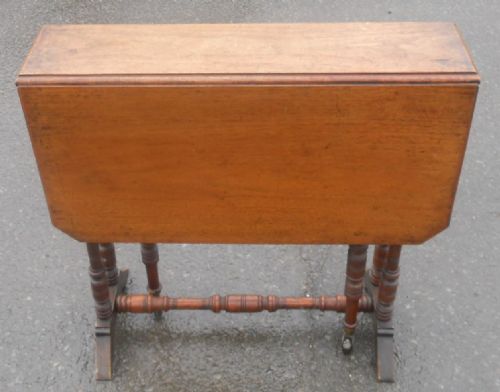

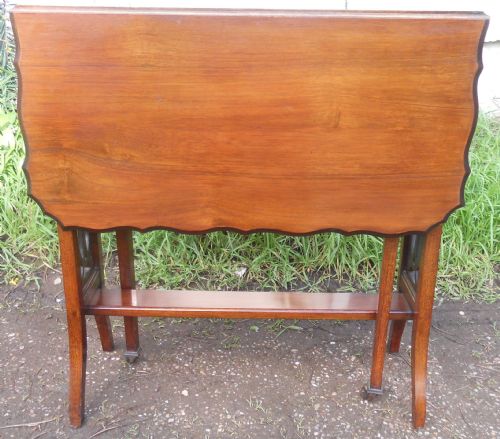
Sutherland Coffee Table
A sutherland coffee table brings a clever folding mechanism and compact footprint to sitting rooms needing flexible surface area.
Sutherland Coffee Table
A sutherland coffee table adapts the traditional drop-leaf dining design into a low table suitable for living spaces, appearing in forms from the Victorian era through the Edwardian period. These pieces frequently manifest as small or baby dimensions, often designated for lamp or occasional use alongside their primary drop-leaf function.
Makers constructed these tables using woods such as mahogany, oak, and burr walnut, sometimes incorporating marquetry inlay, brass accents, or ceramic elements. The defining characteristic remains the narrow central fixed top flanked by two wide folding leaves supported by swinging gate legs.
Materials and construction methods
Cabinet makers utilised solid timbers and veneers like burr walnut and mahogany, applying wood inlay and marquetry to enhance surfaces on select Edwardian and Victorian examples. The structural integrity relies on slender gate legs that swing outward on hinges to support the descending drop leaves when extended.
Tables span stylistic categories including Arts and Crafts, Jacobean Revival, and standard Victorian or Edwardian designs, employing brass hardware for hinges and occasional fittings. The joinery accommodates the folding action while maintaining stability in both the folded and open positions.
Listings demonstrate that Edwardian mahogany and Victorian burr walnut dominate the surviving selection of these tables.
Distinctions in quality and execution
Quality separates pieces through the selection of timber figures, particularly in burr walnut and figured mahogany examples where grain patterns dictate the visual weight of the top. Superior execution shows in the precision of the folding hinge mechanism and the flush alignment of leaves when lowered.
The refinement of the supporting gate legs and the crispness of any wood inlay or marquetry distinguish standard utility pieces from finer drawing room furniture. Proportion also plays a role, with baby and miniature scales requiring careful balance between the narrow central platform and the extending leaves.
The Sutherland Coffee Table Glossary
- Drop-leaf
- A table design featuring hinged flaps that fold down at the sides to reduce the footprint when not in use. This mechanism allows the table to expand quickly for entertaining.
- Marquetry
- Decorative veneer work arranged in pictorial or geometric patterns using various coloured woods. Artisans applied this technique to enrich the surfaces of Edwardian and Victorian tables.
- Gate leg
- A hinged leg that swings outward from the frame to support an open table leaf. It provides physical stability to the dropping side sections.
- Burr walnut
- Wood taken from the burl growth of a walnut tree, exhibiting intricate, swirling grain patterns. Cabinet makers prized this material for high-status occasional furniture.
- Occasional table
- A small, movable table designed for intermittent use in sitting rooms or bedrooms. These pieces function as lamp stands, side supports, or low coffee surfaces.
Sutherland Coffee Table: Frequently Asked Questions
What is a sutherland table?
A sutherland table is a narrow drop-leaf table where the folding flaps constitute a significant portion of the surface area, supported by swinging gate legs.
Originally designed in the nineteenth century as a compact dining or tea table, smaller versions now serve effectively as low coffee tables.
How do you fold the leaves?
You lift each drop leaf slightly to release the supporting gate leg, swing the leg inward toward the central base, and lower the leaf flat.
This folding action reduces the width of the table significantly, allowing it to tuck away beside a sofa or wall.
What woods were used?
Cabinet makers built these tables primarily in mahogany, walnut, burr walnut, and oak, occasionally incorporating satinwood for inlay details.
Figured timbers appear frequently on pieces intended for formal drawing rooms, while simpler oak versions align with Arts and Crafts aesthetics.
How do I date a sutherland table?
Dating relies on stylistic clues, timber choices, and construction details associated with Victorian, Edwardian, and Arts and Crafts periods.
Earlier nineteenth-century examples often feature solid walnut or burr walnut veneers, whereas Edwardian pieces frequently showcase inlaid mahogany.