




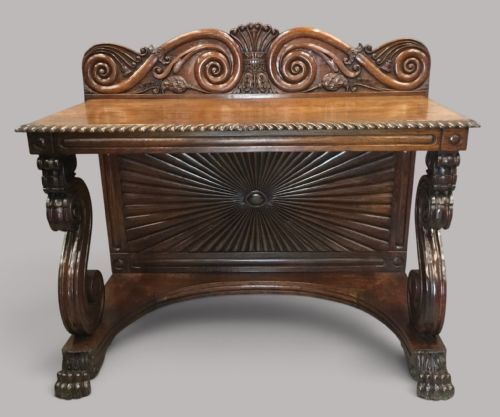

Sunburst Wood Carving
These sunburst wood carving pieces capture light and movement on a wall, bringing dynamic geometry and warmth to a room.
Sunburst Wood Carving
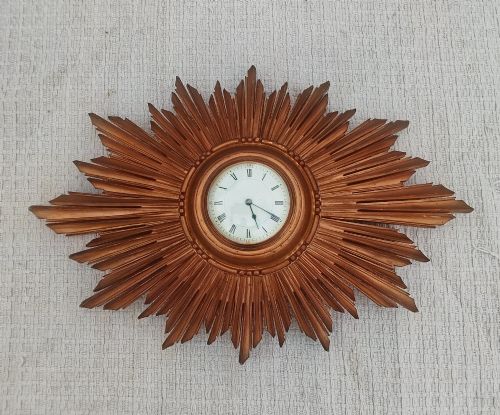
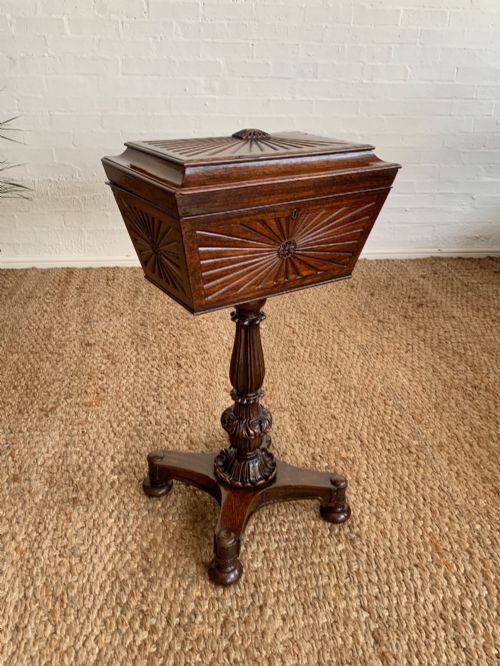
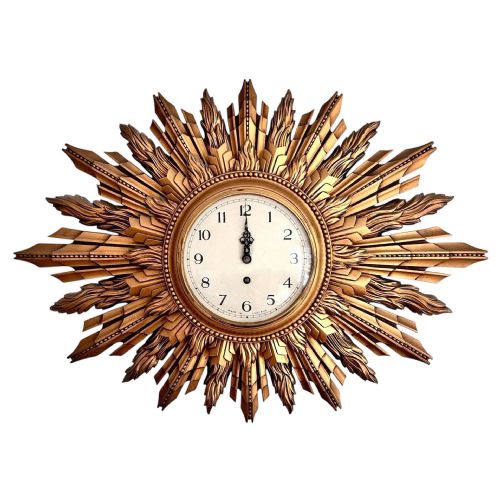
A sunburst wood carving typically appears on wall clocks and mirrors, designed to draw the eye with radiating points or veneer. When you search for this phrase, you encounter items ranging from early twentieth century timepieces to nineteenth century tables.
The objects span multiple eras, including the 1820s, 1860s, 1900, 1920, 1930, and 1950. Wall clocks by makers such as Smiths sit alongside French giltwood mirrors and William IV rosewood work tables with caddy tops.
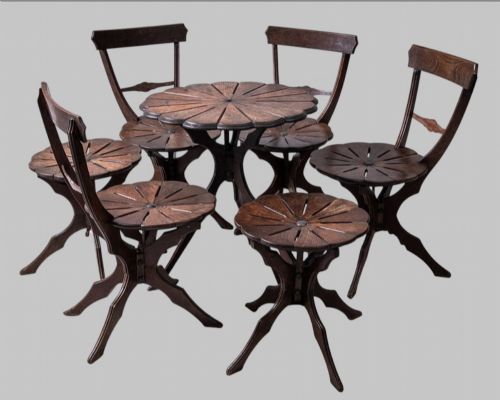
Regional styles vary from Alpine folk art to French neoclassical and Art Deco designs. Pieces often utilise radial patterns in wood or giltwood finishes to enhance the starburst effect.
Materials and construction
Craftsmen utilised rosewood, oak, and padouk, applying radial veneer techniques to create geometric centrepieces on tables. The natural grain of the timber follows the directional rays of the design.
Giltwood and gilded wood finishes dominate the decorative wall pieces and clocks, reflecting light across carved wooden points. Brass and metal components frequently appear in clock mechanisms and structural mounts.
Carvers employed traditional hand-tool methods on solid woods for items like Alpine folk art suites and console tables. Glass inserts are integrated securely into mirror frames and clock faces.
Sunburst Wood Carving Retail Price Guide 2026
Typical asking prices for sunburst wood carving among the pieces listed under this phrase on Sellingantiques today, from the lower quarter to the upper quarter. They describe what is for sale here now, not the wider market.
Sunburst clocks from the 1930s prove that timekeeping was once treated as an excuse for an indoor firework display.
Assessing quality and execution
The precision of the radial veneer work determines the visual success of wooden sunburst surfaces. Even alignment and tight joints indicate superior cabinetmaking compared to irregular grain matching.
The depth and crispness of the carved rays separate standard production from finer workmanship. Sharp detailing in giltwood and solid timber remains well-defined even beneath layers of historic finish.
Provenance and originality of components influence the standing of a piece. Retaining original glass, dials, and structural elements preserves the integrity of items from the nineteenth and twentieth centuries.
Smiths
The Sunburst Wood Carving Glossary
- Radial veneer
- Wood veneers cut and arranged in a circular pattern resembling the sun's rays. This technique creates striking geometric patterns on tabletops.
- Giltwood
- Timber that has been coated with gold leaf or a gold-coloured finish. It provides a bright, reflective surface popular in neoclassical and Art Deco design.
- Work table
- A small movable table equipped with compartments or a caddy top for sewing and needlework supplies. They frequently feature decorative carvings on the lid.
- Sconce
- A wall-mounted lighting fixture designed to hold candles or electric bulbs. Examples often incorporate carved wooden or gilt frames.
- Padouk
- A dense tropical hardwood known for its deep reddish-brown colour. It was utilised in Anglo-Indian furniture for its durability and fine finish.
Sunburst Wood Carving: Frequently Asked Questions
What is a sunburst wood carving?
A sunburst wood carving is a decorative motif featuring rays extending outward from a central point, commonly found on mirrors, clock cases, and table tops. The design creates a strong focal point in interior spaces.
Craftsmen execute these patterns through carved wooden rays or precision-cut radial veneers. The style adapts across different periods, appearing in Georgian, Victorian, and mid-century modern pieces.
How do I date a sunburst clock?
Dating a sunburst clock involves examining the materials, movement type, and stylistic traits of the frame. Art Deco pieces from the 1930s often feature streamlined geometric rays, while mid-century examples utilise bolder atomic shapes.
Maker signatures on the dial or mechanism provide precise attribution. The presence of specific woods like rosewood or oak also helps narrow down the period of manufacture.
Where should I hang a sunburst mirror?
A sunburst mirror works effectively above a mantelpiece, console table, or in an entrance hallway where it can reflect natural light. Its radiating design acts as a natural anchor for surrounding wall art.
Ensure the wall fixings match the weight of the piece, particularly for larger giltwood or metal-backed mirrors. Pairing the mirror with a complementary side table creates a balanced vignette.
What is radial veneering?
Radial veneering is a woodworking method where wedge-shaped pieces of wood grain are arranged in a circle around a central point. This creates a symmetrical, sun-like pattern on flat surfaces such as dining tables.
Mastering this technique requires precise cutting and alignment of the timber. The natural variations in the wood grain enhance the visual depth of the pattern.