
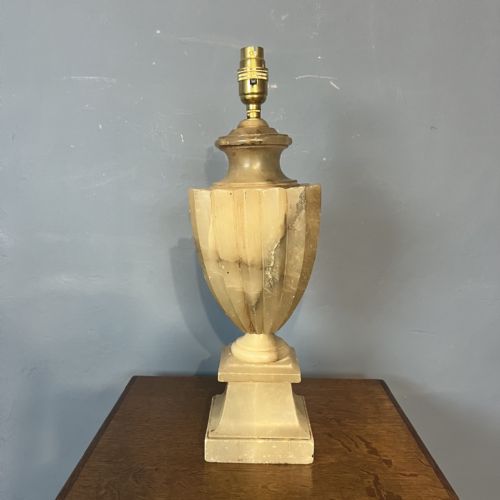
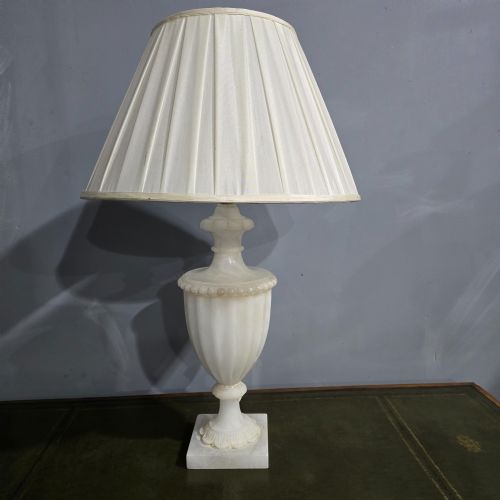


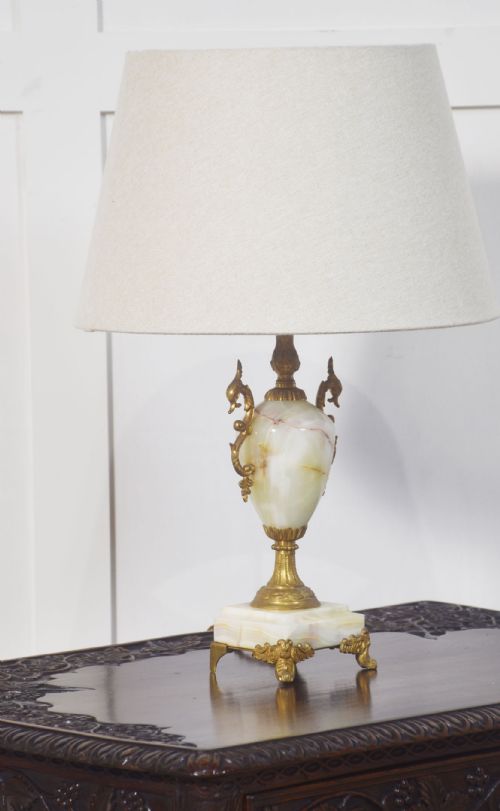


Stone Urn Bedside Lamp
A stone urn bedside lamp brings classical form and warm light to a room, drawing on alabaster, marble, and onyx.
Stone Urn Bedside Lamp
A stone urn bedside lamp takes the classical shape of an urn and adapts it for interior lighting. You meet these pieces in periods ranging from the nineteenth century through the Edwardian era and into the early twentieth century.
The forms draw heavily on neoclassical, classical revival, and French neoclassical styles. They function primarily as table lamps, often utilising urn bodies made of alabaster, marble, or white onyx paired with fabric shades.
Many examples survive as pairs, offering symmetrical options for bedside tables. The physical presence combines solid stone vessels with metal mounts in brass or gilt bronze.
How they were made
Makers shaped natural stone such as alabaster, marble, and onyx into hollow urn profiles on lathes. These turned stone bodies were frequently fitted with metal mounts in brass or gilt bronze to secure the components and add decorative detail.
Wiring and electrical fittings were integrated into the traditional vessels during the twentieth century, adapting decorative stone cassolettes and urns for practical use. Fabric shades complete the construction, resting above the stone and metal structure.
Materials documented across the listings include alabaster, marble, white onyx, brass, glass, and gilt bronze within Edwardian and nineteenth-century pieces.
What varies in quality
The grade of the stone dictates much of the character, with translucent alabaster and finely veined marble holding greater visual depth than uniform synthetic or lower grade alternatives. Weight and thickness of the stone urn bodies signal robust construction.
The integration of metal mounts separates standard items from finer examples. Precision in the cast brass or gilt bronze collars, handles, and bases determines the overall refinement of the piece.
The Stone Urn Bedside Lamp Glossary
- Alabaster
- A fine-grained, soft stone that is often translucent when carved thinly. It was a preferred material for Edwardian urn lamps.
- Cassolette
- A decorative urn with a reversible lid that can function as a vase or a burner. French examples from the nineteenth century are adapted into lamps.
- Gilt bronze
- Bronze that has been coated with a thin layer of gold. It provides metallic contrast against white marble and onyx bodies.
- Neoclassical
- A style reviving classical Roman and Greek motifs. It defines the urn shapes and architectural details seen on these pieces.
- Onyx
- A banded variety of chalcedony or calcite stone used for turning lamp bodies. White onyx offers distinctive natural patterning.
Stone Urn Bedside Lamp: Frequently Asked Questions
What periods do these lamps come from?
The pieces span the nineteenth century, the Edwardian era, and the early twentieth century around 1900 to 1920.
Design influences across these decades lean heavily on classical revival and French neoclassical traditions.
Are these lamps sold in pairs?
Many listings feature matched pairs of urn lamps, which suit symmetrical placement on bedside tables.
Single lamps also appear, often sharing the same alabaster or marble construction.
What materials are used for the bodies?
Bodies are turned from natural stones including alabaster, marble, and white onyx. These are frequently mounted with brass or gilt bronze.
Fabric shades are typically paired with the stone urn bases.
How do I identify French styles?
French classical and neoclassical examples often incorporate cassolette forms and detailed bronze or brass mounts.
They display a decorative emphasis distinct from simpler Edwardian stone turnings.