
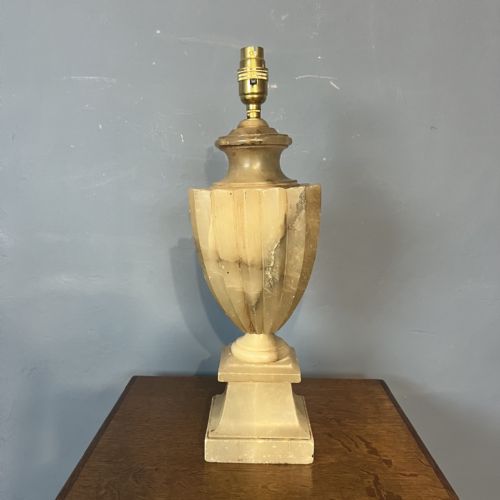


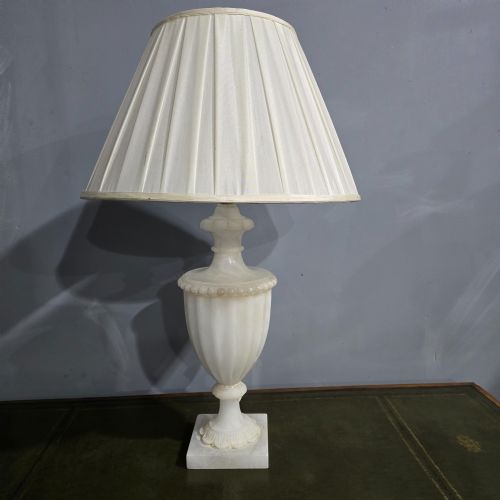


Carved Marble Urn Lamps
Carved marble urn lamps bring classical form and heavy stone into a room, offering steady light through carved alabaster and marble.
Carved Marble Urn Lamps
Carved marble urn lamps combine classical stone vessels with electrical lighting, drawing on centuries of sculptural tradition. You will find pieces shaped as campana urns or traditional vases, often mounted on square or stepped plinths.
The selection ranges widely across the nineteenth and twentieth centuries, taking influence from Neoclassical, Victorian, and Edwardian tastes. Alongside standard table lamps, the evidence shows related forms like cassolettes and urn bases paired with glass fruit.
Origin points vary significantly among the items listed, featuring English, French, and Italian work alongside Chinese export pieces. Makers utilised the natural veining of the stone to give each body distinct visual weight.
Materials and construction methods
Craftsmen shaped solid blocks of marble and alabaster on lathes or by hand, hollowing the heavy stone to create the urn body. Softer stones like alabaster allow for a translucent quality when lit from within or beside.
Metal mounts in gilt bronze, ormolu, and brass frequently secure the stone sections together and provide bases or collars. Hardwood elements such as rosewood and ebonised walnut appear alongside the stone in related furniture forms.
The listings span from the nineteenth century through the 1930s, featuring Italian, French, and English origins.
Distinctions in quality
Quality rests in the crispness of the stone carving and the selection of the marble block itself. Finer pieces display lively natural veining and precise turning without visible seam lines or crude repairs.
The integration of metal mounts separates standard production from superior examples. Heavy gilt bronze or chased ormolu fittings that fit flush against the stone indicate skilled workshop assembly.
The Carved Marble Urn Lamps Glossary
- Alabaster
- A fine-grained stone, often white or translucent, used historically for carving vases and urn figures. It transmits light softly when placed near a bulb.
- Campana urn
- A bell-shaped vessel with a flared rim and footed base, frequently adapted for lighting. This classical silhouette originates from ancient Roman metal and pottery shapes.
- Cassolette
- A decorative vessel shaped like an urn, often featuring a reversible lid that functions as a burner or candle holder. Nineteenth-century examples are frequently converted to table lamps.
- Ormolu
- Gilt bronze ornamentation applied to furniture and decorative objects. The technique involves coating metal in a mercury and gold amalgam before firing.
- Neoclassical
- A style spanning the eighteenth and nineteenth centuries that revives classical Greek and Roman motifs. Urns, swags, and fluted columns dominate this design language.
Carved Marble Urn Lamps: Frequently Asked Questions
How do I clean a marble lamp?
Dust the stone regularly with a dry, soft cloth to prevent grime settling into the natural pores. Avoid harsh chemical cleaners that can strip the polished finish or damage the surrounding metal mounts.
For alabaster sections, use extreme care with moisture because the stone is relatively soft and porous. Wipe gently with a barely damp cloth and dry immediately.
Are these lamps heavy?
Solid stone construction makes these pieces significantly heavier than ceramic or wooden alternatives. The substantial weight provides a stable base that resists tipping on side tables.
Take care when lifting or moving the lamps, supporting both the stone body and the base rather than pulling by the stem or shade fittings.
What periods do these lamps date from?
The selection spans the nineteenth century through to the early decades of the twentieth century. Victorian and Edwardian examples sit alongside pieces marked by Neoclassical Revival styles.
European workshops in France and Italy produced many of the stone urns, while Chinese export pieces incorporate hardwood and marble table structures.
How do I match a shade?
Consider the scale of the stone urn and the visual weight of the metal mounts when selecting a fabric shade. A simple drum or empire shade in neutral linen complements the classical lines of the stone without competing for attention.
Ensure the harp and fitting proportions keep the bulb centred within the shade to balance the overall height of the lamp.