
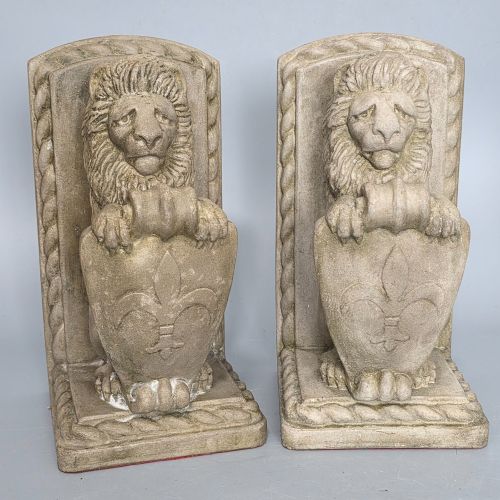


Stone Bookends
Stone bookends are heavy desk accessories carved from marble, serpentine and soapstone to hold volumes upright.
Stone Bookends
Stone bookends appear across several periods, most commonly taking the form of Victorian carved figures or Art Deco geometric silhouettes. When you search for stone bookends, you meet pairs shaped as lions, dogs, squirrels and architectural elements.
The materials span English and European marbles alongside Chinese soapstone and jade marble. Many examples originate from the Grand Tour tradition, replicating classical sculpture in miniature for nineteenth-century libraries.
Materials and construction
Makers utilised natural mineral blocks, sawing and hand-carving materials such as serpentine, alabaster and cast stone into balanced pairs. Hard stones like marble and jade marble required abrasive grinding and polishing to achieve a smooth finish.
Softer varieties like soapstone allowed for deep undercut carving, visible in detailed animal figures and desk seals. Metal elements occasionally appeared combined with the stone base, creating contrasting textures in the finished piece.
The archive records pieces fashioned from the actual stone of the Houses of Parliament alongside classic Italian animal figures.
Judging quality
Quality rests primarily on the crispness of the carving and the natural patterning of the mineral. Superior pairs display anatomical precision in animal figures and careful matching of the stone grain across both blocks.
Simpler cast stone versions rely on uniform moulding, whereas carved serpentine and marble pieces depend entirely on the skill of the mason. The weight and stability of the mineral base determine how effectively the pair performs its function.
The Stone Bookends Glossary
- Serpentine
- A hydrous silicate of magnesium, usually green or mottled, often used for decorative carvings. This mineral takes a high polish and resembles marble.
- Grand Tour
- A cultural journey undertaken by wealthy Europeans in the eighteenth and nineteenth centuries. Travellers purchased small sculptures and architectural models as souvenirs.
- Soapstone
- A talc-schist stone that is soft and easily carved. It has a soapy feel to the touch and appears frequently in Chinese export carvings.
- Dog of Fo
- A traditional Chinese guardian lion depicted in pairs outside temples. These mythical creatures appear frequently on carved oriental bookends.
Stone Bookends: Frequently Asked Questions
How heavy are stone bookends?
These items are solid mineral blocks designed to anchor heavy volumes in place. Their substantial mass prevents large books from slipping.
Lighter soapstone pairs suit smaller shelves, while marble and serpentine weigh considerably more.
What is serpentine marble?
Serpentine marble is a green, mottled stone often confused with true marble due to its polished appearance. It comes from serpentine rock formations.
Victorian carvers frequently utilised this material for classical animal models.
How do I clean stone bookends?
Dust the surface regularly with a soft, dry cloth to prevent dirt from settling into natural crevices. Avoid harsh chemical cleaners that can damage the polish.
Soapstone and alabaster require particular care to protect their softer surfaces from moisture.
Are all stone bookends old?
The selection includes nineteenth-century pieces alongside twentieth-century Art Deco and mid-century examples. Materials and carving styles help indicate the likely period of manufacture.
Victorian examples often feature classical revival motifs, while Art Deco designs favour streamlined forms.