



Steel Barrel Firearm
A steel barrel antique firearm is a historic mechanism of self-defence or warfare, prized for its mechanical ingenuity and period craftsmanship.
Steel Barrel Firearm
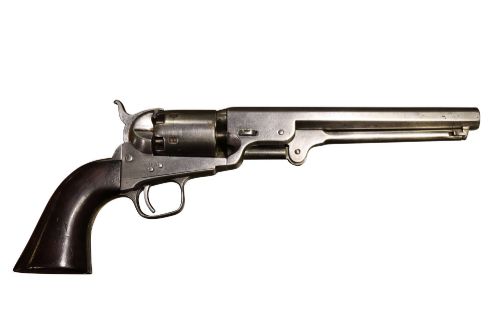
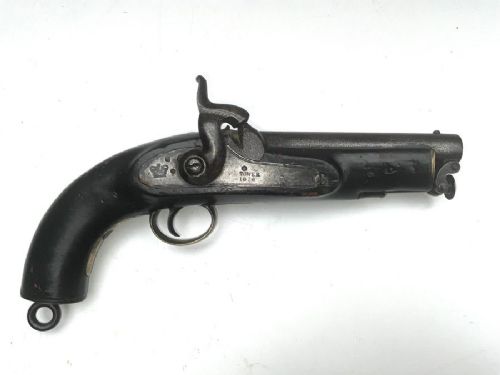
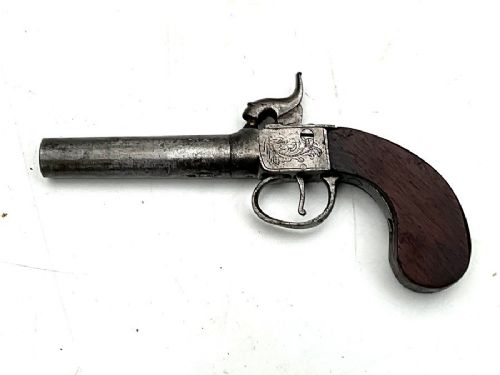
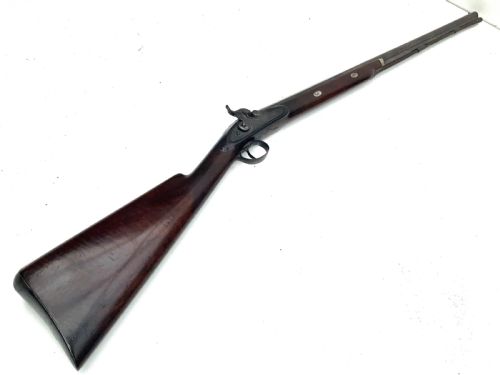
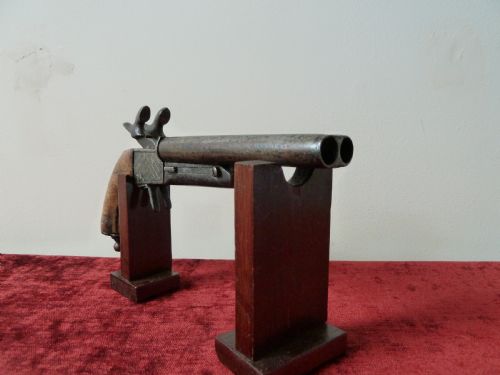
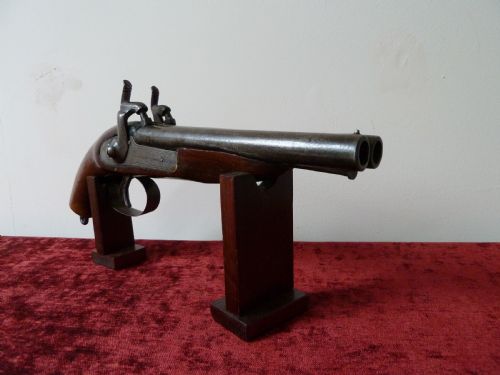
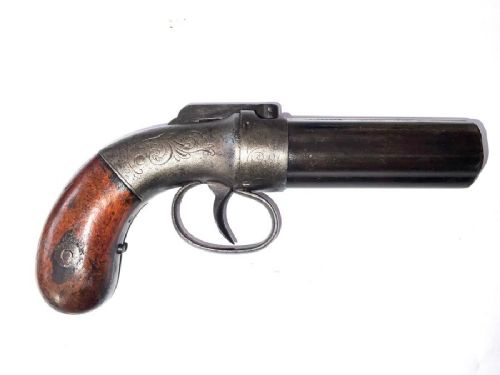
A steel barrel antique firearm encompasses a diverse range of muzzle-loading and early cartridge handguns and long guns originating primarily from the eighteenth and nineteenth centuries. When exploring a steel barrel antique firearm, buyers encounter forms such as flintlock pocket pistols, percussion cap revolvers, pepperbox pistols, and military muskets from British, European, and global workshops. Georgian and Victorian examples dominate the selection, spanning active military service pieces, private duelling arms, and compact travelling weapons.
The historical scope reaches from early eighteenth-century Queen Anne turn-off pistols to mid-nineteenth-century pinfire and percussion systems. Shooters, historians, and collectors seek these objects to examine the rapid evolution of ignition technology, from flintlock mechanisms to percussion caps and pinfire cartridges. Most pieces combine steel barrels with wooden stocks, occasionally augmented by brass furniture or silver wire inlay.
How they were made
Makers constructed the core mechanical elements of each steel barrel antique firearm from forged iron and steel, often pairing them with dense hardwoods such as walnut. Stocks frequently featured hand-carved details, while higher-grade models incorporated brass trigger guards, silver wire inlay, or mother-of-pearl panels.
Gunsmiths utilised forge-welding techniques to shape iron and steel into rifled or smoothbore barrels, subsequently applying proof marks at official stations like London or Birmingham. Lock mechanisms - whether flintlock, miquelet, percussion, or pinfire - relied on precisely tensioned springs, hand-filed sears, and meticulously fitted hammers to ensure reliable ignition.
Some nineteenth-century pocket pistols feature sneaky foldaway bayoons for when gunpowder diplomacy unexpectedly requires a closer argument.
What varies in quality
The distinction between standard military issue and bespoke civilian arms largely dictates the overall refinement of a steel barrel antique firearm. Maker reputation heavily influences desirability, with signed locks from notable London gunsmiths commanding greater attention than unmarked contract pieces.
Preservation of original metal finishes, crispness of barrel engraving or maker stamps, and the structural integrity of the wooden stock determine collector standing. Mechanisms that retain strong spring tension and crisp half-cock and full-cock action represent higher manufacturing standards of their respective period.
John Manton And Son·Allen And Thurber·J R Cooper·T Potts·Twigg·James Barber·Thomas Henshaw·La Motte·I Parr·J Robinson
The Steel Barrel Firearm Glossary
- Flintlock
- An ignition mechanism utilising a piece of flint held in a cock to strike a steel frizzen, creating sparks to ignite priming powder. This system dominated military and civilian arms throughout the eighteenth and early nineteenth centuries.
- Percussion cap
- A small metal cup containing priming explosive placed on a nipple, detonated by the fall of the hammer. This innovation largely replaced the flintlock system during the nineteenth century.
- Queen Anne type
- A pistol style characterised by a barrel and breech forged as a single piece, with the breech screwing off for front-loading. This design was popular for pocket and coat pistols during the eighteenth century.
- Pepperbox
- A multi-barrelled repeating firearm where the entire cluster of barrels rotates with each pull of the trigger or cocking of the hammer. It serves as a direct predecessor to the multi-chamber revolver.
- Proof mark
- An official stamp applied to a barrel or action after successful testing under high powder pressure. These marks help historians identify the place and era of manufacture.
Steel Barrel Firearm: Frequently Asked Questions
How do I care for a steel barrel antique firearm?
Keep the piece in a stable, dry environment away from direct heat sources and high humidity to prevent active corrosion on the steel components. Apply a light microcrystalline wax or preservative oil periodically to protect the metal surfaces and nourish dry antique wooden stocks.
Avoid aggressive cleaning agents or abrasive scouring pads that might obliterate original patinas, proof marks, or delicate engraving. Regular gentle dusting and careful handling using cotton gloves will preserve the historical integrity of the mechanism.
Were these weapons used in military service?
Many examples on the market, such as Tower-stamped dragoon pistols and Brown Bess muskets, were standard-issue arms for infantry and cavalry units. These military contracts prioritised robust construction and standardisation over ornate decoration.
Conversely, civilian models like pocket pistols and duelling arms were privately purchased by officers, gentlemen, and travellers for personal protection. Examining government acceptance stamps and unit markings helps determine a piece's military background.
What is the difference between flintlock and percussion?
Flintlock firearms rely on a spark generated by striking flint against steel to ignite loose gunpowder in an external pan. This system requires dry weather conditions and careful priming before every single shot.
Percussion firearms utilise a closed percussion cap placed over a hollow nipple, struck directly by a hammer to fire the charge inside. This later nineteenth-century development offered superior reliability in wet weather and faster reloading times.
How can I tell the era of a piece?
Stylistic clues such as stock shape, brass furniture design, and the transition from flintlock to percussion ignition provide a reliable chronological framework. Eighteenth-century arms typically feature graceful, sweeping lines and flintlock mechanisms, while mid-nineteenth-century pieces often adopt boxlock actions or revolving clusters.
Maker signatures, engraved dates, and official London or Birmingham proof marks offer precise historical anchors. Comparing these hallmarks against known trade directories narrows down the exact decade of production.