
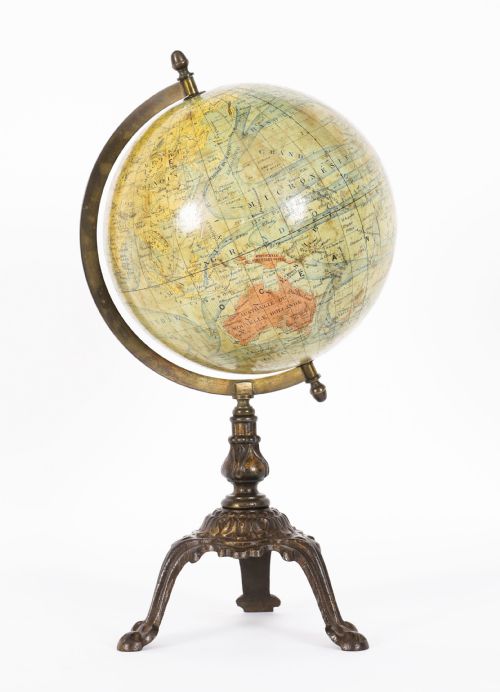
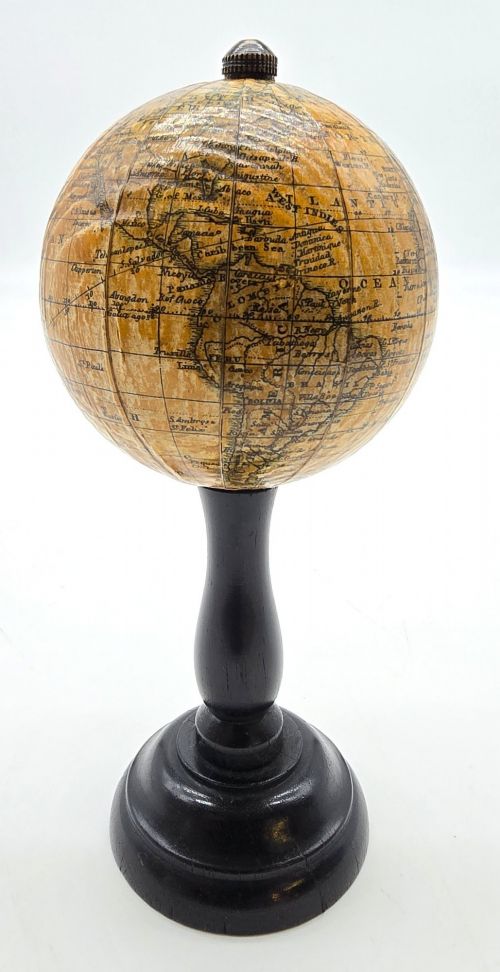


Standing Terrestrial Globe
A standing terrestrial globe brings the mapped world into the room, offering both geographical reference and traditional decor.
Standing Terrestrial Globe
A standing terrestrial globe provides a physical representation of the Earth mounted upon a dedicated support structure, taking forms from small desk models up to large library and floor standing globes. When you search for a standing terrestrial globe, you encounter pieces spanning from the eighteenth century through to the mid-twentieth century, originating from English, French, and German makers. The selection ranges from miniature table variants to substantial library pairs.
The objects listed show diverse formats including floor standing globes, library globes, and desk globes resting on stands. Materials such as mahogany, ebonised wood, and brass appear alongside paper gores and plaster cores. These pieces reflect periods including the Georgian, Victorian, Edwardian, and interwar eras.
Materials and construction methods
Supporting structures utilise woods like mahogany and ebonised wood, alongside metals such as brass, cast iron, and general metalwork. Stands range from simple turned wooden columns to architectural floor-standing mountings designed to support large terrestrial and celestial spheres.
Several examples survive in matched pairs combining a terrestrial globe of the earth with a celestial globe charting the night sky.
Assessing quality in antique globes
Quality in these pieces rests upon the clarity and detail of the cartography printed upon the paper gores, as well as the precision of the gores' alignment. Finer examples exhibit crisp typography, detailed geographical boundaries, and well-preserved original colouring on the paper surface.
The integrity and craftsmanship of the stand significantly influence the overall standard of the piece. Superior examples feature robust joinery in woods like mahogany, finely cast brass meridian rings, and stable floor-standing or desktop frames that securely hold the sphere.
Lebegue & Cie·G & J Cary·J. Forest·Malby's·Geographia·M.Vivien·Raths·Phillips
The Standing Terrestrial Globe Glossary
- Terrestrial globe
- A spherical map representing the earth, showing continents, oceans, countries, and major cities. These objects served as geographical reference tools and decorative study furnishings.
- Gores
- The paper strips, tapered at the poles, printed with map details and applied to the spherical core of the globe. Accurate alignment of these strips is essential for proper cartographic representation.
- Meridian ring
- The brass or metal ring that encircles the globe, allowing it to spin on its axis and often calibrated with degrees. It supports the sphere within its floor or table stand.
- Library globe
- A large scale globe, often paired with a celestial counterpart, traditionally housed in studies and libraries. These pieces measure substantial diameters, such as twelve or eighteen inches.
- Celestial globe
- A companion to the terrestrial globe, mapped with constellations and stars rather than the geography of the earth. They frequently appear in matched pairs with terrestrial models.
Standing Terrestrial Globe: Frequently Asked Questions
What is a standing terrestrial globe?
A standing terrestrial globe is a spherical map of the earth mounted on a dedicated base, table stand, or floor-standing frame. These instruments display historical geographical data from their respective periods.
They combine cartography with furniture design, serving both as educational tools and decorative objects in studies and libraries.
How do I date an antique globe?
Dating relies heavily on the political boundaries, country names, and colonial territories printed on the paper gores. Cartographic milestones shown on the map provide a clear terminus post quem for the year of production.
Additionally, the style of the wooden or brass stand, along with any maker's cartouche or date printed on the sphere, helps narrow the period of manufacture.
Where were these globes manufactured?
The evidence shows production across multiple European nations, notably England, France, and Germany. Prominent publishing houses and instrument makers produced these globes for international markets.
English makers such as Cary and Malby operated alongside French firms like Lebegue and J. Forest, as well as German manufacturers.
How should I care for a paper globe?
Paper and plaster globes require stable environmental conditions away from direct sunlight to prevent the paper gores from fading and the varnish from discolouring. Consistent indoor humidity helps protect the delicate paper surface.
Dusting should be performed gently with a dry, soft cloth, avoiding any moisture or cleaning agents that could damage the antique printed surface.