
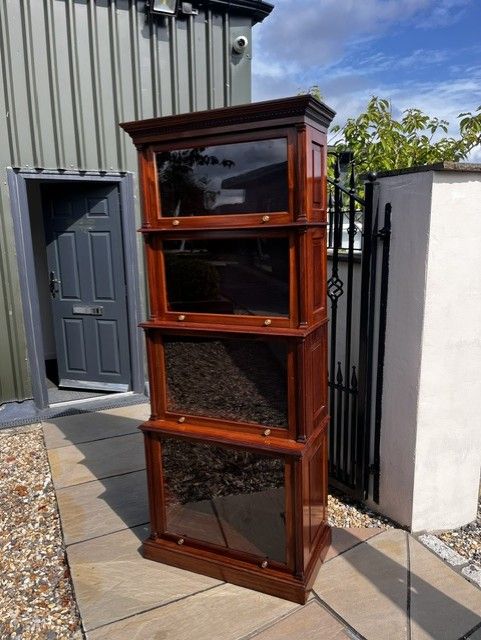


Brown Mahogany Library Globe
These brown mahogany library globe pieces bring together geography and fine cabinet-making for any study.
Brown Mahogany Library Globe
When you search for brown mahogany library globe, you meet pieces that range from terrestrial and celestial spheres on stands to sectional bookcases designed to house working libraries. The selections span several decades, bringing together nineteenth-century cartography and early twentieth-century modular storage.
The evidence shows forms that include floor globes, table globes, and stacking bookcases, reflecting the diverse furnishings of traditional libraries. Each piece demonstrates the heavy reliance on rich timber and detailed paper gores.
How they were made
Cabinet-makers utilised solid mahogany, oak, and brass to construct the frames and modular housings for these items. Brass fittings secure the rotating axes of globes and provide hardware for sectional bookcase doors.
Cartographers applied printed paper gores over plaster spheres to create detailed terrestrial and celestial maps. Artisans then mounted these spheres onto turned wooden stands or paired them with glass-fronted barrister bookcases.
Listings feature items from the 1860s, Victorian, Edwardian, 1920, 1930, and Art Deco periods, utilising mahogany, oak, brass, and glass.
What varies in quality
The refinement of the cartography and the precision of the paper gores separate standard globes from exceptional examples. Finer globes exhibit sharper geographical detail and careful hand-colouring across the sphere.
Cabinetwork quality reveals itself in the grain of the mahogany, the smoothness of sectional stacking mechanisms, and the clarity of original glass panes. Superior pieces maintain their original finish and structural integrity without heavy restoration.
G & J Cary·Malby's·Crunchley
The Brown Mahogany Library Globe Glossary
- Terrestrial globe
- A spherical map representing the earth. These items detail countries, oceans, and historical trade routes.
- Celestial globe
- A spherical map depicting the constellations and stars. They were often produced as companion pieces to terrestrial globes.
- Barrister bookcase
- A modular sectional bookcase featuring glass doors that lift and slide into the cabinet. This design protects heavy volumes of books.
- Paper gores
- Printed strips of paper shaped to fit smoothly over a sphere. Cartographers paste these sections onto plaster balls to form complete maps.
Brown Mahogany Library Globe: Frequently Asked Questions
What is a library globe?
A library globe is a large terrestrial or celestial sphere mounted on a stand for study. These items served both as practical reference tools and scholarly decor in traditional rooms.
They often measure twelve to eighteen inches across and sit upon turned wooden bases with brass meridian rings.
How do sectional bookcases relate to globes?
Sectional bookcases share the domestic and institutional spaces where library globes were kept. Both items reflect the Victorian and Edwardian desire to house collections of books and reference materials.
They utilise mahogany and oak construction to match the formal furniture of period libraries.
What periods do these pieces represent?
The pieces span the nineteenth and early twentieth centuries, including Victorian, Edwardian, and Art Deco eras. This range covers the height of British cartographic publishing and modular furniture design.
Craftsmen produced these works from the 1860s through to the 1930s.
Which materials appear most often?
Mahogany, solid mahogany, oak, brass, glass, and paper form the primary materials across these listings. Cartographers used plaster and paper for the globes themselves, supported by timber frames.
Brass fittings and glass panels complete the construction of the associated bookcases and globe mountings.