




Staffordshire Equestrian Figurines
Staffordshire equestrian figurines bring nineteenth-century pottery riders and mounted royals directly into your home.
Staffordshire Equestrian Figurines
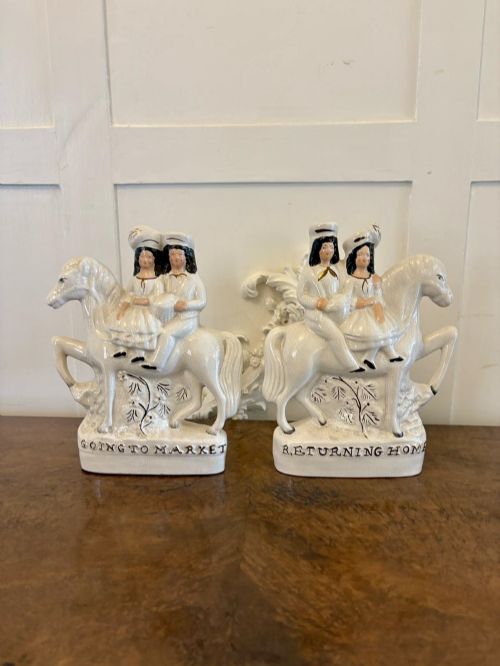
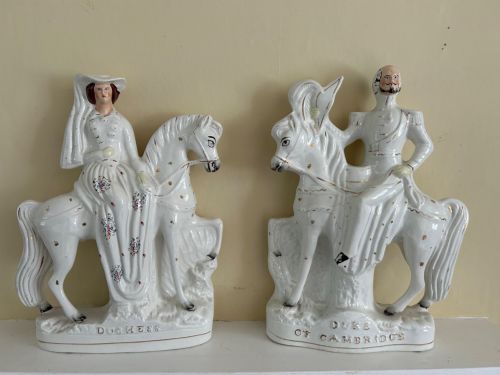
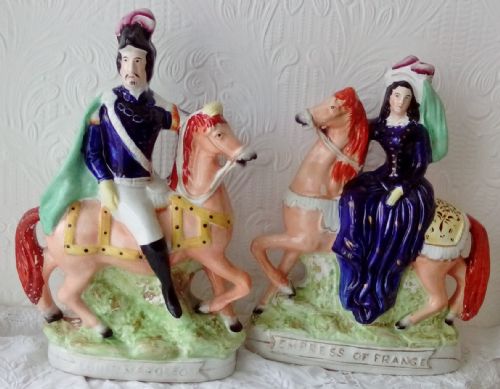
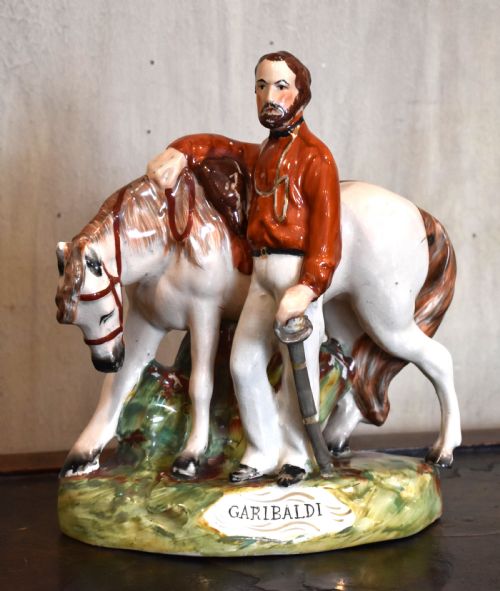
Staffordshire equestrian figurines capture figures on horseback, ranging from royalty and historical commanders to literary characters and folk subjects. These Victorian earthenware pieces often appear in pairs or as flatback pottery designed for display on mantelpieces.
The subjects span the Duke and Duchess of Cambridge, Louis Napoleon, Joan of Arc, Garibaldi, and Scottish highlanders, alongside jockeys and highwaymen like Tom King. Most examples date from the nineteenth century, specifically around eighteen sixty to eighteen eighty, reflecting popular mid to late Victorian tastes.
How they were made
The flatback construction technique allowed makers to economise on material and weight for figures intended to stand against a wall. Artisans finished each ceramic piece with hand-painted enamel colours over the glaze.
Listings feature nineteenth-century earthenware pieces utilising enamel paint, lead glaze, and gilt across Victorian styles.
What varies in quality
Painting precision distinguishes the finer examples, particularly in the rendering of facial expressions, regalia, and horse markings. Crisp enamel paintwork and careful application of gilt separate superior Victorian pottery from simpler production.
Modelling detail also dictates quality, as seen in the definition of the horse's form and the rider's attire. Larger figures and documented pairs often display greater sculptural ambition and stronger visual presence.
The Staffordshire Equestrian Figurines Glossary
- Flatback
- A pottery figure finished with a flat, unglazed or minimally glazed reverse side designed to face a wall. This method saved clay and reduced kiln weight during production.
- Earthenware
- A porous, opaque ceramic body fired at lower temperatures than stoneware or porcelain. It serves as the primary base material for nineteenth-century Staffordshire figures.
- Enamel Paint
- Vitreous pigments applied over the fired glaze and subjected to a second, lower-temperature firing to fuse the colour. This technique provided the bright palette seen on Victorian riders.
- Lead Glaze
- A glossy vitreous coating containing lead oxide applied to ceramics before firing to seal the porous clay body. It gives these figures their characteristic shine.
Staffordshire Equestrian Figurines: Frequently Asked Questions
What are Staffordshire equestrian figurines?
Staffordshire equestrian figurines are nineteenth-century ceramic figures depicting people on horseback, produced in the pottery districts of England.
They represent historical leaders, royals, soldiers, and literary figures intended for domestic display.
How were these figures displayed?
Makers designed these flatback pieces to sit securely on mantelpieces, shelves, and sideboard tops against a wall.
Pairs were often arranged symmetrically to balance the decoration of a Victorian room.
How do I date Staffordshire figures?
Dating relies on stylistic markers, subjects, and manufacturing techniques characteristic of the Victorian period between eighteen sixty and eighteen eighty.
Costume details and historical events associated with the figures provide chronological clues.
Are these figures painted by hand?
Enamel paint and gilt highlights were applied by hand over the glazed ceramic body by pottery workers.
This accounts for the individual variations in colour and detail found across different examples.