
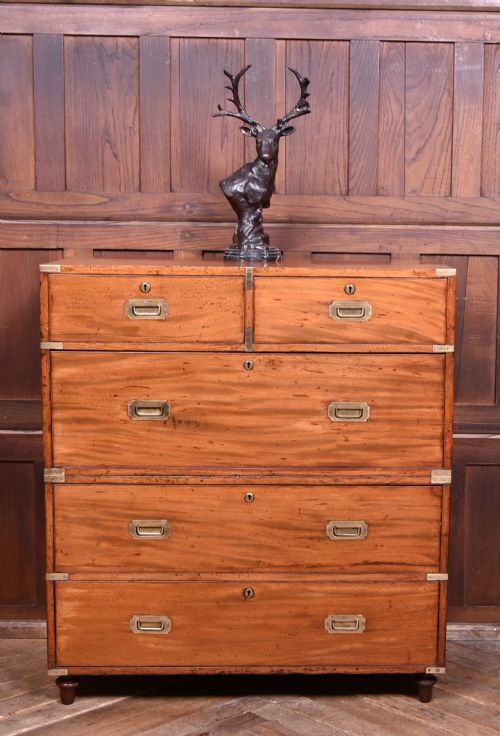
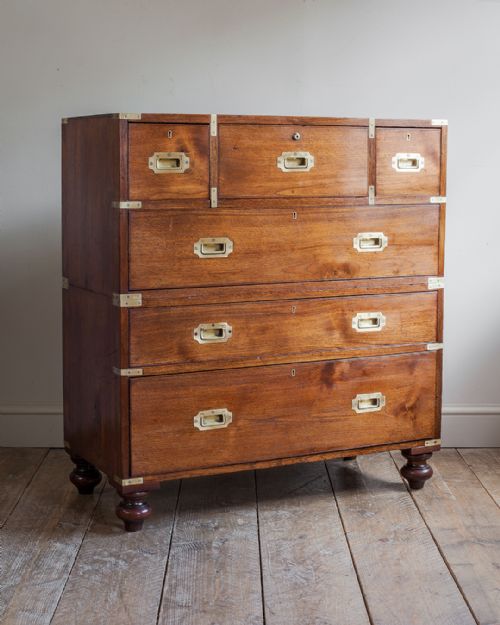
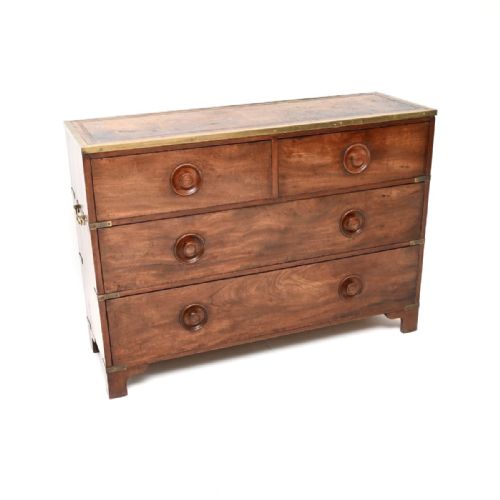
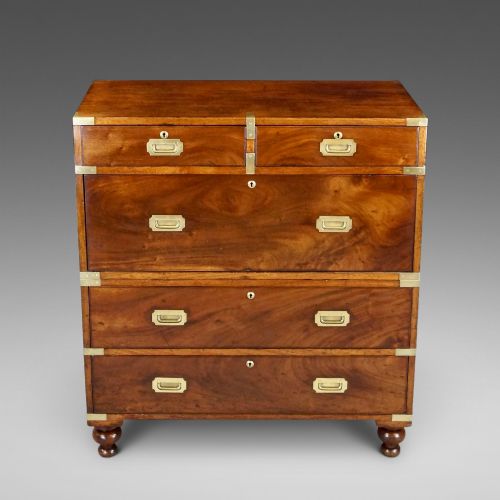
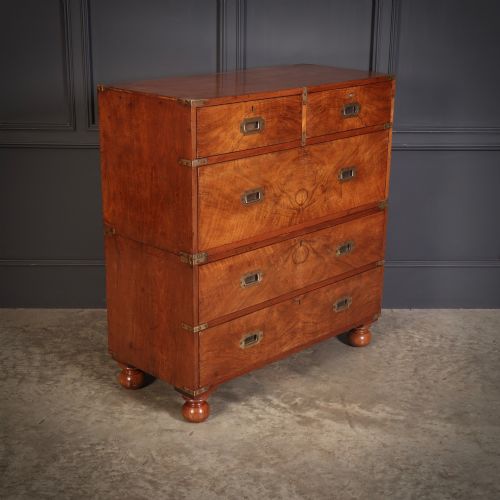

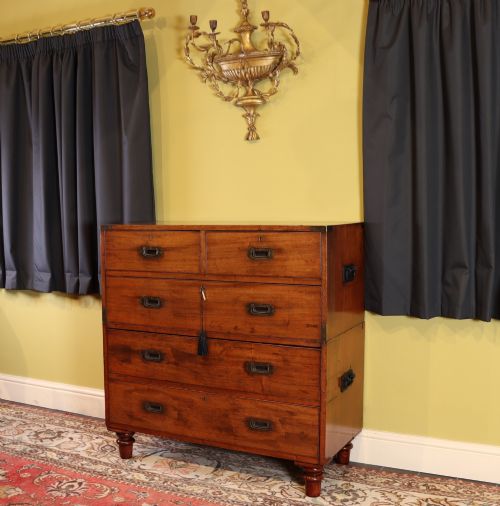

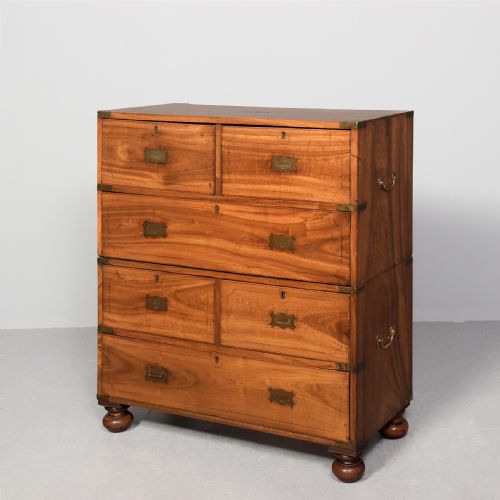
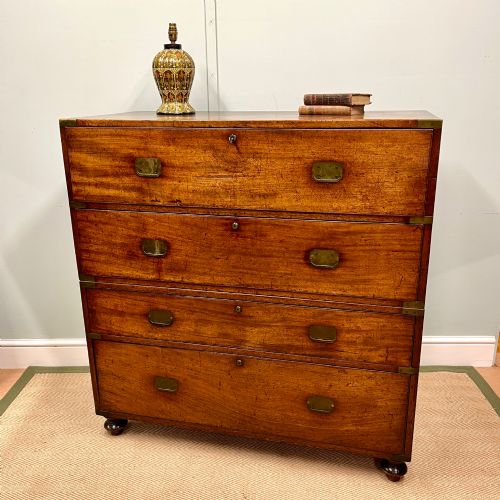
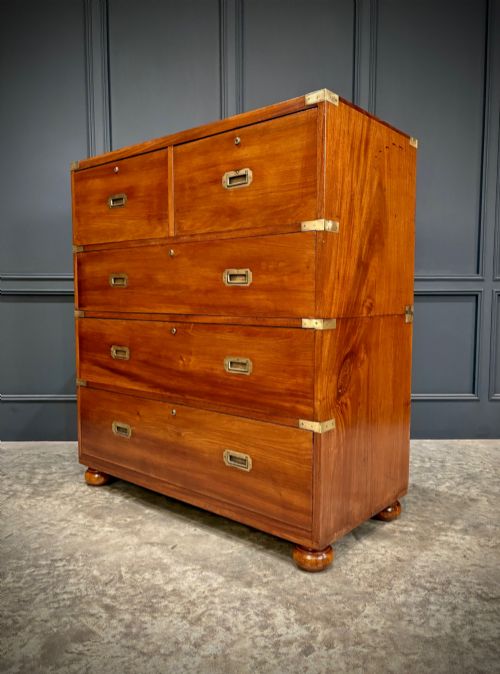


Split Campaign Furniture Chest
Split campaign furniture chests are modular military storage pieces built for travel, offering remarkable ingenuity and rugged timber construction.
Split Campaign Furniture Chest
When you examine a split campaign furniture chest, you are looking at a modular storage system designed specifically for the relocation needs of military officers and colonial administrators. These chests divide into two or more stacked sections, making them manageable for transport on horseback, ships or trains.
The versions you will most frequently encounter on this page date from the nineteenth century, including the Victorian era and Georgian periods. They typically appear as chests of drawers, cabinets or secretaire desks fitted with recessed brass handles and corner brackets to withstand the rigours of travel.
Woods such as mahogany, teak and camphor wood dominate the selection, reflecting the global origins of these pieces from British Colonial outposts and Anglo-Indian workshops. Each example balances utilitarian strength with the refined proportions expected by officers stationed abroad.
How they were made
Cabinet makers utilised dense, durable timbers such as mahogany, teak, padouk and camphor wood to resist warping in humid climates while enduring heavy transit. These woods were often worked into solid boards or applied as figured veneers over sturdy carcases.
The construction relied heavily on brass binding, flush-fitting carrying handles and corner reinforcement plates screwed directly into the timber to protect vulnerable edges. Dovetail joints secured the drawer structures, ensuring stability despite constant dismantling and reassembly.
Camphor wood chests carried the subtle scent of the East into muddy tents, keeping colonial moths at bay.
What varies in quality
Quality in these chests is largely defined by the integrity of the timber selection and the precision of the brass hardware integration. Superior examples exhibit tightly fitted brass corners and flush handles that sit perfectly level with the wood surface.
The presence of a fitted secretaire drawer with internal pigeonholes and leather-lined writing surfaces elevates the sophistication of a piece. Finer items also retain their original two-part configuration, locking mechanisms and keys, demonstrating superior workshop execution.
S. W. Silver & Co. London & Liverpool·Army & Navy
The Split Campaign Furniture Chest Glossary
- Secretaire chest
- A chest of drawers featuring a pull-out writing drawer with a hinged front and internal compartments. This clever adaptation provided officers with a portable desk space.
- Two-part chest
- A modular cabinet built in separate upper and lower sections that stack together. This construction method facilitated easier handling and transport during military campaigns.
- Brass binding
- Metal strips and corner pieces fitted flush to the exterior edges of the chest. This hardware protected the timber from impacts during transit.
- Camphor wood
- An aromatic hardwood native to Asia, frequently utilised for campaign chests due to its natural insect-repellent properties. It protected uniforms and documents from tropical pests.
- Recessed handle
- A drawer pull or carrying handle inset into the wood face so it does not project beyond the surface. This design prevented snags and allowed units to pack tightly together.
Split Campaign Furniture Chest: Frequently Asked Questions
What is a split campaign chest?
A split campaign chest is a modular storage unit built in two or more stacked sections designed for easy transport by military officers. The separation allowed heavy furniture to be packed and moved during active service.
These pieces combine robust timber construction with protective brass hardware. They function as practical drawer units or secretaire desks adapted for travel.
Why are they made in two parts?
Dividing the chest into separate stacked sections reduced the weight and awkward dimensions for handlers during transit. Officers frequently relocated, so modular furniture was essential for baggage logistics.
Each section locks securely onto the one below using internal pins or brass side brackets. This ingenious construction kept the stack stable on ships and wagons.
How do I use one at home?
These chests integrate well into modern interiors as bedroom storage, hallway cabinets or living room sideboards. Their compact proportions and flat tops provide useful display and surface space.
The modular nature means you can separate the sections if needed or keep them stacked as a tall chest of drawers. Their historical character brings warmth and texture to contemporary rooms.
How do I identify a Victorian campaign chest?
Victorian examples typically feature dense timbers like mahogany or teak, combined with substantial brass corner brackets and flush carrying handles. Many date from the mid-nineteenth century during the height of British military expansion.
Look for construction details such as dovetailed drawer boxes and maker stamps if present. The inclusion of a secretaire drawer often points directly to this active military period.