

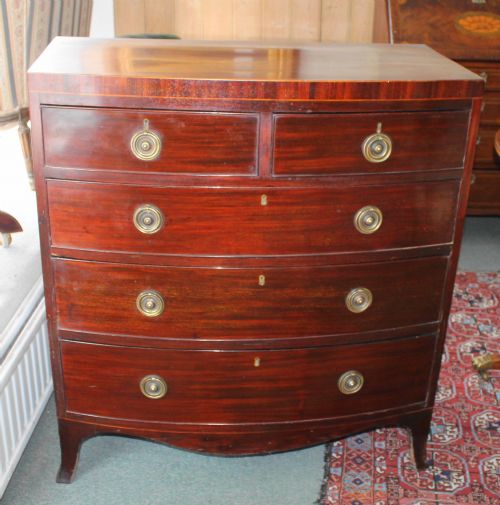
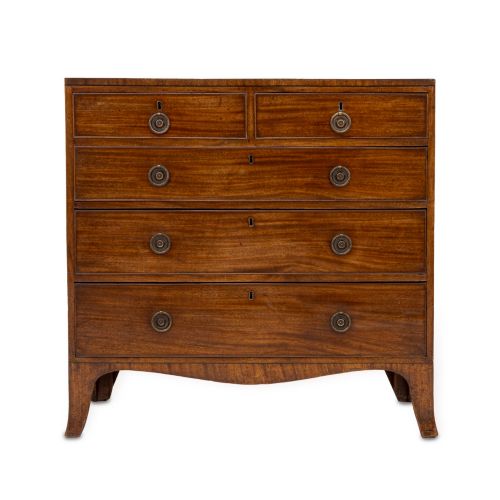
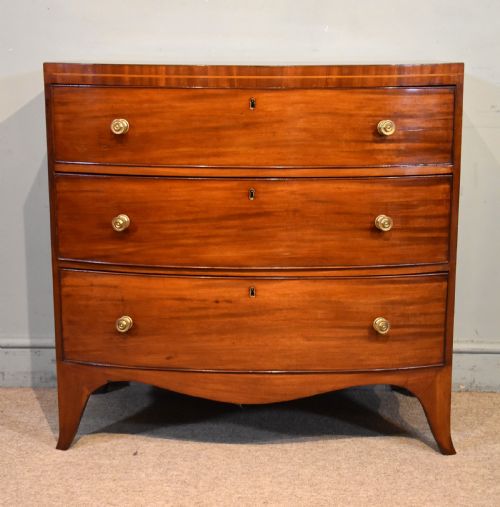

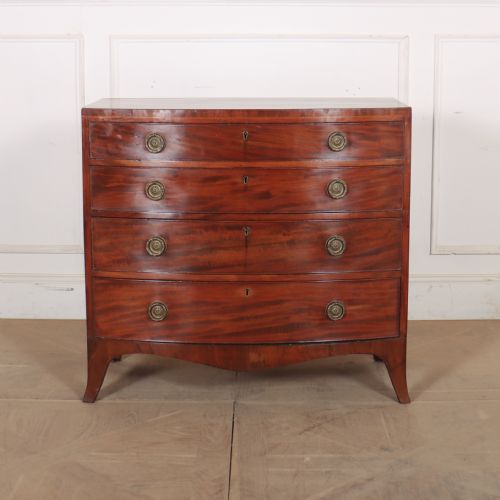


Splay Leg Wooden Chest
A splay leg wooden chest delivers compact storage with clean period lines, offering a practical anchor for a traditional bedroom.
Splay Leg Wooden Chest
A splay leg wooden chest typically takes the form of a chest of drawers, often constructed with bow front or serpentine profiles from the Georgian and Regency periods. These pieces serve as functional storage furniture, combining cabinet work with distinctive outwardly angled supports.
Buyers browsing this selection encounter numerous examples originating from the eighteenth and nineteenth centuries. The listings feature refined cabinet work, including compact proportions and inlaid finishes characteristic of Georgian and Regency workshops.
The most common formats on this page are mahogany bow front chests of drawers from the George III and Regency eras. These items demonstrate the classic proportion and understated decorative detailing valued by collectors of period furniture.
How they were made
Makers constructed these chests predominantly from solid mahogany, frequently applying figured veneers to the drawer fronts. Workshops incorporated secondary timbers alongside brass hardware for drawer pulls and escutcheons.
Craftsmen enriched surfaces using decorative stringing and banding in contrasting timbers such as satinwood, boxwood, and harewood. Inlaid details define the serpentine and bow front silhouettes seen across the Georgian and Regency periods.
The listings feature mahogany as the dominant primary material, complemented by satinwood, boxwood, and harewood.
What varies in quality
The sophistication of the timber selection and the precision of the inlay dictate the distinction between standard items and exceptional examples. Finer pieces display carefully chosen mahogany grain patterns matched across the drawer fronts alongside intricate satinwood or boxwood stringing.
Structural integrity and the retention of original brass fittings significantly influence the standing of an individual chest. Expert construction in the drawer linings and stability in the bracket or splay feet determine the enduring quality of the piece.
The Splay Leg Wooden Chest Glossary
- Bow front
- A cabinet front that curves outward in a convex shape. This profile gained popularity during the late eighteenth century to soften the rectangular geometry of standard chests.
- Serpentine
- A front configuration featuring a central convex curve flanked by concave sections. This undulating line requires advanced woodworking skill to execute properly.
- Inlay
- The technique of inserting contrasting strips or pieces of wood into recessed portions of a base timber to form decorative patterns. Craftsmen utilised satinwood and boxwood for this purpose.
- Bracket foot
- A furniture foot formed by two side pieces joined at a right angle beneath the corners of a case piece. These supports often take moulded or shaped profiles on Georgian furniture.
- Tallboy
- A tall chest of drawers constructed in two sections, typically a smaller chest stacked upon a larger base. This form maximised vertical storage capacity in period bedchambers.
Splay Leg Wooden Chest: Frequently Asked Questions
How do I date a mahogany chest?
Dating relies on examining the construction methods, secondary timbers, hardware styles, and overall proportions of the piece. Regional design shifts from plain mahogany to inlaid satinwood offer reliable chronological markers.
Comparative analysis of foot styles and drawer lining construction helps differentiate late eighteenth-century examples from nineteenth-century interpretations.
Where were these chests used?
These chests served primarily as principal storage furniture within domestic bedchambers and dressing rooms. Their compact proportions allowed them to fit neatly against walls while holding linens and apparel.
Over subsequent generations, collectors relocated these items into living rooms and hallways as decorative statement pieces.
How do I care for antique mahogany?
Maintaining antique mahogany involves placing the furniture away from direct heat sources and fluctuating humidity. Consistent indoor conditions prevent timber movement and veneer splitting.
Regular dusting with a dry cloth preserves the polished surface without the need for heavy chemical polishes.
What distinguishes Hepplewhite style?
Hepplewhite design is characterised by graceful curving lines, lighter proportions, and delicate ornamentation inspired by neoclassical motifs. This aesthetic moved away from heavy baroque forms towards refined elegance.
Pieces associated with this style frequently display contrasting stringing, tapered supports, and serpentine facades.