
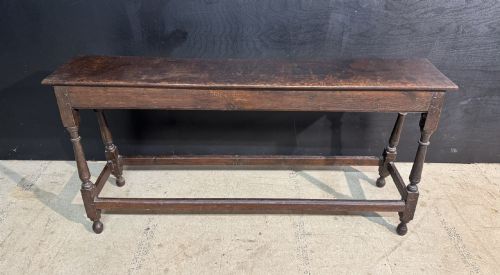
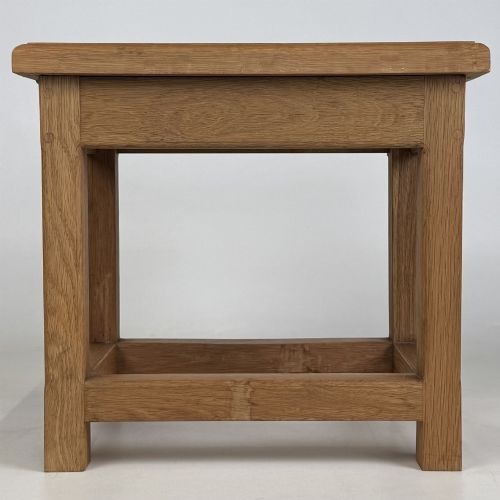


Solid Oak Jointed Stool
These solid oak jointed stools are sturdy early seating built to last centuries, combining utilitarian strength with classic period timber framing.
Solid Oak Jointed Stool
A solid oak jointed stool represents a durable form of early seating built with pegged mortise and tenon joinery rather than glued joints. These pieces serve primarily as functional low seating or side tables within traditional domestic interiors.
The versions met on this page range from genuine mid 17th century examples to later revival interpretations spanning the Georgian, Victorian, Edwardian, and early 20th century periods. Buyers encounter both single pieces and pairs alongside related low side table forms.
Makers designed these heavy timber items to withstand daily household use, resulting in straightforward rectangular top boards supported by four square or turned legs braced with low stretchers.
How they were made
Carpenters constructed each solid oak jointed stool using dense native hardwood timbers, shaping the structural components with hand tools before securing the frame with wooden pegs. This traditional jointing technique allows the wood to expand and contract naturally through seasonal humidity changes without compromising stability.
Selected examples incorporate surface ornamentation including carved rails and turned leg profiles, reflecting the aesthetic preferences of the 17th century Jacobean style or its later 19th and 20th century revivals.
Listings span multiple centuries, ranging from original mid 17th century examples to Georgian, Victorian, Edwardian, and early 20th century revivals in solid oak.
What varies in quality
The distinction between a standard example and a superior solid oak jointed stool lies in the age of the timber, the crispness of any hand carving, and the retention of original construction pegging. Period pieces from the 17th century display authentic surface patination accumulated through generations of handling.
Later revivals from the Edwardian era or the early 20th century exhibit varying degrees of decorative ambition, ranging from plain utilitarian forms to elaborately carved interpretations of earlier Jacobean models.
The Solid Oak Jointed Stool Glossary
- Joint stool
- An early form of domestic seating constructed by a joiner using pegged mortise and tenon joints rather than simple nailed or glued construction. These sturdy items predate the widespread use of upholstered chairs in ordinary households.
- Jacobean style
- A heavy, formal design idiom dating from the reign of James I, characterised by straight lines, dark oak timber, and geometric or strapwork carving. Revivals of this style appeared frequently during the 19th and early 20th centuries.
- Mortise and tenon
- A traditional wood-joining method where a projecting peg on one piece fits snugly into a matching hole in another, typically secured with a wooden dowel. This forms the structural skeleton of every genuine joint stool.
- Stretcher
- A horizontal timber rail connecting the legs of a stool near the floor to provide lateral rigidity and prevent the frame from spreading under weight. On these stools, stretchers also served as footrests away from cold flagstone floors.
Solid Oak Jointed Stool: Frequently Asked Questions
What is a joint stool?
A joint stool is a heavy wooden seat constructed by a joiner using pegged timber frames rather than turned and glued chair components. These items served multiple household purposes including seating and temporary table surfaces.
Historically, households used them at the dining table before individual chairs became common for every family member.
How old are these stools?
The pieces listed span from genuine mid 17th century originals down to Edwardian and early 20th century revival interpretations. Revival pieces were built in imitation of older styles during the 1800s and 1900s.
Examining the construction methods and timber characteristics helps determine whether a stool dates to the 1600s or a later period.
How were they used historically?
People utilised these sturdy oak stools throughout the home as flexible seating around the hearth or at dining boards. Their flat tops also allowed them to function as makeshift side tables for holding household objects.
Because they were portable and strong, servants and family members moved them easily from room to room.
How do I style a joint stool today?
These compact wooden stools fit easily beside modern armchairs as low side tables or bedside surfaces. Their neutral oak tones complement both traditional period rooms and contemporary minimalist spaces.
Placing one in an entryway provides a practical surface for brief moments of rest or for displaying decorative objects.