



Solid Oak Extendable Table
A solid oak extendable table offers a sturdy timber surface that grows to seat dinner guests easily.
Solid Oak Extendable Table
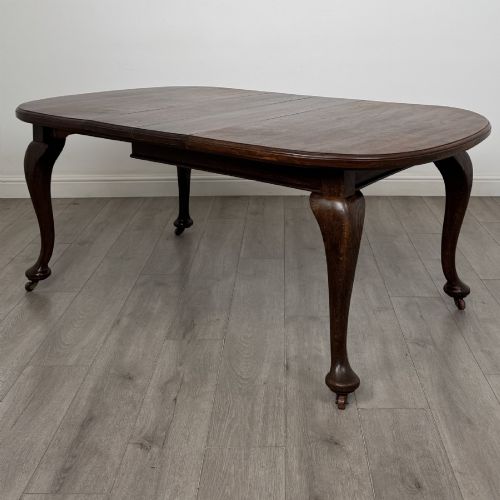
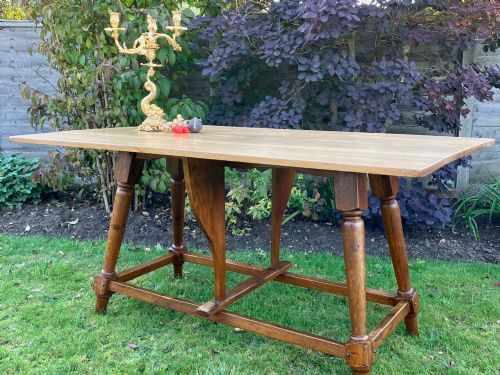
A solid oak extendable table provides a heavy wooden dining surface designed to expand for larger gatherings. When searching for a solid oak extendable table, buyers encounter forms ranging from early gateleg designs to Edwardian draw-leaf variants.
The pieces on this page span several centuries, with Edwardian and 1920s examples appearing alongside 18th-century, Victorian, and 17th-century pieces. These tables serve primarily as dining room centerpieces built from dense native timber.
Drop-leaf and draw-leaf mechanisms dominate the extending mechanisms available. Buyers are most likely to meet 20th-century interpretations that adapt historical styles like Jacobean Revival and Arts & Crafts for modern dining rooms.
Judging quality in oak tables
Quality rests in the smoothness of the extending mechanism and the stability of the leaves when fully opened. Tables that operate with minimal friction demonstrate superior carpentry over those with stiff or binding extension tracks.
The depth of the timber grain and the integrity of the original joints distinguish finer examples from standard production pieces. A well-constructed frame remains rigid whether closed for daily meals or extended for guests.
Solid Oak Extendable Table Retail Price Guide 2026
Typical asking prices for solid oak extendable table among the pieces listed under this phrase on Sellingantiques today, from the lower quarter to the upper quarter. They describe what is for sale here now, not the wider market.
Some of these gatelegs have swung their wooden legs out to catch dropping dinner plates for over three hundred years.
The Solid Oak Extendable Table Glossary
- Draw-leaf
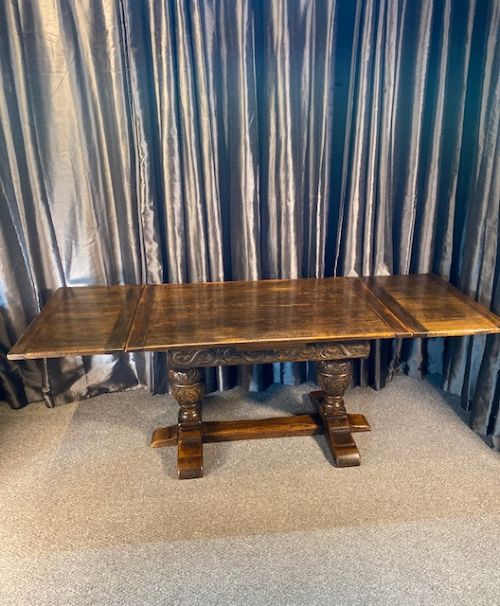
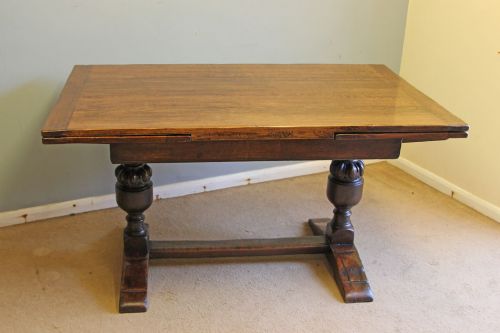
- A table design featuring two leaves stored beneath the main top that pull out to extend the surface. This mechanism allows the table length to increase quickly without removing separate boards.
- Gateleg
- A drop-leaf table where hinged legs swing outward like gates to support the folding flaps. It provides a compact footprint when closed and a wide surface when opened.
- Refectory
- A long narrow dining table traditionally used in communal dining halls. These sturdy forms often feature trestle bases or heavy corner legs connected by stretchers.
- Jacobean Revival
- A 19th and 20th-century style copying the dark, heavily carved furniture of the early 17th century. It incorporates turned bulbous legs and geometric panel ornamentation.
- Arts & Crafts
- A design movement prioritising honest construction and visible hand craftsmanship over mass production. Pieces from this tradition display plain oak surfaces and straightforward functional joinery.
Solid Oak Extendable Table: Frequently Asked Questions
How do draw-leaf tables work?
Draw-leaf tables feature two additional leaves hidden beneath the primary tabletop. When pulled outward, these leaves slide into place on wooden runners to extend the dining surface.
This design keeps the leaves stored internally so they remain attached to the table at all times. It offers a quick transformation without requiring extra storage space for loose boards.
Can these tables fit modern dining rooms?
These tables adapt well to contemporary spaces because many examples were built in compact Edwardian or 1920s proportions. The extending mechanisms allow the footprint to shrink for daily use and expand only when hosting.
Solid oak pairs easily with various seating styles, bridging historical character and modern utility. The neutral wood tones integrate smoothly into diverse interior colour schemes.
How do I care for solid oak?
Solid oak requires regular dusting with a dry cloth and occasional treatment with suitable natural waxes. Keeping the timber away from direct heat sources prevents the wood from drying out or splitting.
Spills should be wiped up promptly to protect the finish from water marks. Using placemats and coasters helps preserve the surface during daily family meals.
What is the difference between a gateleg and a drop-leaf?
A gateleg table is a specific type of drop-leaf table where the hinged flaps are supported by pivoting legs that swing out from the centre frame. Standard drop-leaf tables may use stationary brackets or other folding supports instead.
Both styles allow the table to fold down to a narrow profile when not in use. Gateleg versions typically provide robust wooden support directly beneath the centre of each folding leaf.
How do I identify a 17th-century table?
Seventeenth-century oak tables display deep patination earned through centuries of use and hand-tooled construction marks. They often utilise heavy gateleg configurations joined with pegged mortise and tenon joints.
The timber shows distinctive medullary rays and surface wear that modern machinery cannot replicate. These early pieces reflect the simpler joinery methods of pre-industrial carpentry.