
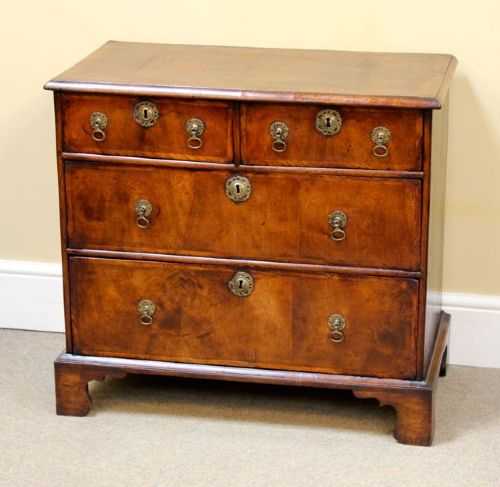
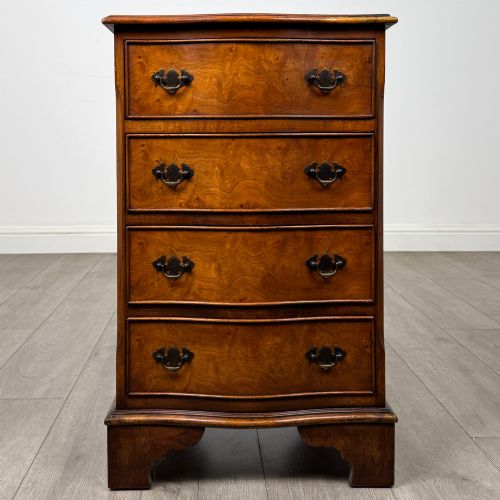


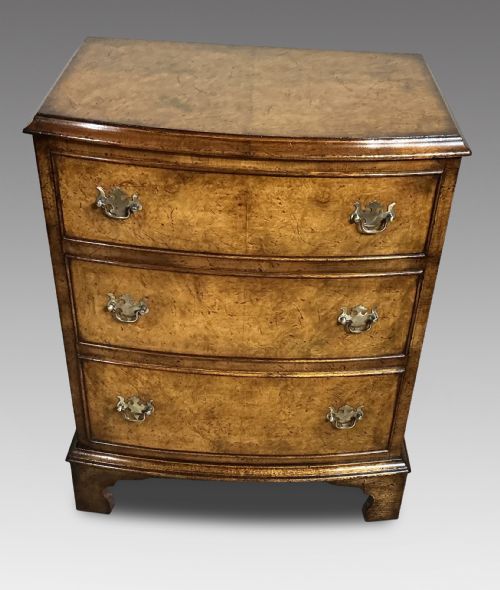


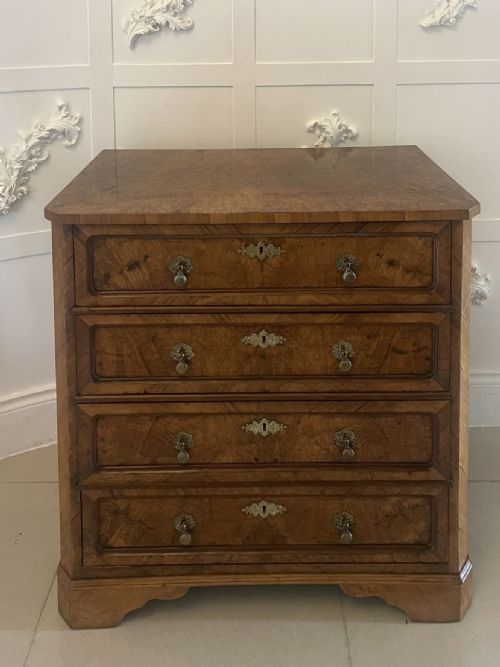
Small Walnut Dresser
A small walnut dresser or compact chest brings warm timber figure into a room without dominating the floor space.
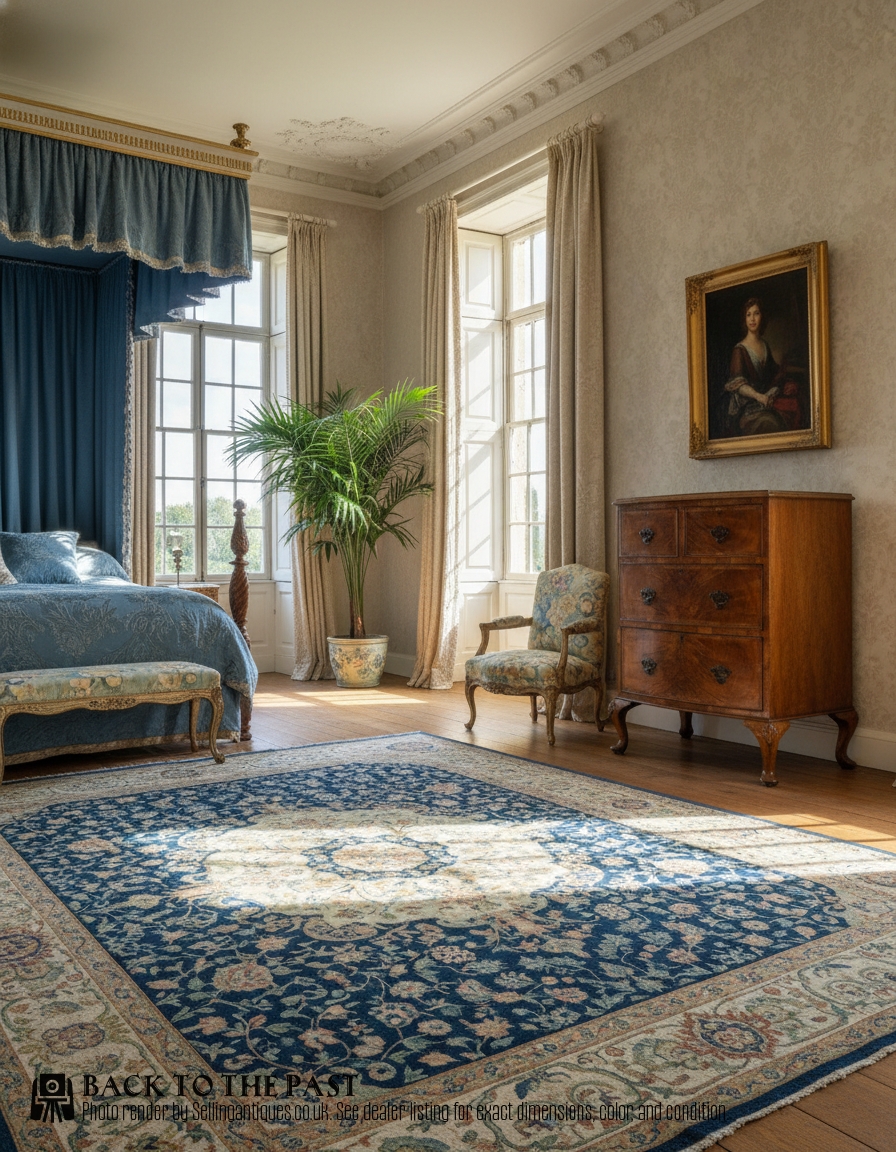
Small Walnut Dresser
A small walnut dresser or compact chest of drawers offers practical storage scaled for tighter rooms. Buyers seeking this search phrase encounter pieces spanning the eighteenth century through to the Edwardian period and the early decades of the twentieth century.
The selection ranges from early Georgian and George II examples to later revivals in the Queen Anne and Georgian styles. Alongside traditional chests, the inventory includes bow fronts, serpentine shapes, and side cupboards.
Early eighteenth-century works share the floor with nineteenth-century Victorian pieces and 1930s burr walnut productions. Oak appears alongside walnut, often used for secondary timbers or cross-banding within dresser bases.

How they were made
Cabinet makers utilised solid walnut, burr walnut veneers, and figured walnut timber applied to carcases of oak and general wood. Cross-banding in oak and walnut frames the drawer fronts on select eighteenth-century dresser bases.
Brass handles and escutcheons punctuate the facades, securing drawer operation and adding metal contrast to the dark timber grain. Surface treatments include painted wood finishes on specific twentieth-century variations alongside traditional polished wood.
Some chests retain their original brass handles, having watched generations of household keys vanish into the drawers below.
What varies in quality
Quality rests in the selection of the timber, particularly the choice of burr or figured walnut veneers across the drawer fronts and top surface. Early pieces display tight grain patterns and careful timber matching that elevates the visual depth.
The proportion of the piece and the integrity of the original brass hardware dictate the standing of a small dresser. Untouched surfaces with preserved patination mark out the finer examples from later revivals and standard production.
The Small Walnut Dresser Glossary
- Burr walnut
- A figured wood grain taken from the wart or burl growths of the walnut tree. It produces highly decorative, swirling patterns prized by cabinet makers.
- Cross-banding
- A narrow strip of veneer laid across the grain direction of the main surface. This technique frames drawer fronts and tabletops on period furniture.
- Bow front
- A convex, curved cabinet front that projects outward in an arc. This shape appears on several twentieth-century walnut chests.
- Serpentine
- A front contour that curves outward in the centre and inward at the sides. It creates a flowing, undulating line across the drawer tiers.
- Block front
- A cabinet facade divided vertically into three sections, with the outer sections flush and the central section recessed. This form provides distinct architectural depth.
Small Walnut Dresser: Frequently Asked Questions
What is a small walnut dresser?
A small walnut dresser typically refers to a compact chest of drawers or a low dresser base built from walnut timber. These pieces provide surface top space and stacked drawer storage scaled for modest rooms.
Cabinet makers produced these items across the eighteenth, nineteenth, and twentieth centuries in styles ranging from plain Georgian to elaborate Queen Anne revivals.
How do I date a walnut chest?
Dating relies on examining the construction methods, timber choice, handle hardware, and overall proportions of the piece. Eighteenth-century examples often feature solid walnut or cross-banded details, while later Victorian and 1930s pieces utilise burr walnut veneers.
Revival pieces from the early twentieth century frequently emulate earlier George II or Queen Anne aesthetics using contemporary machinery and finishing techniques.
Where should I place a compact dresser?
The reduced footprint of a small walnut chest suits hallways, alcoves, bedrooms, and dining rooms where full-sized furniture overwhelms the floor plan. Side cupboards and lower chests function well as lamp tables or surface display areas.
Keep wooden furniture away from direct heat sources and strong sunlight to protect the walnut veneer and polished surface patination.
What is burr walnut veneer?
Burr walnut veneer consists of thin slices of wood cut from irregular tree growths containing clustered bud formations. Artisans lay these decorative sheets over stable secondary timbers to create striking patterned surfaces.
This material appears frequently on Georgian style pieces and 1930s production chests listed in the inventory.