
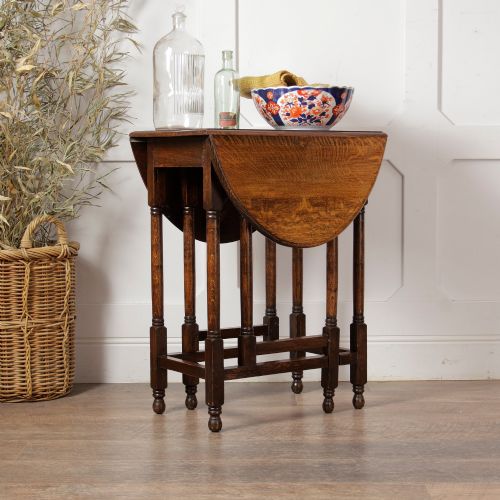


Small Gateleg Coffee Table
A small gateleg coffee table brings centuries of folding timber craft into modern rooms, offering surface space that tucks away at a moment's notice.
Small Gateleg Coffee Table
A small gateleg coffee table combines the hinged drop-leaf action of traditional gateleg furniture with the lower stature required for seating areas. These pieces draw from periods spanning the seventeenth century through to the nineteen thirties, though Edwardian and early twentieth century examples appear most frequently.
The form typically presents an oval top supported by swinging legs that pivot outwards to hold the leaves. Makers adapt these tables across various styles, including Jacobean Revival, Arts and Crafts, and Victorian designs, using the drop-leaf mechanism to shift between compact forms and extended surfaces.
Occasional tables and side tables frequently share this grouping due to their comparable proportions and drop-leaf formats. Buyers encounter both rectangular and oval profiles, constructed to serve as functional coffee tables within contemporary interiors.
Materials and construction methods
Construction relies heavily on timbers such as oak and mahogany, complemented by walnut, burr walnut, and wood inlay. Artisans utilise these hardwoods to build sturdy frames capable of supporting the pivoting gate mechanism without warping.
Detailing involves brass fittings, ceramic elements, and metal components alongside marquetry inlay. These additional materials provide structural reinforcement and decorative contrast on the drop leaves and tabletops.
Assessing quality in construction
Quality reveals itself in the precision of the hinge work and the stability of the swinging leg frames. Superior examples maintain a level surface across the drop leaves when fully extended, demonstrating careful timber selection that resists seasonal movement.
The refinement of the surface finish and the integration of decorative elements like wood inlay distinguish finer pieces. Construction depth is evident in how cleanly the gate supports lock into position beneath the leaves.
The Small Gateleg Coffee Table Glossary
- Gateleg table
- A table with hinged leaves supported by legs that swing outward like a gate. This design allows the surface area to expand or contract easily.
- Drop leaf
- A hinged section of a tabletop that can be folded down when not in use. It rests on a pivoting support to create an extended surface.
- Marquetry
- Decorative patterns formed by fitting together thin pieces of wood veneer. It creates intricate designs on tabletops and furniture surfaces.
- Sutherland table
- A narrow style of drop-leaf table featuring exceptionally thin leaves and slender legs. The leaves fold down almost vertically to occupy minimal floor space.
Small Gateleg Coffee Table: Frequently Asked Questions
What is a gateleg coffee table?
A gateleg coffee table is a low surface featuring hinged drop leaves supported by swinging legs. It adapts easily to changing space requirements in a room.
These pieces draw on historical folding table designs, scaled down to sit comfortably beside low seating while retaining their mechanical functionality.
How do I use a drop leaf table?
To use a drop leaf table, lift the hinged side sections and swing the supporting leg outward until it locks beneath the timber. This creates a stable extended surface for everyday use.
When floor space is limited, simply swing the support back inward and let the leaf drop down against the side of the base.
What woods are used for these tables?
Common timbers include oak and mahogany, alongside walnut and burr walnut. These sturdy woods provide the structural strength needed for moving joints and folding leaves.
Some examples incorporate wood inlay or decorative brass and metal fittings to accent the primary timber.
How do I identify Edwardian examples?
Edwardian tables often feature mahogany construction with slender supports, reflecting the lighter furniture fashions of the early twentieth century. These pieces frequently employ double spider leg configurations or refined drop leaves.
Comparing the timber finish and leg turning against known early twentieth century styles helps confirm the period.
Are these tables suitable for daily use?
These tables are designed for functional living spaces, providing surface area for daily items while remaining adaptable. The folding leaves make them practical for rooms requiring flexible layouts.
Routine care involves protecting the timber surface and ensuring the gate hinges move smoothly without strain.