


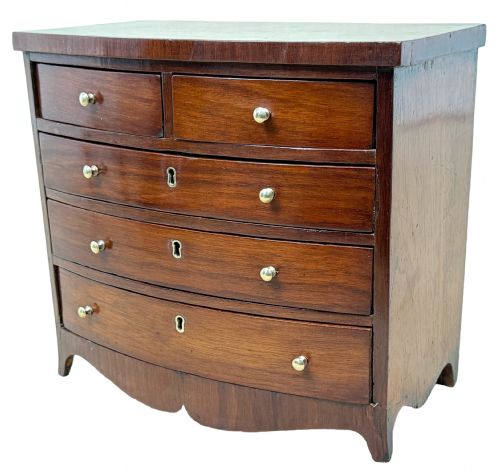
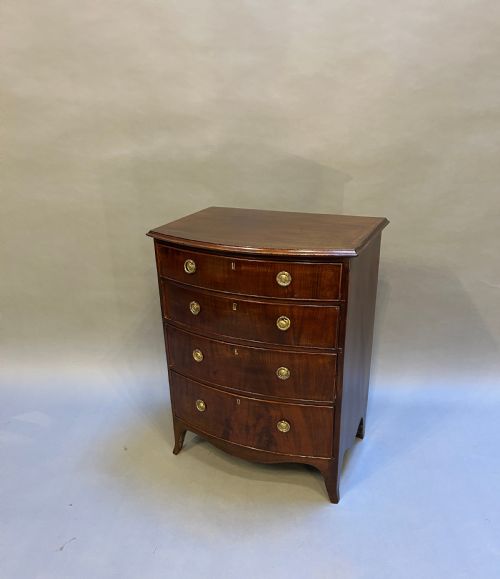
Small Bowfront Drawers
Small bowfront drawers combine compact proportions with a graceful curving facade, offering practical storage without dominating a room.
Small Bowfront Drawers
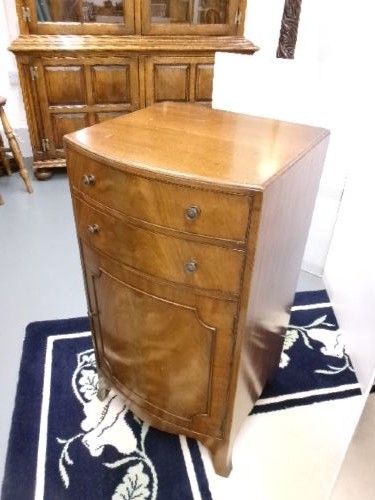
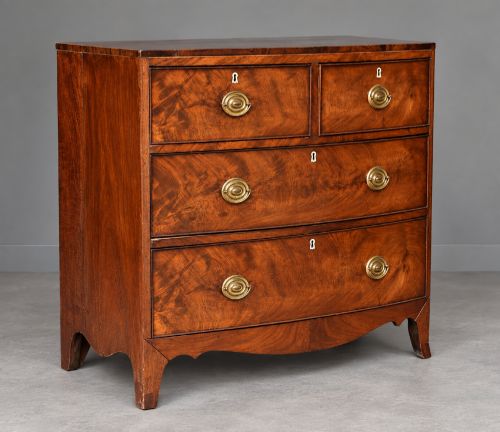
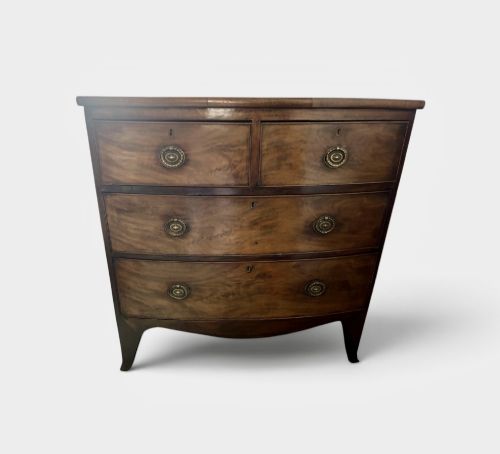
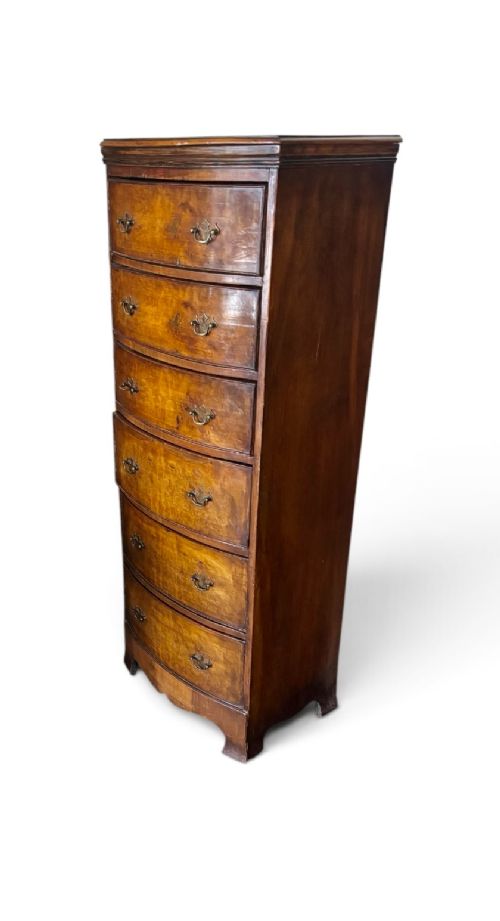
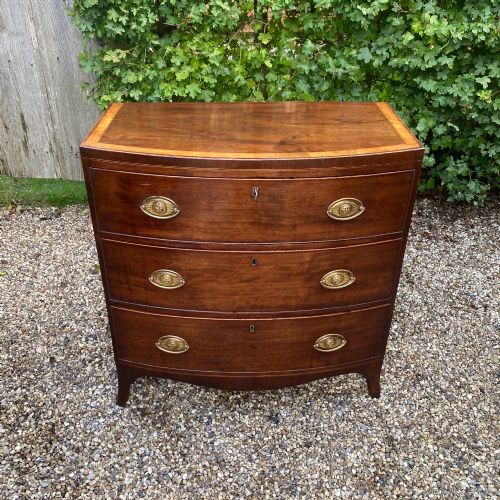
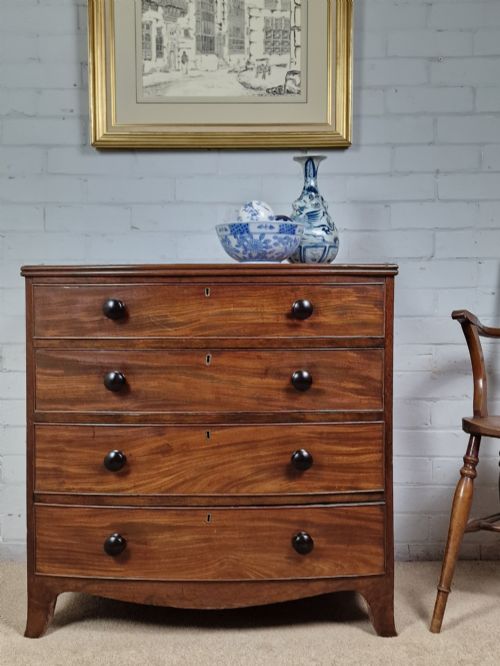
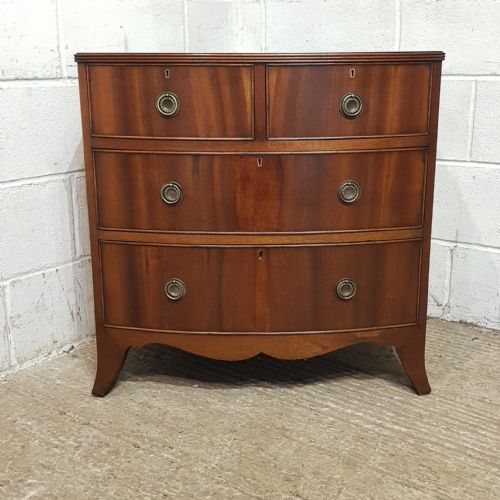
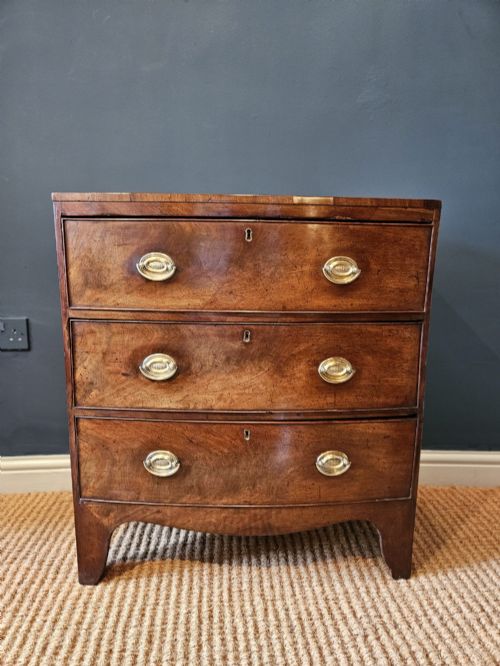
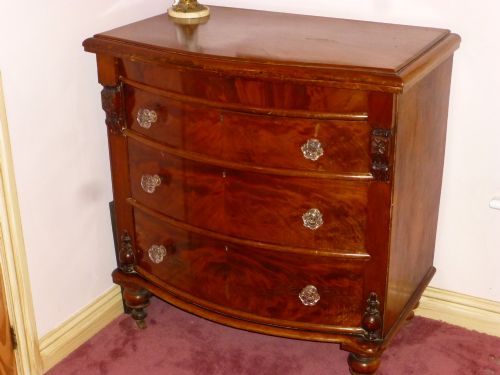
Small bowfront drawers appear frequently as compact chests of drawers, bedside cabinets, and diminutive miniatures dating from the Georgian, Regency, and Victorian periods. Buyers encounter these versatile pieces in various formats, ranging from full-sized chest variants to diminutive apprentice pieces and bedside tables.
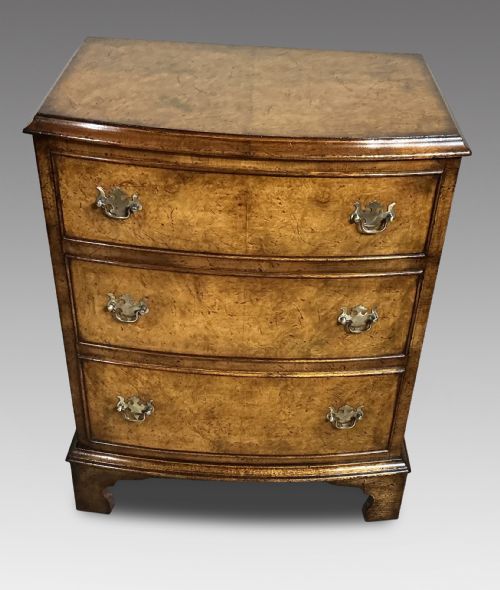
The aesthetic centres on the convex curve of the front facade, which softens the geometry of a room while maintaining deep storage capacity in the central drawers. Mahogany remains the predominant timber, though walnut, satinwood, and burr walnut appear regularly across 18th, 19th, and early 20th century examples.
Materials and construction
Cabinetmakers constructed the curved front facade using solid mahogany or walnut, often enhanced with figured veneers, satinwood banding, and delicate inlaid lines. The curved drawer fronts required skilled timber selection and precise carpentry to ensure smooth operation within the rounded framework.
Brass handles and escutcheons punctuate the polished timber surfaces, while secondary woods such as oak or pine line the interior drawer boxes. Surviving pieces frequently demonstrate period joinery techniques, including hand-cut dovetails on the drawer constructions.
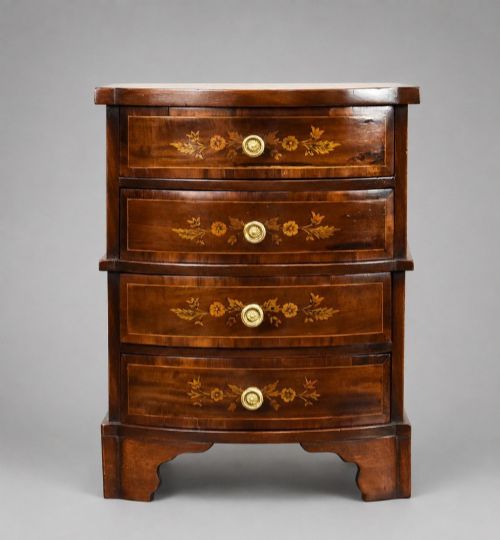
Tiny apprentice pieces allowed young woodworkers to prove their joinery skills by building miniature chests that could easily sit on a mantelpiece.
Judging quality and proportion
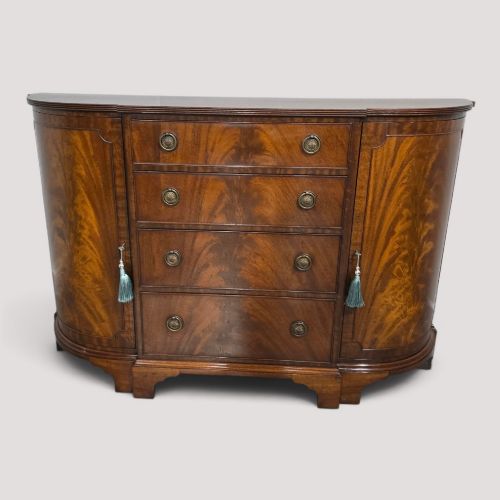
Quality reveals itself in the harmony of the proportions and the grain selection of the timber, particularly where figured mahogany or burr walnut wraps across the curved drawer fronts. Finer examples display meticulous attention to detail in the matching of veneer patterns and the integration of delicate inlaid stringing.
The integrity of the structural carcass and the crispness of the mouldings distinguish standard production from superior cabinet work. Original brass hardware and smoothly functioning drawers further elevate the standing of a piece.
Edwards and Roberts
The Small Bowfront Drawers Glossary
- Bowfront
- A convex curving front facade typical of cabinets and chests produced from the Georgian era onwards. This curved design softens the overall silhouette while maximising central storage depth.
- Brushing slide
- A pull-out shelf positioned above the top drawer, traditionally utilised for writing or grooming without opening the main drawers. It slides flush into the carcass when not in use.
- Caddy top
- A raised, moulded tabletop style with distinct stepped edges, frequently seen on 18th and early 19th century chests. This decorative edging frames the upper surface of the cabinet.
- Tallboy
- A tall chest of drawers constructed in two stacked sections, combining generous vertical storage with a compact footprint. They appear in walnut and mahogany variants from the Georgian period into the 20th century.
- Apprentice piece
- A miniature piece of furniture created by a craftsman to demonstrate skill and secure admission to a trade guild. These scaled-down items replicate the exact joinery and proportions of full-sized furniture.
Small Bowfront Drawers: Frequently Asked Questions
Where should I place small bowfront drawers?
Their compact dimensions make these chests exceptionally versatile for hallways, living rooms, and bedrooms where floor space is limited. They function particularly well as bedside cabinets or alternative bedside tables.
The curved facade prevents sharp corners projecting into narrow walkways, allowing the furniture to sit comfortably against walls or within alcoves without obstructing movement.
How do I identify a Georgian bowfront chest?
Georgian examples typically feature rich, dense mahogany timber with a warm patina, hand-cut dovetailing on the drawer linings, and subtle proportions. Look for period characteristics such as bracket feet, cockbeading around the drawer edges, and original brass pull handles.
Later revival pieces often display machine-cut internal elements or lighter secondary woods, helping to distinguish 18th century work from 20th century interpretations.
What is the difference between a chest and a commode?
In British cabinet-making terminology, a chest of drawers primarily provides stacked storage drawers, whereas a commode often denotes a more decorative, French-influenced cabinet piece. Georgian and Regency pieces sometimes use the terms interchangeably for low, elegant drawer units.
Commodes in these listings frequently showcase finer satinwood veneers, marquetry, or half-round shapes intended for formal reception rooms rather than bedchambers.
How do I care for antique mahogany and walnut?
Maintain the timber by keeping pieces away from direct sunlight and away from sudden temperature fluctuations caused by radiators or fires. Regular dusting with a soft, dry cloth preserves the polished surface without building up residue.
Applying a traditional beeswax polish sparingly once or twice a year nourishes the grain and maintains the natural lustre of the aged wood.