


Slatted Book Stand
A slatted book stand is a sturdy companion for your volumes, offering both accessibility and handsome timber grain to any study.
Slatted Book Stand
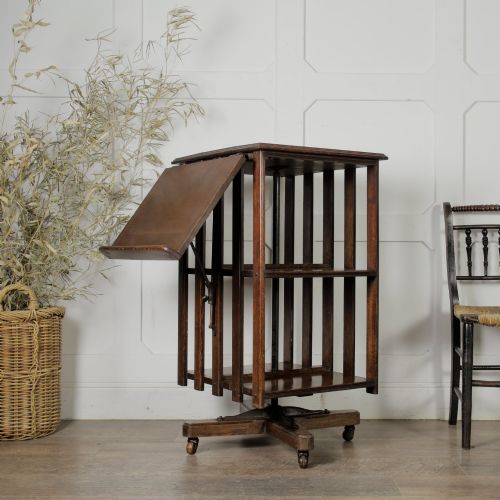
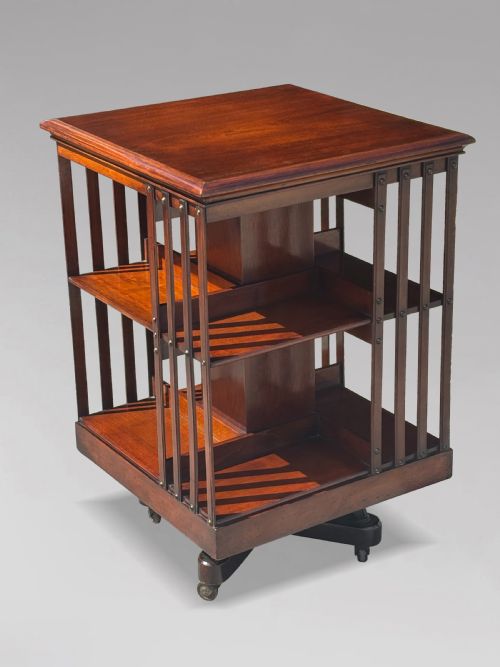
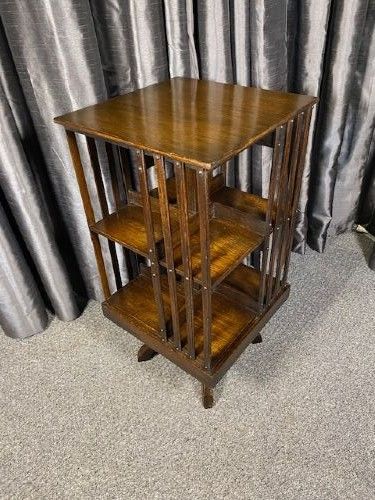
When you search for a slatted book stand, you encounter pieces designed to hold books and periodicals within easy reach, often taking the form of revolving bookcases, tier whatsits, and lecterns. The versions you are most likely to meet on this page hail from the Edwardian period and the nineteenth century, constructed with practical household utility in mind.
These items bring together functional storage and period craftsmanship, appearing in timber forms that suit both studies and libraries. The selection balances revolving table models with floor-standing iterations in oak and mahogany.
Makers of the era designed these stands to sit beside armchairs or on desks, relying on slatted partitions to keep volumes upright and visible. The resulting pieces reflect the domestic habits of early twentieth-century and Victorian homes without unnecessary ornamentation.
How they were made
The construction of these pieces relies primarily on solid oak and mahogany, selected for their durability and rich grain patterns. Workshops employed traditional joinery techniques to build stable frames capable of supporting heavy rows of volumes.
Metal components such as cast iron and brass appear in internal revolving mechanisms and supportive fittings, ensuring smooth rotation where applicable. Secondary timbers like pine occasionally form internal partitions or backing boards out of sight.
Finishers applied natural waxes and oils to seal the wood, highlighting the figuring in the mahogany and the characteristic medullary rays of quarter-sawn oak. Every joint was fitted by hand to withstand daily domestic handling.
Listings feature woods including oak, mahogany, teak, and pine, combined with brass and cast iron fittings.
What varies in quality
Quality in these stands rests upon the density of the timber selection and the precision of the joinery rather than decorative excess. Finer examples utilise heavier cuts of quarter-sawn oak or figured mahogany that hold their structure without warping over decades of use.
The sophistication of the internal mechanism dictates the performance of revolving models, where superior engineering ensures a balanced, silent spin. Lesser pieces may exhibit slight play in the spindle or simpler lap joints that lack the resilience of dovetail or mortise construction.
Heals
The Slatted Book Stand Glossary
- Revolving bookcase
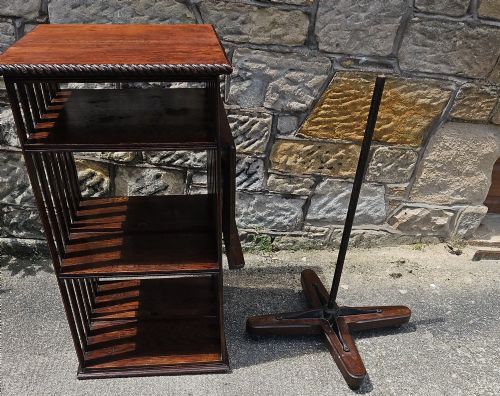
- A freestanding bookstand mounted on a concealed pivot and cross-base, allowing access to volumes from all sides. This form became popular in late Victorian and Edwardian studies for holding reference books.
- Quarter-sawn
- A method of milling timber where the log is cut at right angles to the growth rings, producing a stable board with distinct figuring. This cut was favoured for high-quality oak furniture.
- Canterbury
- A low stand featuring slatted partitions traditionally used for holding sheet music, books, or periodicals. Metamorphic versions incorporate folding actions or adjustable components.
- Lectern
- An angled reading stand designed to hold a book at a comfortable height for a standing reader. These often incorporate supportive ledges to prevent volumes from slipping.
- Whatnot
- An open set of multi-tiered shelves used for displaying or storing books and ornaments. The form evolved during the nineteenth century into robust multi-tier configurations.
Slatted Book Stand: Frequently Asked Questions
What is a slatted book stand?
A slatted book stand is a piece of furniture designed to hold books upright using open wooden bars, commonly seen in revolving bookcase and lectern formats.
These items were built to keep working volumes visible and accessible in studies, drawing rooms, and offices during the Victorian and Edwardian eras.
How do revolving bookstands work?
Revolving bookstands sit upon a hidden internal pivot and a weighted cross-base, which allows the upper tiers to spin freely.
This mechanism enables a reader to access multiple shelves of books from a single seated position without moving the heavy furniture.
Where were these stands used?
These pieces found their place beside reading desks, next to armchairs, or upon library tables in late nineteenth and early twentieth-century homes.
Their compact footprints made them ideal for keeping frequently referenced texts close at hand in domestic interiors.
How do I care for antique oak?
Antique oak benefits from occasional applications of natural beeswax to nourish the timber and protect the grain from drying out.
Avoid placing these stands in direct sunlight or near heat sources to prevent the solid wood from splitting or warping over time.