



Silvered Pewter Candle Holder
These silvered pewter candle holder examples combine metallic sheen with sculptural form, offering a distinctive domestic light source.
Silvered Pewter Candle Holder
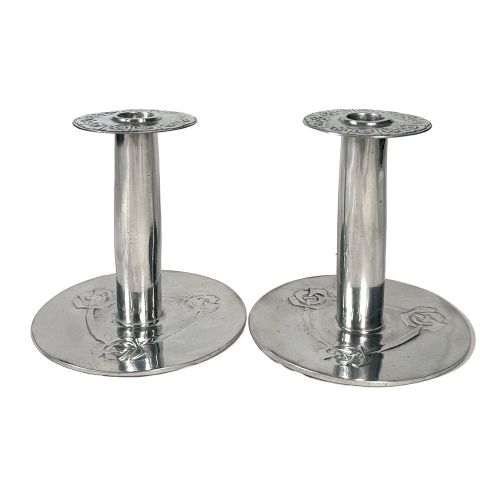
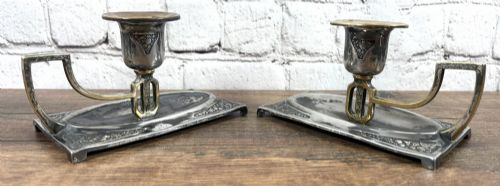
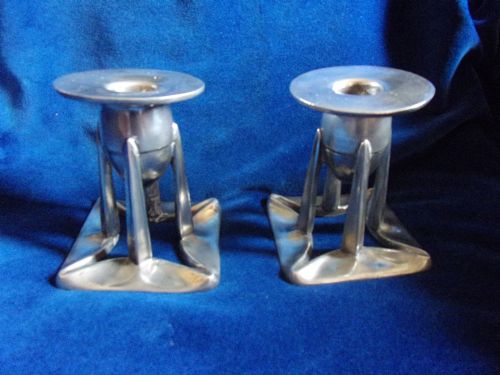
A silvered pewter candle holder takes the form of candlesticks, wall sconces, and candelabra, shaped predominantly in the nineteenth century and the early twentieth century. You are most likely to meet pairs designed in the Art Nouveau and Arts and Crafts styles, alongside Victorian Rococo Revival pieces.
Makers fashioned these objects from metal alloys, applying silvering to the surface to catch the light. The designs range from simple geometric quatrefoil cross shapes to elaborate figural candlesticks depicting maidens.
How they were made
Craftsmen cast pewter and electroplated metal into moulds, sometimes incorporating brass elements to construct the structural body of the candle holder. Surface decoration frequently involved applied silvering to give the base metal a brighter, reflective finish.
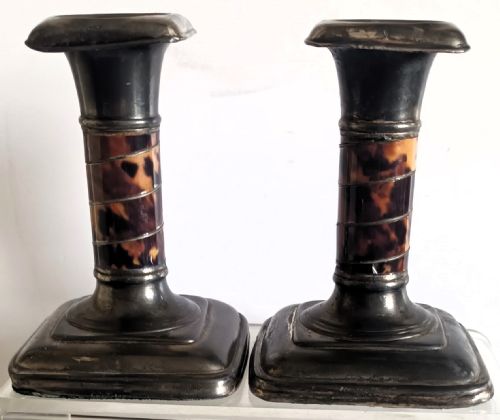
Certain workshops integrated contrasting inlays such as tortoiseshell or enamel panels directly into the pewter framework. This combination of cast metal and decorative detail required careful assembly by period metalworkers.
Silvered Pewter Candle Holder Retail Price Guide 2026
Typical asking prices for silvered pewter candle holder among the pieces listed under this phrase on Sellingantiques today, from the lower quarter to the upper quarter. They describe what is for sale here now, not the wider market.
Listings feature items spanning the nineteenth century, nineteen hundred, and nineteen twenty, utilising pewter, brass, tortoiseshell, and enamel.
What varies in quality
The standard of a silvered pewter candle holder rests upon the crispness of the cast ornamentation and the survival of the original surface finish. Pieces produced by recognised designers display finer sculptural definition in motifs like floral tendrils and figural elements.
The integrity of the applied silvering and the secure fitting of mixed materials such as enamel or tortoiseshell determine the overall excellence of the construction. Simpler production runs exhibit less intricate detailing and broader casting lines.
WMF·Archibald Knox·Liberty & Co·Alexandre Clerget
The Silvered Pewter Candle Holder Glossary
- Pewter
- A malleable metal alloy consisting primarily of tin, used widely for domestic tableware and decorative objects. It accepts casting and patination readily.
- Silvered pewter
- Pewter that has received a thin coating of silver to enhance its reflective properties. This finish provides a bright metallic appearance while utilising a less costly base metal.
- Art Nouveau
- A decorative art style characterised by undulating asymmetrical lines, whiplash curves, and floral motifs. It flourished around nineteen hundred.
- Arts and Crafts
- A design movement emphasising handcraftsmanship and simple vernacular forms. It reacted against mass production by valuing traditional metalworking techniques.
- Candelabra
- A branched candlestick holding multiple tapers on a single base. These branch structures require balanced weight distribution to remain stable.
Silvered Pewter Candle Holder: Frequently Asked Questions
What periods do these holders come from?
The pieces span the nineteenth century and the early twentieth century, with notable concentrations around nineteen hundred. Styles range from Victorian Rococo Revival through to Art Nouveau and Arts and Crafts.
Design influences shift from ornate nineteenth-century revivalism toward the organic, flowing lines characteristic of nineteen hundred production.
How were silvered pewter holders used?
Households utilised these items to hold wax candles for interior illumination in parlours and dining rooms. Pairs functioned symmetrically on mantelpieces and tabletops, while wall sconces provided fixed bracket lighting.
They served both a practical lighting function and a decorative role within period domestic interiors.
How do I tell Art Nouveau from Victorian styles?
Art Nouveau examples rely on whiplash curves, stylized plant forms, and flowing asymmetrical silhouettes. They frequently feature maiden figures or organic motifs characteristic of nineteen hundred design.
Victorian pieces draw on earlier revival idioms, displaying heavier scrollwork and traditional Rococo ornamentation rather than fluid linear abstraction.
What materials accompany the pewter?
Makers combined pewter with brass, electroplated metal, and applied silvering to create varied surface textures. Some workshops added enamel panels or tortoiseshell inlays to enrich the visual contrast.
These secondary materials highlight the decorative ambitions of specific design movements like Arts and Crafts.