


Silver Waist Clasp
These silver waist clasp examples are decorative Victorian and Edwardian fasteners designed to anchor and ornament a belt.
What silver waist clasp pieces are
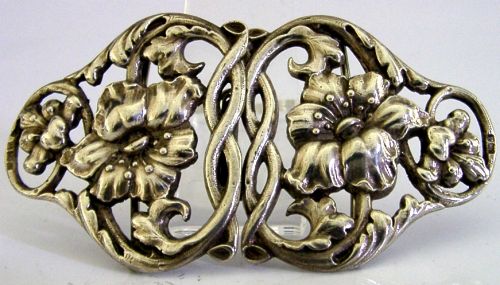
A silver waist clasp serves as both a functional belt fastener and an ornamental accessory for period costume. Buyers searching for a silver waist clasp encounter Victorian and Edwardian examples that reflect the shifting tastes of the nineteenth and early twentieth centuries.
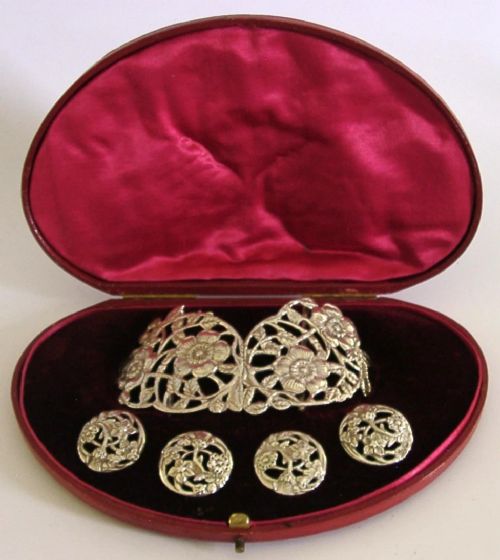
The surviving pieces on this page include belt buckles, matched buttons and buckle sets, and military-style waist belt clasps. These items bridge domestic dress accessories and uniform fittings, spanning the Victorian era, the Edwardian period, and French Empire styles.
How they were made
Makers utilised sterling silver and silver gilt, shaping the metal through casting and hand-finishing techniques. Some pieces incorporate backing materials such as velvet and leatherette to support the metalwork within fitted cases.
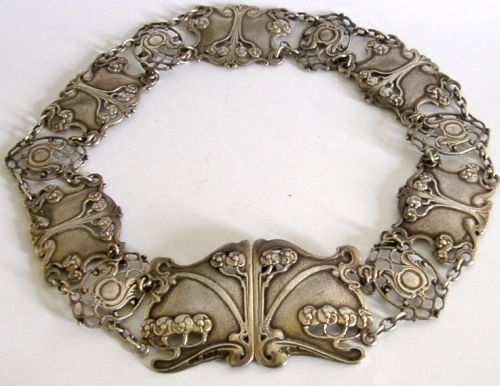
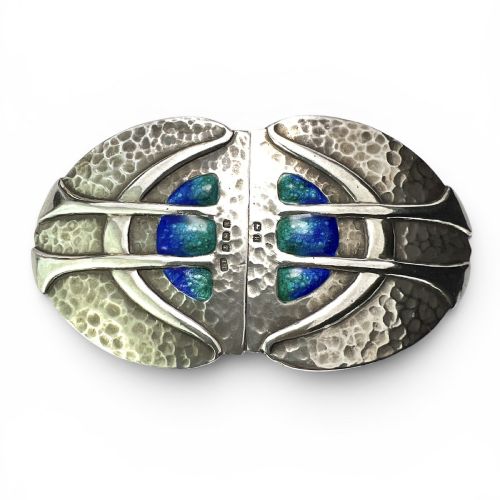
Art Nouveau designs display flowing, organic contours typical of turn-of-the-century metalworking, while Victorian and Napoleonic pieces rely on distinct regional casting methods and heavy gauge metal.
Retail Price Guide 2026
Typical UK retail prices for silver waist clasp, calculated from the Sellingantiques database of over a million retail prices indexed since 2003. This retail price guide relies exclusively on Sellingantiques data; no external sources or auction records are used, so the figures do not describe the wider market.
Current listings span the Victorian and Edwardian periods, utilising sterling silver, silver gilt, velvet, and leatherette.
What varies in quality
The distinction between standard production items and superior examples lies in the crispness of the cast relief and the depth of the hand-chasing. Pieces that retain their original gilding or form part of an intact cased set with velvet and leatherette linings represent higher tiers of craftsmanship.
Condition and completeness dictate the standing of a piece within the range, particularly where matched button sets accompany the main buckle. Finer examples show minimal wear to the high points of the silver decoration and maintain the structural integrity of the clasp mechanism.
The Silver Waist Clasp Glossary
- Sterling silver
- A standard alloy of silver containing 92.5 percent pure silver by mass and 7.5 percent other metals, usually copper. This composition provides the durability required for functional dress accessories.
- Silver gilt
- Silver objects that have been coated with a thin layer of gold over the base metal. This technique offers the rich appearance of solid gold while utilising silver beneath.
- Art Nouveau
- An international style of art and architecture that peaked in popularity around 1900. It is characterised by flowing, asymmetrical lines inspired by natural forms such as plants and flowers.
- Leatherette
- A form of imitation leather made by covering a fabric base with plastic or resin. It frequently appears as the protective lining material in period presentation cases.
Frequently Asked Questions
What periods do these clasps come from?
The available evidence points to the nineteenth century, including Victorian and Edwardian eras, alongside French Empire influences.
Dates span from around 1800 up to the early years of the 1900s.
How were these clasps used originally?
These pieces functioned as decorative fastenings for waist belts on period garments and formal attire.
Some examples formed part of matched sets that included coordinating buttons for complete dress coordination.
What materials are used in these items?
Makers constructed these pieces primarily from sterling silver, solid silver gilt, and standard silver.
Cases and mountings occasionally incorporate textiles like velvet and leatherette.
How do I identify an Art Nouveau clasp?
Art Nouveau examples from around 1900 feature distinct organic motifs and flowing, sinuous lines.
Floral patterns, such as the English rose, often define the cast relief on these pieces.