



Silver Serving Dish Lid
A silver serving dish lid brings a touch of period elegance to the dining table, sealing heat within classic tureens and entree dishes.
Silver Serving Dish Lid
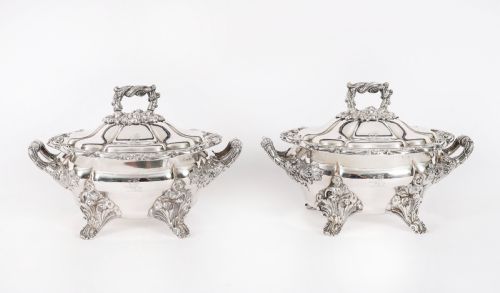
When searching for a silver serving dish lid, buyers typically encounter pieces designed to fit utilitarian tableware such as entree dishes, sauce tureens, and warming dishes. These covers frequently appear in rectangular and oval forms alongside matching vessels from the Georgian, Victorian, and Edwardian periods.
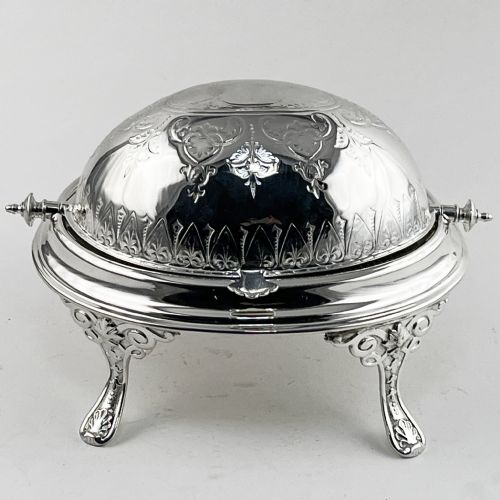
The selection ranges from simple domestic dining pieces to substantial revolving lidded butter dishes and double rollover designs. Many examples originate from the nineteenth and early twentieth centuries, reflecting formal dining habits of past decades.
Origin and period styles dictate the precise shape of the lid, whether styled in the restrained manner of the Regency era or the cleaner geometric lines associated with Art Deco tableware. Solid silver items exist alongside a substantial number of plated variants.
Materials and construction methods
Many items recorded here utilise silver plate and electroplated nickel silver over a base metal, while earlier examples rely on Old Sheffield Plate where silver is fused to copper. Solid silver constructions appear less frequently among the listed covers compared to plated versions.
Craftsmen shaped these covers through hammering and pressing techniques before applying cast handles, finials, or decorative crests to the top surface. Interior surfaces occasionally incorporate fitted wooden elements or glass inserts depending on the specific serving function.
Listings feature items from the Georgian, Victorian, and Edwardian eras, spanning Old Sheffield Plate and silver plate over copper and nickel.
Distinctions in quality and execution
Superior examples display crisp casting on handles and finials, with heavier gauges of metal providing a substantial weight when lifted. Lesser pieces often exhibit thinner plating that shows the underlying copper or nickel base through years of polishing.
The refinement of applied decorative crests and the smoothness of the revolving mechanism in double rollover designs separate standard utilitarian ware from superior workshop output.
Hamilton and Inches·Daniel and Arter·Walker and Hall·Elkington·Matthew Linwood·William Hutton and Sons·Cresswick·Christofle·Gallia·Tiffany and Co
The Silver Serving Dish Lid Glossary
- Old Sheffield Plate
- An early method of fusing a thin sheet of silver onto a thicker copper base before rolling them together into sheets. This technique predates modern electroplating.
- Entree Dish
- A shallow vessel with a removable lid used for serving side dishes or main courses at the table. These often feature rectangular or oval outlines.
- Sauce Tureen
- A small deep container equipped with a lid and handles, intended for holding gravies and sauces during formal meals.
- Electroplated Nickel Silver
- A base alloy of copper, nickel, and zinc coated with a thin layer of silver using an electrical current. This process became widespread during the Victorian era.
Silver Serving Dish Lid: Frequently Asked Questions
What is a silver serving dish lid used for?
These covers kept food warm during long formal meals by trapping heat inside matching tureens, entree dishes, and warming vessels.
They also protected the contents from airborne dust and added a decorative element to the dining table arrangement.
How do I identify Old Sheffield Plate?
Old Sheffield Plate pieces often reveal a faint copper tint along exposed edges where the outer silver layer has worn thin through centuries of use.
Items made with this technique typically date from the Georgian era or the early nineteenth century.
What is an entree dish lid?
An entree dish lid is the matching cover for a shallow rectangular or oval serving container used during multi-course dinners.
These lids frequently include removable handles that allowed the cover to double as an additional serving dish when inverted.
How should I clean antique silver plate?
Clean plated items gently with a specialist silver cloth or a mild non-abrasive cream to preserve the thin metallic layer on the surface.
Avoid aggressive scrubbing, which can wear away the silver plating and expose the base metal underneath.