
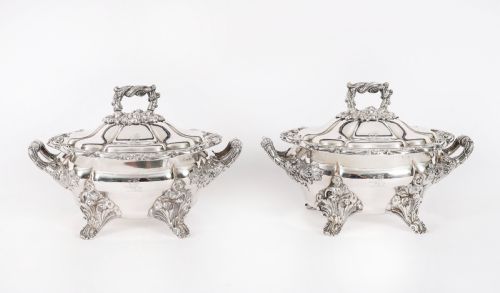
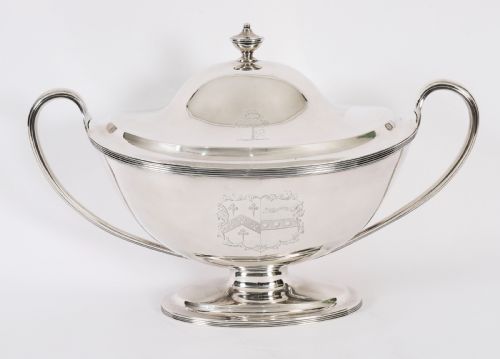


19th Century Silver Tureen
These 19th century silver tureen pieces are formal serving vessels designed for grand dining tables, combining utility with distinct period craftsmanship.
19th Century Silver Tureen
A 19th century silver tureen is a heavy serving vessel meant for soups, sauces, or warming dishes at the dining table. The pieces found here span the Regency, George III, and Victorian eras, taking the form of tureens, entree dishes, warming dishes, and porcelain supper sets.
Most examples met on this page are silver plated or fashioned from Old Sheffield plate rather than solid sterling silver. They appear as oval lidded sauce tureens, large soup tureens, and twin-handled punch bowls or serving dishes.
How these tureens were produced
Makers utilised sterling silver, silver plate, electroplated nickel silver, and copper, often pairing metalwork with porcelain and glass. Old Sheffield plate involved fusing a thin layer of silver to a thicker copper core, a method visible in early nineteenth-century pieces.
Later nineteenth-century items frequently employed electroplating over nickel silver, allowing manufacturers to coat complex stamped and cast metal forms uniformly. Workshops also shaped porcelain into specialised components for supper sets.
Some nineteenth-century diners required rotating porcelain supper sets simply to avoid reaching across the table for a vegetable.
What sets individual pieces apart
The standard of a tureen rests on the crispness of its cast handles, feet, and decorative borders. Pieces showing hand-raised silver or finely detailed Old Sheffield plate stand apart from mass-produced items.
Attribution to documented makers and silversmiths elevates a piece. The presence of clear hallmarks, maker marks, or original crests and ladles distinguishes finer examples from unmarked work.
William Bennett·Daniel and Arter·Elkington·Matthew Linwood·William Hutton and Sons·Cresswick·Dan Holy·Birchall and Hayne·Coalport·Mappin Bros
The 19th Century Silver Tureen Glossary
- Old Sheffield plate
- A composite material made by fusing a sheet of silver to a copper ingot, developed in the eighteenth century and common in early nineteenth-century tureens. It often reveals a thin copper edge where the metals meet.
- Electroplated nickel silver
- A base metal alloy of copper, nickel, and zinc coated with a layer of silver using an electrical current. This technique became widespread during the Victorian era for serving dishes.
- Entree dish
- A shallow covered serving vessel designed for holding individual courses at the dinner table. They frequently appear in matched pairs or sets of four.
- Soup tureen
- A large, deep vessel with a lid and handles, used for serving soup at the centre of the table. They often rest on fixed or separate matching bases.
- Supper set
- A complex arrangement of porcelain dishes, often fitted with a rotating lazy susan for communal dining. These pieces combine ceramic containers with metal warming stands.
19th Century Silver Tureen: Frequently Asked Questions
What is the difference between a tureen and an entree dish?
A tureen is generally deep and bulbous, designed to hold liquids like soups or sauces, complete with a fitted lid and sturdy handles. An entree dish is shallower and wider, intended for solid courses and meats.
Both forms belong to formal nineteenth-century dining services but served distinct functions on the table. Tureens sat centrally for serving portions out, while entree dishes often flanked them or were placed directly before guests.
How do I care for a silver plated tureen?
These pieces require gentle cleaning with non-abrasive silver polishes to preserve the plating over the base metal. Avoid harsh scrubbing that can wear away thin silver layers, particularly on Old Sheffield plate.
Store them in dry conditions and handle them by their main bodies rather than relying solely on soldered handles. Regular dusting prevents tarnish build-up without needing frequent polishing.
Can I use these tureens for serving food today?
Many silver and silver-plated tureens remain structurally sound for serving dry foods or warmed dishes. However, old silver plate and soldered joints require hand washing rather than dishwasher use.
For pieces containing porcelain liners or glass elements, check for hairline cracks before filling them. Modern acidic foods should not be left in contact with antique metal surfaces for extended periods.
How do I identify a Regency period tureen?
Regency tureens usually display classical Revival motifs, such as neoclassical urn shapes, reeded borders, and paw feet. They frequently date from around eighteen hundred to eighteen twenty.
Look for the characteristic warmth of Old Sheffield plate or heavy sterling silver construction, accompanied by crisp hand-chased detailing rather than machine stamping.