
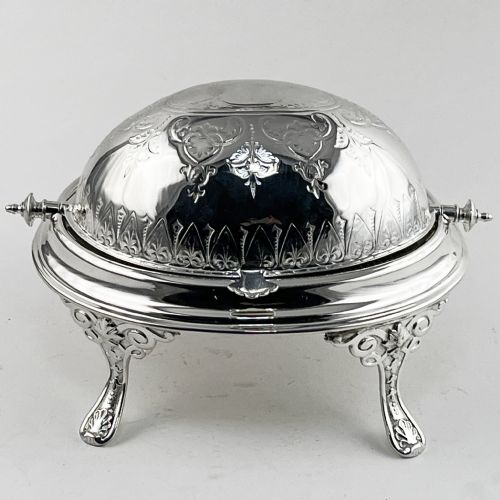


Silver Plated Lidded Bowl
A silver plated lidded bowl brings substantial table presence without the upkeep of solid silver, offering practical elegance for serving.
Silver Plated Lidded Bowl
A silver plated lidded bowl encompasses serving dishes, entrée dishes, sauce tureens, punch bowls, and preserve dishes designed for formal dining tables. These pieces span the nineteenth century through the Art Deco period, including Victorian and Edwardian examples alongside earlier Old Sheffield Plate.
The selection ranges from small butter dishes and sauce tureens to large two-handled punch bowls and covered serving dishes. Buyers encounter various forms, such as revolving lidded mechanisms, crested vessels, and paired tureens.
Origins include British workshops, Scottish makers, and French manufacturers from the 1890s, 1900s, 1910s, and 1930s. The assortment reflects formal dining traditions across more than a century of domestic silver plate production.
Materials and construction methods
Base metals such as copper, nickel silver, and electroplated nickel silver form the structural body beneath the surface plating. Old Sheffield Plate combines a fused layer of silver onto a copper core, a method developed in the eighteenth century.
Electroplated nickel silver, commonly abbreviated as EPNS, utilises an electrical current to bond a thin layer of silver onto a nickel alloy substrate. Additional elements like cut glass bodies and cast handles appear on specific serving dishes.
A revolving lidded butter dish lets you slide the cover away magically with one finger mid-breakfast.
Factors of distinction
The weight and gauge of the underlying metal dictate the structural rigidity of the dish and its lid. Substantial construction prevents warping and maintains the integrity of hinged or revolving mechanisms.
The crispness of cast decorative borders, applied crests, and handles distinguishes standard production from finer workmanship. Plating thickness and the preservation of the underlying metal across high-contact surfaces complete the evaluation.
Hamilton and Inches·Daniel and Arter·Christofle·Gallia
The Silver Plated Lidded Bowl Glossary
- Old Sheffield Plate
- A composite material made by fusing a thin sheet of silver to a copper ingot before rolling into sheets. This early technique often reveals traces of copper along cut edges.
- EPNS
- An abbreviation for electroplated nickel silver, denoting a base metal coated with silver using an electrolytic process. It became standard industry practice from the mid-nineteenth century onward.
- Entrée dish
- A covered serving vessel traditionally used for the course served before the main meal. Many feature removable handles that allow the base to function as two separate open dishes.
- Tureen
- A deep, bowl-shaped vessel equipped with a lid and frequently handles, designed for serving soups, sauces, or vegetables. Sauce tureens represent smaller iterations intended for table condiments.
- Revolving lidded dish
- A specialised serveware form featuring a curved lid that rotates open beneath the body rather than lifting off. This mechanism allows easy access to butter or preserves during meals.
Silver Plated Lidded Bowl: Frequently Asked Questions
What is the difference between Old Sheffield Plate and EPNS?
Old Sheffield Plate involves mechanically fusing silver to a copper base through heat and pressure. This older method contrasts with EPNS, which uses electricity to deposit silver onto a nickel silver alloy.
Items made in Old Sheffield Plate often display subtle copper bleeding where the underlying metal shows through wear. EPNS pieces typically reveal a greyish nickel tone beneath worn silver rather than warm copper.
How were lidded serving dishes used historically?
These covered vessels kept food warm at the dining table before individual plating became common. Servants brought them from the kitchen to the sideboard or dining table for guests to help themselves.
Revolving styles allowed diners to access butter or preserves without removing and placing a lid elsewhere on a crowded table. Sauce tureens remained stationary on the table for condiments accompanying specific courses.
How do I date an antique silver plated bowl?
Stylistic markers provide the clearest indication of date, ranging from Regency and Victorian ornamentation to Edwardian elegance and geometric Art Deco lines. Manufacturing marks and the choice of base metal also assist in establishing chronology.
Old Sheffield Plate points toward earlier nineteenth-century production, while electroplating marks become prevalent from the Victorian era onward. Specific maker signatures help narrow the decade of manufacture.
Can these antique bowls still be used for serving food?
Many collectors continue to utilise silver plated bowls and tureens for formal dining and modern entertaining. Careful hand washing preserves the remaining silver layer against abrasive detergents.
Avoiding harsh scouring pads ensures the underlying copper or nickel alloy remains protected beneath the plate. Regular polishing maintains the bright finish appropriate for display and service.