


Silver Plate Food Cover
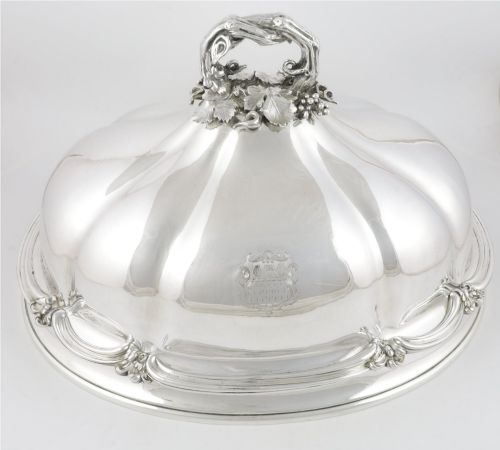
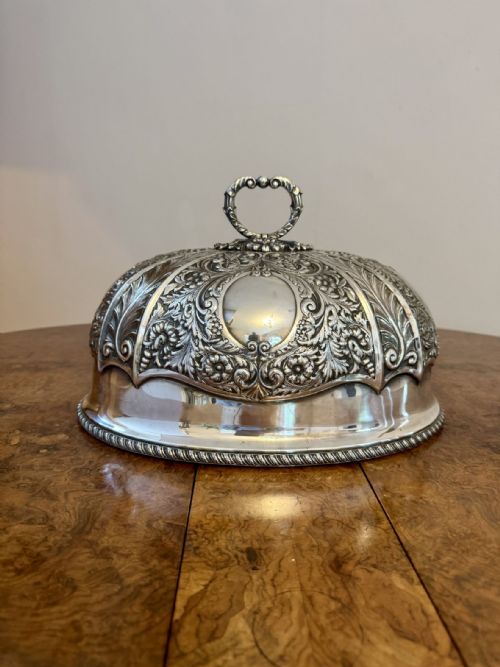
These silver plate food cover pieces keep joints warm at table, combining practical utility with grand dining room display.

Silver Plate Food Cover
A silver plate food cover serves to protect joints, meat, and dishes at the dining table while preserving heat. The search phrase covers a range of domestic serving wares designed for grand dining.
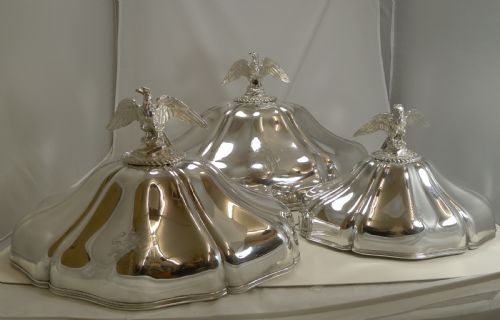
The pieces appearing here include large meat domes, game covers, warming dishes, and rectangular or oval entree dishes. They span periods from the Georgian era through to the Edwardian period.
Makers and workshops from both English and French origins produced these items in various scales, from small single-dish covers to grand graduated sets.
Materials and construction methods
Many early examples utilise Old Sheffield Plate, a process fusing a thin sheet of silver onto a copper base metal core. This technique often reveals hints of copper showing through along the high points of edges and rims.
Later Victorian and Edwardian manufacturing shifted towards EPNS, meaning electroplated nickel silver, where a layer of silver is deposited onto a base metal via an electrical current.
Makers shaped these metals into domes, cloches, and dish covers, frequently incorporating applied borders, cast handles, and engraved crests or feather designs.
Listings feature items spanning the Georgian, Regency, William IV, Victorian, and Edwardian periods, utilising Old Sheffield Plate, EPNS, and copper.
Distinctions in grade and execution
Quality rests in the weight of the metal, the crispness of chased or engraved decoration, and the substance of the handle. Superior pieces feel substantial in the hand and maintain balance when lifted.
The method of plating creates a distinction, with Old Sheffield Plate prized for its fused metal layers, whilst high-grade electroplate displays thick, even silver coverage over nickel silver or base metal.
Maker attribution also lifts a piece, as marked examples from renowned workshops command attention for their superior finishing and detailed craftsmanship.
Roberts Cadman·Henry Wilkinson·Mappin and Webb·Boulton·Dan Holy·Durand·Christofle·Atkin Brothers
The Silver Plate Food Cover Glossary
- Old Sheffield Plate
- An early method of fusing silver to a copper core before electroplating was invented. It results in a distinct dual-metal structure often showing copper beneath worn silver.
- EPNS
- Electroplated nickel silver, a common nineteenth-century technique for coating a base metal alloy with a layer of pure silver using electricity.
- Cloche
- A bell-shaped cover used to keep individual dishes or plates warm at the table.
- Entree dish
- A shallow serving vessel with a removable lid, used for serving courses before or alongside the main roast.
- Meat dome
- A large, high-domed cover designed specifically to fit over a platter holding a joint of meat or poultry.
Silver Plate Food Cover: Frequently Asked Questions
How do I clean my silver plate food cover?
Use a gentle, non-abrasive silver polish applied with a soft cloth to preserve the plating. Avoid harsh scrubbing that might wear through the silver layer, especially on older Old Sheffield Plate where the copper base metal could be exposed.
Rinse with warm soapy water and dry thoroughly with a soft lint-free cloth to maintain the shine.
Can I use these food covers for serving hot food today?
These pieces function well for modern dining tables to keep roasted joints or hot dishes warm during service. They retain heat effectively when warmed with hot water prior to placing them over food.
Take care with handling hot metal surfaces when removing the domes from dishes.
How do I distinguish Old Sheffield Plate from later silver plate?
Look closely at the edges and rims for any subtle pinkish or coppery hue shining through the silver layer. Old Sheffield Plate involves a fused sheet of silver and copper, whereas later electroplated items show a grey nickel base metal underneath worn areas.
Weight and manufacturing seams also provide clues to the age and production method.
What is the difference between a meat dome and an entree dish?
A meat dome is a tall, single cover designed to fit over a large platter holding a joint of meat or a turkey. An entree dish consists of a shallow base paired with a matching lid, meant for smaller side courses.
Entree dishes frequently appear in pairs or sets, while meat domes are usually standalone items.