

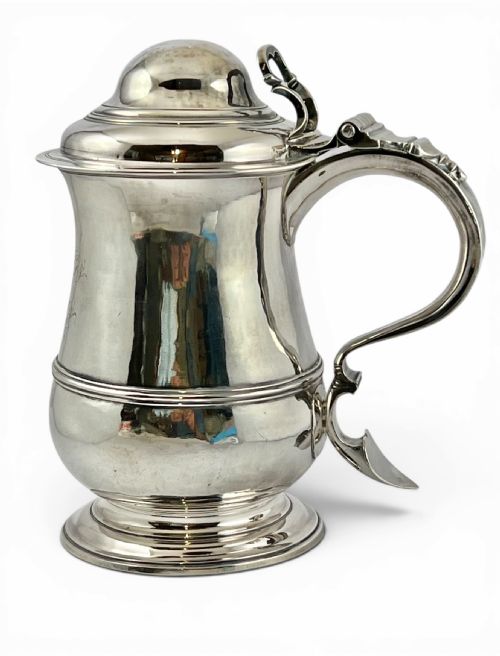


Silver Lidded Stein
A silver lidded stein brings substantial weight and period character to the table, uniting sturdy vessels with secure metal covers.
Silver Lidded Stein
When you search for a silver lidded stein, you encounter robust drinking vessels designed with hinged covers, often referred to interchangeably as tankards across various historical eras. These drinking vessels serve both practical function and display, appearing in forms ranging from compact pint measures to generous quart sizes.
The versions most frequently met on this page span the Georgian period, the 18th century, and the 19th century, alongside later revivals like the Queen Anne style. Makers constructed these pieces from sterling silver, silver plate, Old Sheffield plate, and electroplated nickel silver, sometimes combining metal mounts with glass bodies.
Certain examples incorporate clear glass bases or entire glass cylinders encased in silver mounts, while others rely entirely on heavy metal construction. The stylistic vocabulary draws heavily from Georgian and Victorian aesthetics, with plain cylindrical bodies or chased decoration defining the visual appeal.
Materials and construction methods
Silversmiths and metalworkers utilised solid sterling silver, copper-cored Old Sheffield plate, and later electroplated nickel silver to form the heavy bodies of these lidded vessels. Early examples employ traditional hammering and soldering techniques to raise the metal into sturdy cylindrical shapes.
Covers feature functional hinges thumbpieces designed for single-handed operation, attached securely to the handle. Glass bodies on mounted pieces utilise heavy-walled blown glass secured by tightly fitted silver collars and foot rims.
Listings feature pieces spanning the 18th century, Georgian period, 19th century, and Queen Anne Revival styles.
Distinguishing quality in lidded vessels
Quality rests upon the weight of the metal and the precision of the hinge mechanism connecting the lid to the body. Superior pieces maintain a balanced heft in the hand and a crispness in any chased or engraved decoration.
The integrity of the plating on silver-plated and Old Sheffield plate examples dictates the visual standard, where smooth surfaces without excessive base metal exposure show superior preservation.
The Silver Lidded Stein Glossary
- Tankard
- A tall, cylindrical drinking vessel with a single handle and a hinged lid. This form represents the primary object type associated with the search phrase.
- Old Sheffield Plate
- A composite material made by fusing a thin sheet of silver to a thicker copper base. This technique creates durable tableware characteristic of 18th-century production.
- Electroplated Nickel Silver
- A base metal alloy of copper, nickel, and zinc coated with a layer of pure silver through an electrolytic process. This method became common in the 19th century.
- Thumbpiece
- A small projection attached to the hinged lid of a tankard. It allows the drinker to lift the lid with the thumb of the hand holding the handle.
- Glass Bottom
- A clear glass base fitted to the bottom of a metal tankard. Tradition suggests this design allowed drinkers to keep track of their companions or potential threats.
Silver Lidded Stein: Frequently Asked Questions
What is a silver lidded stein?
A silver lidded stein is a robust drinking vessel featuring a secure metal cover attached by a hinge. These pieces function primarily as tankards for serving beverages.
Examples range from plain 18th-century Old Sheffield plate versions to decorative Victorian glass and silver combinations.
How were these vessels used historically?
These vessels served for consuming ales, beers, and other fermented drinks in homes, taverns, and banqueting halls. The hinged lid kept debris and insects out of the drink.
Larger quart sizes suited communal or heavy consumption, while pint versions served individual drinkers.
How do I care for a silver lidded vessel?
Care requires gentle cleaning with non-abrasive silver polishes to preserve the metallic finish without wearing down thin plating. Hand washing is essential to protect historical materials.
Store the vessel in a stable environment away from extreme humidity to prevent tarnishing and corrosion of underlying base metals.
How do I distinguish 18th-century from 19th-century pieces?
Eighteenth-century examples often display simpler hand-raised forms in solid silver or Old Sheffield plate with crisp joinery. Nineteenth-century pieces frequently utilise electroplating techniques and heavier Victorian ornamentation.
Maker marks, hallmarks, and manufacturing methods provide the primary clues for dating specific pieces accurately.