



Silver Enamel Spoon Set
A silver enamel spoon set brings together precious metal and colourful vitreous work, usually presented in a fitted presentation case.
Silver Enamel Spoon Set
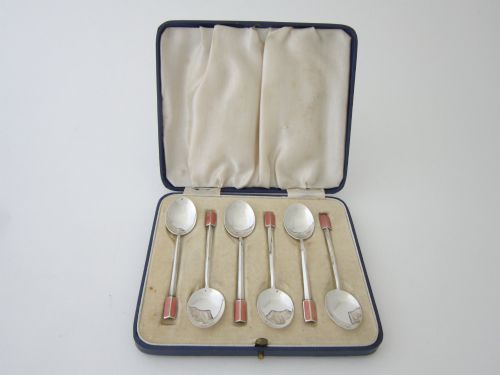
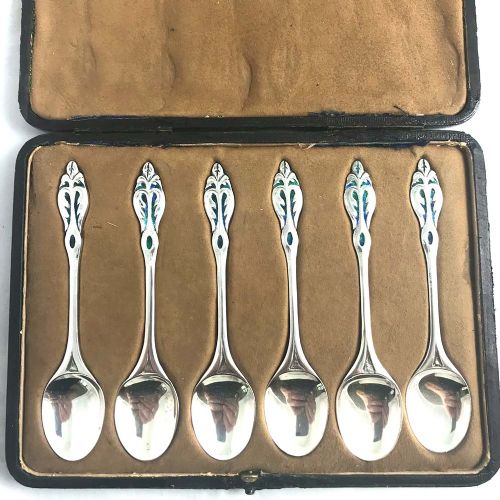
A silver enamel spoon set comprises matched collections of teaspoons, coffee spoons, or demitasse spoons, frequently discovered complete with their original fitted boxes lined in satin, velvet, or leatherette.
The most common versions encountered include Art Deco British flatware alongside Scandinavian and Russian workshop productions dating from the late nineteenth century through the mid-twentieth century.
Many examples are created for specific themes, incorporating polychrome heraldic motifs, botanical flowers, card suits, or guilloche rainbow colourways across the bowl backs and handles.
How they were made
Makers fashioned the base cutlery from sterling silver or silver gilt, often applying translucent or opaque vitreous enamel over engine-turned guilloche patterns to create shimmering light effects.
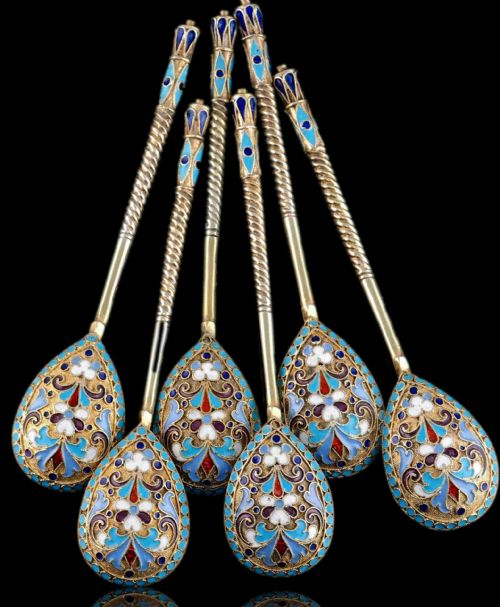
Russian pieces frequently utilised intricate cloisonné wirework soldered to the silver surface to form complex cellular compartments before firing coloured glass pastes.
Many English and Scandinavian spoons featured specialised terminal designs, including bean knops, seal tops, or handle decorations shaped like reindeer and floral emblems.
Listings feature items spanning the late nineteenth century through the mid-twentieth century, with a strong representation of Art Deco and regional European designs.
What varies in quality
The standard of a silver enamel spoon set depends heavily on the complexity of the enamelling technique, ranging from simple painted surfaces to precise guilloche engraving and multi-coloured cloisonné.
Completeness dictates value, as sets retaining their original signed presentation boxes with intact interior fabrics remain considerably more desirable to collectors than loose pieces.
The reputation of the silversmith or retailer, such as established Birmingham makers or Nordic design houses, elevates the standing of individual sets above standard commercial output.
Dmitrii Nikolaevich Nikolaev·David Andersen·Henry Clifford Davis·Walker and Hall·Simon Groth·Turner and Simpson·Barker Ellis Silver Co·Georg Jensen·Liberty and Co
The Silver Enamel Spoon Set Glossary
- Cloisonné
- An enamelling technique where thin metal wires are soldered to a metal base to create small partitions that are filled with coloured glass paste and fired. This method produces intricate cellular patterns common in Russian work.
- Guilloche
- A decorative mechanical engraving technique that etches precise repetitive geometric patterns into metal. When covered with translucent enamel, it creates a luminous wave effect.
- Silver Gilt
- Silver that has been coated with a thin layer of gold on its surface. This technique is also known as vermeil and frequently appears on interior spoon bowls.
- Basse Taille
- An enamelling method where the metal background is carved or engraved in low relief beneath translucent enamel. This allows light to reflect through the coloured glass at varying depths.
- Bean Knop
- A terminal shaped like a coffee bean found at the top of spoon handles. It is particularly characteristic of mid-century coffee spoon sets.
Silver Enamel Spoon Set: Frequently Asked Questions
What are silver enamel spoon sets?
These items are matched groups of small eating implements fashioned from silver and decorated with fused glass powder. They were predominantly produced as luxury tableware for tea and coffee service.
Most surviving examples are housed in original fitted presentation cases lined with soft fabrics. They reflect various design movements including Art Deco and Arts and Crafts.
How were these spoon sets used?
They were utilised primarily for stirring afternoon tea, demitasse coffee, or chocolate. Their decorative nature meant they often formed part of formal hospitality settings.
Many sets were given as presentation gifts, wedding presents, or souvenirs. Consequently, they survive in remarkably pristine condition inside their protective boxes.
How do I care for a cased set?
Store the box in a stable environment away from direct sunlight and damp conditions to protect the delicate enamel and fabric linings. Avoid abrasive cleaning agents that might scratch the vitreous glass or remove silver gilt layers.
Gentle dusting with a soft cloth is usually sufficient for maintenance. Polishing should be restricted strictly to un-enamelled silver sections using appropriate non-abrasive products.
How can I tell the period and origin?
Examine the hallmarks stamped on the reverse of the stems for assay office symbols, date letters, and maker marks. British pieces often feature standard town marks like Birmingham anchors or London leopards.
Foreign pieces, particularly from Russia or Scandinavia, carry specific regional silver standards and workshop signatures. Stylistic clues such as geometric Art Deco lines or naturalistic floral motifs also help date the manufacture.