




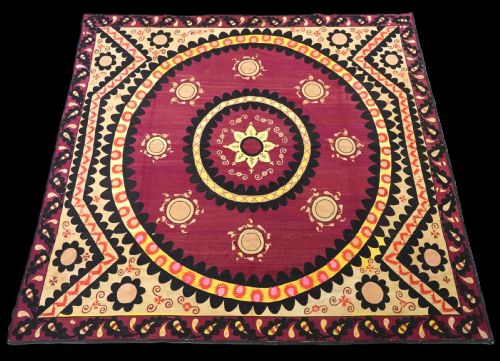

Silk Thread Suzani
A silk thread suzani brings rich Central Asian folk art into a room through vibrant hand embroidery.
Silk Thread Suzani
A silk thread suzani is a traditional embroidered hanging originating from Central Asian workshops and households, spanning the mid-nineteenth to the early twentieth century.
The pieces listed here showcase distinct regional styles including Uzbek, Bokhara, Tashkent, and Lakai work, presented in formats ranging from full work panels to smaller nim suzanis and prayer suzanis.
Buyers seeking these textiles find items that function primarily as wall hangings or decorative tapestries, embodying Central Asian traditional design through distinctive floral and geometric motifs.
How they were made
These textiles rely on fine silk thread embroidery meticulously worked onto ground fabrics composed of cotton, wool, or adras silk and cotton blends.
Artisans applied dense stitching to create both partial designs and fully embroidered surfaces, visible in examples described as full work or palak suzanis.
Silk Thread Suzani Retail Price Guide 2026
Typical asking prices for silk thread suzani among the pieces listed under this phrase on Sellingantiques today, from the lower quarter to the upper quarter. They describe what is for sale here now, not the wider market.
The listings show pieces spanning from the mid-nineteenth century to the early twentieth century, utilising silk, cotton, wool, and adras grounds.
What varies in quality
Quality rests in the density of the embroidery and the complexity of the design layout, distinguishing fully worked palak panels from simpler compositions.
The vibrancy of the palette and the integrity of the ground fabric, whether cotton, wool, or adras, define the visual impact of each piece.
The Silk Thread Suzani Glossary
- Suzani
- A traditional embroidered textile from Central Asia, usually used as a wall hanging or decorative tapestry. These pieces display intricate needlework executed in silk thread.
- Adras
- A traditional woven fabric made from a mixture of silk and cotton yarns. It serves as a sturdy and textured ground for embroidery.
- Palak
- A designation for a fully embroidered suzani where the ground fabric is almost entirely covered in dense stitching. This style represents a high level of needlework execution.
- Nim
- A term used to describe a half-size or smaller suzani format. These pieces offer a more compact option for interior display.
- Lakai
- A specific style of Central Asian embroidery associated with Lakai groups, known for distinct folk art patterns and energetic compositions.
Silk Thread Suzani: Frequently Asked Questions
How do I hang a suzani?
These textiles hang best when supported evenly across the top edge using a sleeve or discreet clips that distribute the weight without straining the historic fabric.
Direct sunlight should be avoided to protect the natural dyes in the silk threads from fading over time.
What is a prayer suzani?
A prayer suzani incorporates specific architectural or mihrab motifs into the embroidery design, traditionally referencing sacred spaces in Central Asian culture.
Such pieces function visually as striking wall art while retaining their distinctive traditional iconography.
How do I date a suzani?
Dating relies on examining the specific characteristics of the ground cloth, the types of silk threads used, and the style of the embroidery patterns.
Pieces from the nineteenth century often display distinct natural dye palettes and heavier textile foundations compared to later works.
Where were suzanis made?
Suzanis originate primarily from historical centres in Uzbekistan, including regions such as Bokhara and Tashkent, as well as nomadic and village communities.
Each region developed its own palette, stitch density, and decorative vocabulary passed down through generations.