


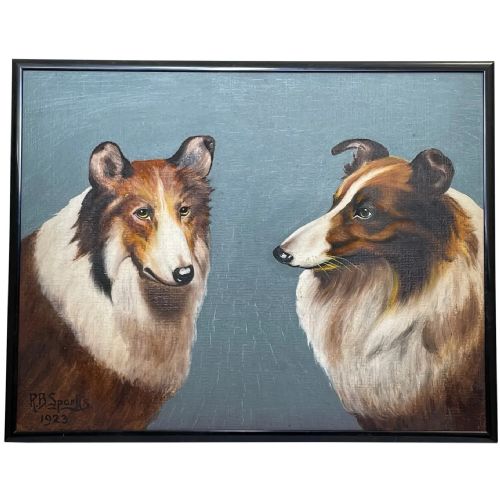
Signed Oil Painting Dog
A signed oil painting dog captures character on canvas, bringing historic canine companionship and sporting tradition into a room.
Signed Oil Painting Dog
When you search for a signed oil painting dog, you encounter works ranging from Victorian sporting scenes to interwar realist portraits. These canvases and panels record specific breeds, from collies and terriers to gun dogs and spaniels, set within landscapes, stables, or interiors. The selection spans the nineteenth century through to the mid-twentieth century, showing both named artists and indistinctly signed studies.
You meet Victorian examples alongside 1920 and 1940 pieces, reflecting shifting approaches to animal portraiture over generations. Some portray prized racing champions or working farm dogs, while others show companion animals resting beside their owners. The most frequent encounters on this page combine traditional British sporting art with detailed canine likenesses.
Materials and construction
These works are painted in oil pigments applied to canvas, wood panels, board, or tin plate, capturing fine textures in fur and fabric. Canvases are stretched over wooden frames, often accompanied by original wood or gilt frames finished with gold leaf. The interaction of oil mediums on these various supports allows for layered depth and tonal richness in the depiction of light and landscape.
Artists utilise brushwork ranging from tight, precise realism in portraiture to looser, expressive strokes in background landscapes. Panel paintings offer a smooth, stable ground for meticulous detail, whereas woven canvas provides a textured surface that holds heavier impasto. Gilt and wood frames complete the construction, frequently bearing the period marks of their makers.
Listings feature works spanning the 19th century, Victorian era, and the 1900 to 1940 decades.
Evaluating the work
Quality rests upon the artist's ability to render the anatomy, expression, and distinct personality of the animal with anatomical conviction. Superior pieces demonstrate confident brushwork in the rendering of fur texture and light, rather than relying on formulaic backgrounds or stiff postures. The integration of the subject within its natural setting, whether a pastoral landscape or a stable interior, separates accomplished works from standard decorative studies.
The preservation of the original paint surface and the character of the period frame influence the integrity of the piece. Works that retain their untouched varnish and show minimal overpainting hold greater visual clarity. Furthermore, a clearly documented signature or attribution connects the piece securely to known schools of British art or named painters.
John Emms·LM Webb·John Trivett Nettleship·ME Hankinson·Molly Maurice Latham·Florence Mabel Hollams·A Betts·Benedict Angell Hyland·E Powell·W Whitehead·E Tyrell·David W Haddon·W Fitz·F Winterhalter·William Howard Hardy·E Gilbert
The Signed Oil Painting Dog Glossary
- Oil on Canvas
- A painting technique where pigmented linseed oil is applied to a woven fabric support stretched across a wooden frame. This combination allows for rich blending of tones and enduring surface flexibility.
- Gilt Frame
- A wooden picture surround coated with a thin layer of gold leaf or metallic paint. These frames often reflect the specific decorative tastes of the painting's period of origin.
- British Sporting Art
- A genre of painting dedicated to horses, hounds, shooting, and rural pursuits. This tradition values precise observation of animals in active landscapes.
- Wood Panel
- A rigid wooden support used instead of canvas for painting. It provides a stable, smooth surface favoured by artists requiring fine detail.
Signed Oil Painting Dog: Frequently Asked Questions
What periods do these dog paintings cover?
The listings encompass nineteenth-century Victorian works alongside twentieth-century pieces up to the 1940s. This span includes Victorian sporting art, interwar realism, and mid-century British school examples.
Changes in painting styles across these decades are visible in how artists handle both the canine subjects and their surrounding landscapes.
Which dog breeds appear most often?
Collies, terriers, gun dogs, spaniels, and hounds feature prominently across the collection. You also encounter specific portraits of St Bernards, Pekingese, greyhounds, and Airedales.
These breeds reflect the popularity of working dogs, hunting companions, and household pets in British domestic life.
Are all the paintings signed by the artist?
Many pieces bear clear signatures, initials, or monograms from named painters, while others remain indistinctly signed or attributed to specific schools. Works attributed to followers of known artists also appear.
Signatures help place the canvas within a specific maker's working life and regional British art traditions.