




Signed Beach Art
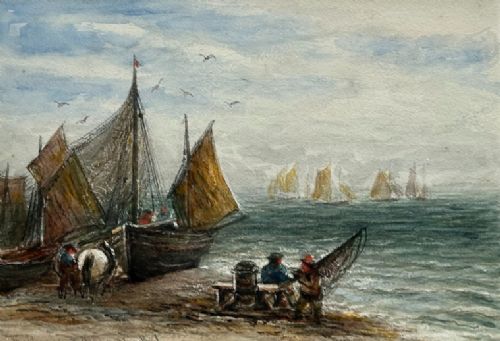
Signed beach art brings maritime life and coastal shores into the room through watercolours, oils, and etchings carrying the artist's hand.
Signed Beach Art
Signed beach art encompasses paintings, watercolours, and etchings depicting coastal scenes, harbours, and shores bearing a signature from periods ranging from the eighteenth century to the mid-twentieth century. On this page, buyers primarily encounter nineteenth-century and early twentieth-century watercolours and oil paintings capturing British and French coastal locations.
The works span diverse regional approaches including the Scottish School, the Hague School, and the 19th Century French School, alongside traditional English and British landscapes. These pieces record historical shorelines, fishing boats, and coastal communities through the eyes of named artists active across different eras.
Materials and construction
Works in this category utilise paper, wood, and canvas as the primary grounds for watercolours, gouache, oils, and etchings with aquatint. Artists applied paint and ink to capture light and atmosphere on coastal views, frequently mounting finished watercolours and prints within giltwood frames accented by gold leaf or gilt.
Techniques range from delicate watercolour washes on paper to textured oil on canvas and oil on board applications. Etchings employ precise linear work combined with aquatint tonal areas to render coastal subjects.
Signed Beach Art Retail Price Guide 2026
Typical asking prices for signed beach art among the pieces listed under this phrase on Sellingantiques today, from the lower quarter to the upper quarter. They describe what is for sale here now, not the wider market.
Listings feature paper, wood, glass, and canvas as core materials, spanning watercolours, oils, etchings, and gouache across eighteenth to mid-twentieth-century periods.
What varies in quality
The standard of execution in brushwork, draughtsmanship, and composition separates finer works from standard decorative pieces. Masterly handling of light on water and the confident rendering of maritime vessels indicate superior artistic capability.
The preservation of the medium, whether paper, canvas, or board, alongside the historical integrity of the framing materials, influences the overall character of the piece.
James Orrock·William Banks Fortescue·F A Roylance·Kate E Booth·William Russell Flint·Norman Janes·Thomas Beach·H Stuart
The Signed Beach Art Glossary
- Watercolour
- A painting method where fine pigment is suspended in water-soluble binder applied to paper. This medium allows for transparent washes that capture coastal light and atmospheric skies.
- Etching
- A printmaking technique where lines are incised into a metal plate with acid before ink is applied and transferred to paper. It produces fine, sharp details often combined with tonal methods like aquatint.
- Giltwood
- Wood that has been decorated with a thin layer of gold leaf or gilt powder. Antique frames finished in this manner provide a traditional ornamental border for paintings.
- Gouache
- An opaque watercolour paint that includes a white pigment filler to create solid, flat areas of colour. It offers greater coverage and density than standard watercolour.
- Aquatint
- A printmaking variant of etching that produces tonal areas resembling watercolour washes. Artists utilise this technique on copper or zinc plates to create graduated shades of light and dark.
Signed Beach Art: Frequently Asked Questions
How do I identify the period of signed beach art?
Examine the paper or canvas type, the framing style, and the handwriting of the signature. Stylistic markers of the Victorian era or mid-century British traditionalism often align with the materials used.
Comparing the subject matter and artistic school to documented periods helps narrow down the creation date. Framing methods and backing boards frequently offer additional clues regarding age.
What subjects appear in signed beach art?
Common subjects include fishing boats, harbour scenes, coastal cliffs, and shorelines with figures engaged in maritime labour. Locations range from British coastal towns like St Ives and Scarborough to French shores.
Artists also depicted specific activities such as spreading nets or returning from voyages. These scenes provide a visual record of historical coastal life.
How should I display watercolour beach art?
Watercolours require protection from direct sunlight to prevent fading of pigments and paper discolouration. Hanging them in rooms with stable humidity levels preserves the paper ground and mounting materials.
Utilising UV-filtering glass during framing safeguards the delicate medium from light degradation over time. Proper mounting ensures the paper does not touch the glass directly.
Are all signatures on beach art original?
Signatures in this category typically match the artist's recorded hand from the period of execution. Evaluating the ink or paint application relative to the underlying surface confirms the signature's integrity.
Provenance and stylistic consistency across the entire composition support the authenticity of the attribution. Specialist consultation can clarify uncertain signatures.
What is the difference between an etching and a watercolour?
An etching is a printed multiple created from an inked metal plate, whereas a watercolour is a unique painted work on paper. Etchings rely on inked lines and tonal aquatint areas, while watercolours utilise transparent pigment washes.
Watercolours show individual brushstrokes under magnification, while etchings display the characteristic indented platemark on the paper margin.