
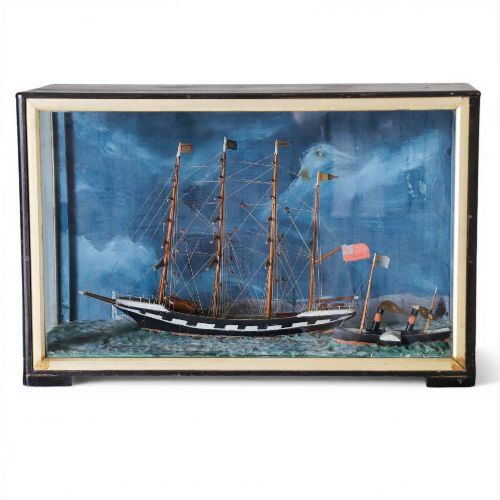
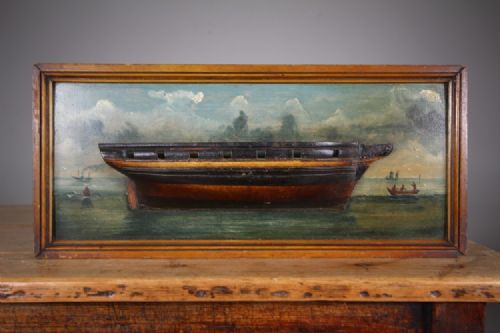
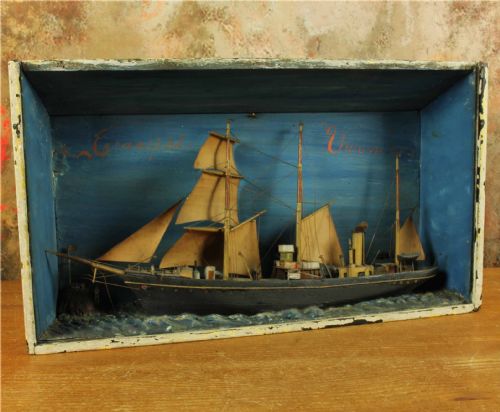


Ship Diorama Shadow Box
These ship diorama shadow box pieces capture detailed maritime scenes within deep wooden frames, offering miniature sailing vessels and seascapes for collectors.
Ship Diorama Shadow Box
A ship diorama shadow box brings historic maritime scenes indoors, capturing vessels upon the ocean within a protected glazed frame. These maritime shadow box pieces present detailed model ships and folk art models set against painted backdrops.
Most examples found here date from the nineteenth century, including Victorian maritime folk art and British folk art creations. Makers constructed these pieces to preserve the likeness of specific sailing vessels and racing scenes.
Materials and construction methods
Craftsmen built these pieces using wood for the structural shadow boxes and glass to protect the delicate contents within. Canvases, paper, fabric, and oil paint formed the painted backdrops representing the sea and sky.
Makers shaped plaster and carved wood to create the waves, while delicate materials like straw work decorated specific examples. Hand-built boat models and scratch-built ship hulls sat inside the painted enclosures, secured by early makers.
The combination of oil paint, canvas, and carved wood gives these maritime dioramas their distinct depth and texture. Artisans utilised traditional folk art techniques to assemble the rigging and miniature hulls by hand.
The listings show pieces spanning the nineteenth century, Victorian era, and early twentieth century up to nineteen twenty.
Factors that distinguish quality
The finesse of the painted seascape and the complexity of the model ship determine the artistic merit of the piece. Detailed rigging and accurately proportioned hulls elevate the work above simpler folk art examples.
The construction of the shadow box itself dictates durability, with well-joined wooden frames protecting the delicate painted canvas and plaster waves. Finer pieces maintain their original surface finishes and retain the crisp details of the vessels.
The Ship Diorama Shadow Box Glossary
- Shadow box
- A deep, glass-fronted wooden frame designed to enclose and protect a three-dimensional scene. It keeps dust and damage away from delicate model ships.
- Maritime folk art
- Decorative and utilitarian objects created by self-taught makers depicting sea-related subjects. These pieces reflect regional traditions rather than formal academic training.
- Turneresque
- Pertaining to the atmospheric, dramatic painting style associated with J. M. W. Turner. In these listings, it describes stormy or luminous oil paint seascapes.
- Clipper
- A very fast nineteenth-century sailing ship with multiple masts and square sails. These vessels frequently inspired detailed diorama models.
- Straw work
- Decorative craft technique using flattened straw to create intricate geometric or pictorial patterns. Certain nineteenth-century maritime pieces incorporate this material for surface embellishment.
Ship Diorama Shadow Box: Frequently Asked Questions
What is a ship diorama shadow box?
A ship diorama shadow box is a deep-framed maritime display featuring a miniature model ship set against a painted canvas backdrop.
Craftsmen enclosed these three-dimensional scenes behind glass to protect the delicate plaster waves, paper elements, and wooden hulls from dust and handling.
How were these shadow boxes displayed?
These pieces were primarily designed to hang on interior walls or sit securely on shelves within nineteenth-century homes and maritime offices.
The protective wooden box construction allowed owners to showcase detailed sailing ships and racing vessels without risking damage to the rigging.
How do I date a nineteenth-century diorama?
Dating relies upon examining the construction materials, the style of the wooden frame, and the specific vessel depicted if named.
Nineteenth-century examples frequently exhibit British or French folk art characteristics, utilising oil paint, canvas, and hand-carved wooden boat components typical of the period.
How do I care for a maritime diorama?
Care involves keeping the piece away from direct sunlight and damp environments to protect the fragile paper, canvas, and painted surfaces.
Glass fronts should be cleaned gently with standard glass cleaner applied to a cloth rather than sprayed directly onto the wooden frame.