
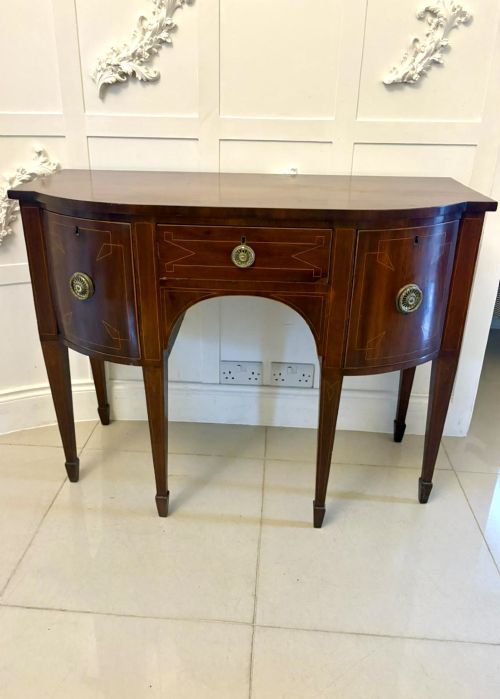
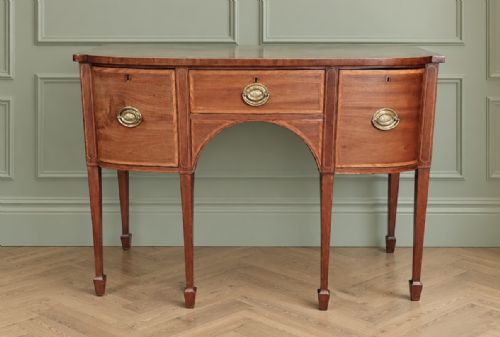
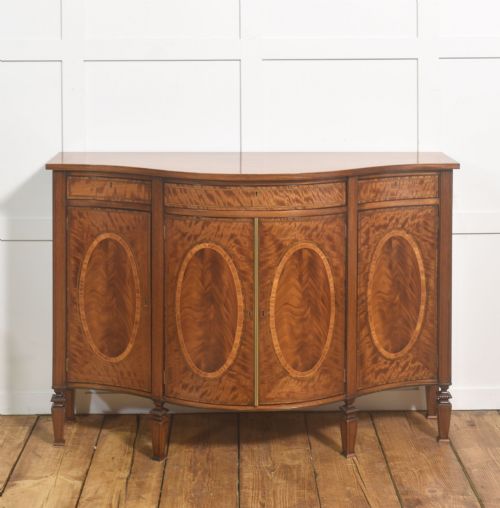
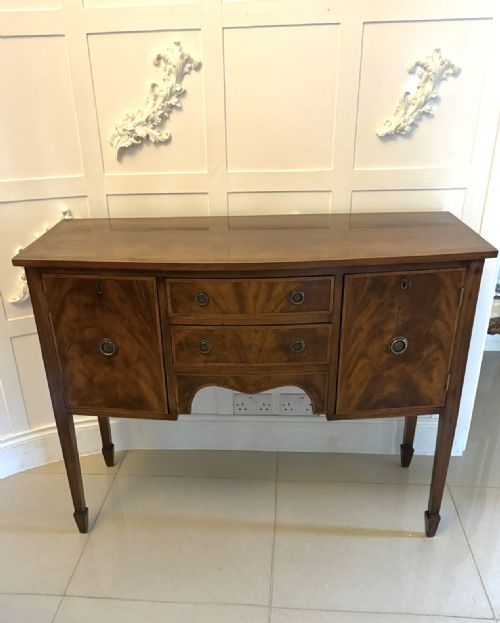




Sheraton Style Bowfront Sideboard
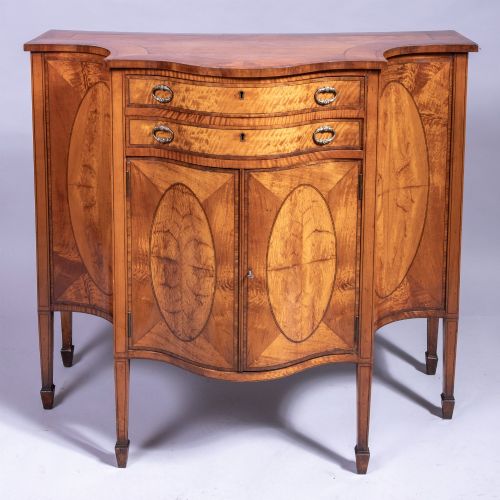
A sheraton style bowfront sideboard brings rhythmic curved fronts and refined satinwood inlay into a dining room or hall.
Sheraton Style Bowfront Sideboard
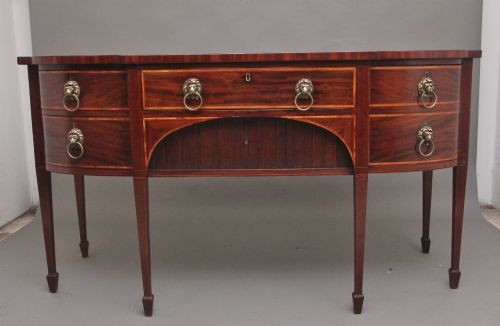
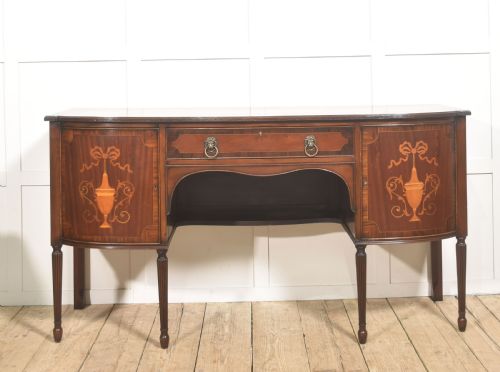
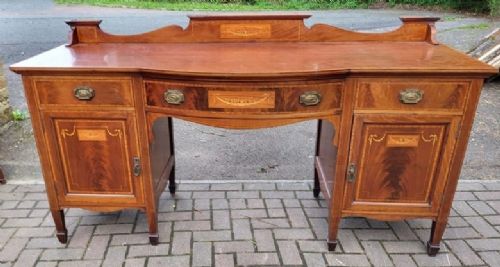
A sheraton style bowfront sideboard provides substantial dining room storage with a characteristic convex curving front that projects into the room. These pieces range from authentic eighteenth-century examples to later revivals produced across the nineteenth and early twentieth centuries.
The versions most commonly met on this page belong to the Edwardian period and the Sheraton Revival of around nineteen hundred, alongside earlier Georgian originals. They appear primarily in forms designated as sideboards, side cabinets, and serving tables.
Makers and cabinetmakers constructed these servers to stand against dining room walls, offering deep central drawers flanked by cupboards. The silhouette relies on precise geometry to soften the rigidity of a long room.
How they were made
Cabinetmakers built these pieces using solid mahogany and flame mahogany veneers laid over secondary timbers to create richly figured surfaces. Workshops added delicate contrasting borders using satinwood, boxwood, ebony, and rosewood stringing.
Inlay and marquetry techniques defined the decorative vocabulary, featuring classical urns, bellflowers, and fan motifs set into the drawer fronts and tops. Brass hardware, including drop handles and backplates, completed the functional elements of the doors and drawers.
The listings span from eighteenth-century Georgian originals through to Edwardian Sheraton Revival interpretations made around nineteen hundred.
What varies in quality
The fineness of a sheraton style bowfront sideboard rests primarily in the selection of the timber veneers and the crispness of the inlaid details. Superior examples exhibit continuous grain matching across the curved drawers and tightly fitted joints that withstand centuries of shifting humidity.
Proportion and restraint separate masterworks from ordinary production, particularly in the balance between the curve of the front and the taper of the legs. Hand-painted flourishes and dense marquetry panels elevate certain revival pieces far above plain commercial output.
The Sheraton Style Bowfront Sideboard Glossary
- Bowfront
- A convex curved front that swells outward in the centre, designed to give extra depth to central drawers while saving floor space at the corners.
- Crossbanding
- A narrow band of veneer applied around the perimeter of a drawer front or tabletop with the grain running perpendicular to the main surface.
- Marquetry
- Elaborate decorative patterns formed by fitting together contrasting pieces of wood veneer, shell, or ivory within a prepared ground.
- Satinwood
- A lustrous, hard timber native to Ceylon and India with a yellowish sheen, heavily utilised in revival pieces for contrasting panels.
- Stringing
- Thin lines of contrasting timber inlaid into shallow channels to outline panels, drawer fronts, and table edges.
Sheraton Style Bowfront Sideboard: Frequently Asked Questions
How do I place a bowfront sideboard in a modern dining room?
These servers anchor a dining space by offering generous surface area for serving food while concealing tableware in deep cupboards.
Position the piece against a principal wall where the curved front can catch sidelight to highlight the mahogany grain and satinwood inlay.
What is the difference between Georgian and revival sideboards?
Georgian originals date from the eighteenth and early nineteenth centuries, displaying hand-cut joinery and natural patination earned through decades of use.
Revival pieces date from the late nineteenth and early twentieth centuries, often incorporating lighter satinwood timbers and painted neoclassical decorations.
How should I clean and maintain polished mahogany surfaces?
Dust the timber regularly with a soft, dry cloth to prevent particulate accumulation from dulling the French polished finish.
Apply a quality beeswax sparingly twice a year to nourish the wood and maintain its natural depth without building up sticky residue.
How do I recognise Sheraton influence on a cabinet?
Sheraton style pieces feature slender tapering legs, restrained neoclassical ornamentation, and symmetrical arrangements of contrasting veneers.
The geometry relies on straight lines contrasting gracefully with the signature convex curve of the bowfront.