
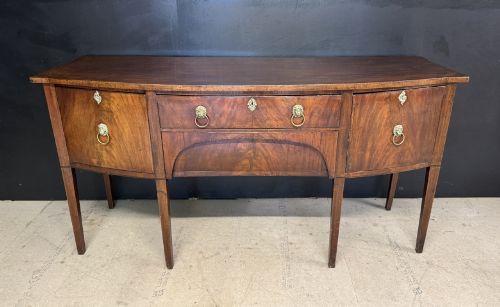
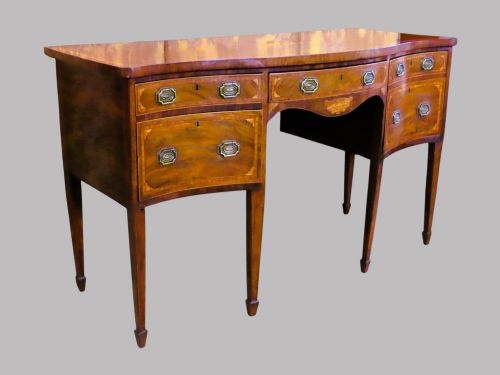
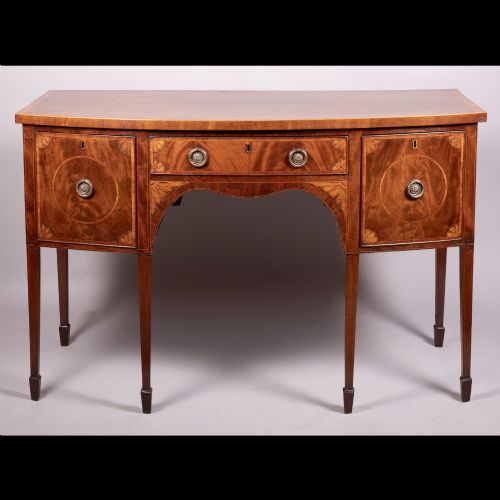

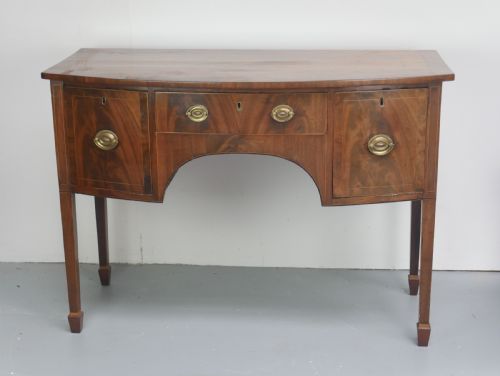
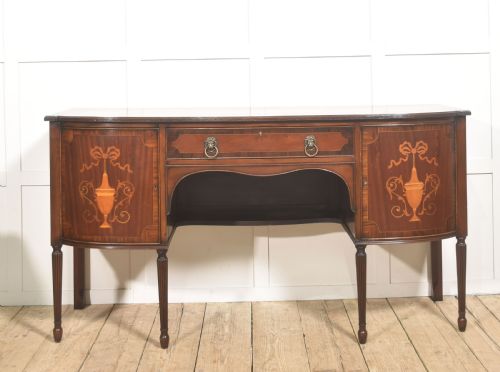

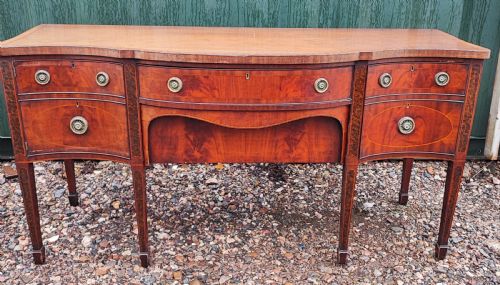


Hepplewhite Mahogany Credenza
A hepplewhite mahogany credenza brings refined late-eighteenth-century dining room storage into the home, combining serpentine lines with delicate cabinetwork.
Hepplewhite Mahogany Credenza
A hepplewhite mahogany credenza or sideboard forms the centrepiece of period dining spaces, offering generous proportions and curved fronts. Buyers meet Georgian and George III examples alongside later revivals from the nineteenth and early twentieth centuries.
The form appears primarily as bow-fronted or serpentine sideboards, commodes, and side cabinets rather than low credenzas. Pieces span eighteenth-century originals to later revival styles reflecting the distinctive design principles attributed to George Hepplewhite.
Georgian periods dominate the selection, accompanied by nineteenth-century interpretations and twentieth-century reproductions. These items serve as functional storage pieces while displaying sophisticated cabinet construction and decorative woodwork.
What varies in quality
The refinement of the silhouette separates standard utility pieces from exceptional works, particularly in the crisp execution of serpentine and bow-front shapes. Superior examples exhibit harmonious proportions and balanced drawer arrangements.
The selection of timber veneers and the precision of the boxwood and satinwood inlay dictate visual depth. Master cabinetmakers achieved subtle contrast and seamless joins that remain evident across the wood surfaces.
Listings feature Georgian and George III periods alongside Hepplewhite revivals up to the twentieth century, constructed in mahogany with boxwood and satinwood inlay.
The Hepplewhite Mahogany Credenza Glossary
- Serpentine
- A front profile characterised by a convex central section flanked by two concave curves. This contour requires advanced woodworking skill to shape accurately.
- Bow front
- A convex, outwardly curved furniture front that softens the linear appearance of a cabinet. It appears frequently on eighteenth-century dining room pieces.
- Flame mahogany
- A highly figured timber cut from the branch junction of the mahogany tree. The grain creates a distinctive flickering flame effect across large panel surfaces.
- Satinwood inlay
- A pale, lustrous contrasting timber inserted into darker mahogany surfaces to form decorative borders. Boxwood inlay is often used similarly for fine linear detail.
Hepplewhite Mahogany Credenza: Frequently Asked Questions
What is a hepplewhite mahogany credenza?
These pieces are large storage items influenced by eighteenth-century design, appearing predominantly as serpentine and bow-front sideboards.
They combine practical cupboard space with decorative veneering and fine inlay work.
How do I date a sideboard?
Dating relies on examining construction methods, timber selection, and hardware styles across Georgian and later revival periods.
Eighteenth-century originals display hand-cut joinery while later pieces often show nineteenth- or twentieth-century manufacturing techniques.
Where should I place a credenza?
These large cabinets suit dining rooms, hallways, or spacious living areas where their length and curved profiles can be appreciated.
Ensure adequate floor space for drawers and cabinet doors to open fully.
What woods were used?
Mahogany serves as the primary structural and visible timber, often selected in flame variations for decorative impact.
Boxwood and satinwood provide the contrasting inlay details found along the edges and drawer fronts.