





Sheraton Revival Tray Table
These sheraton revival tray table pieces bring light timber and painted grace to a room, offering a versatile surface that is as useful today as it was a century ago.
Sheraton Revival Tray Table
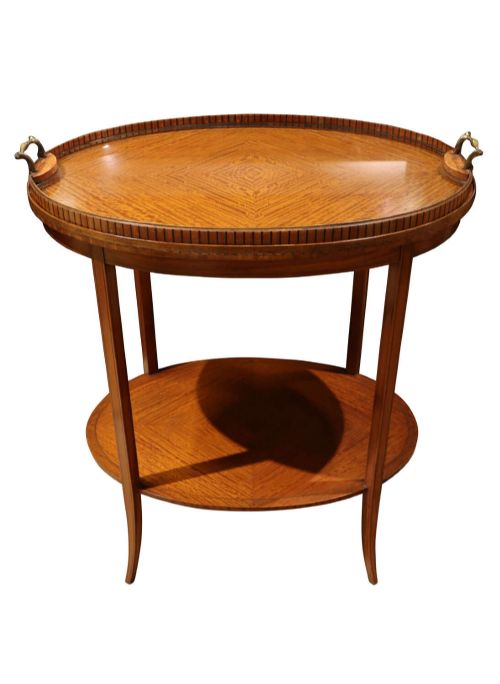
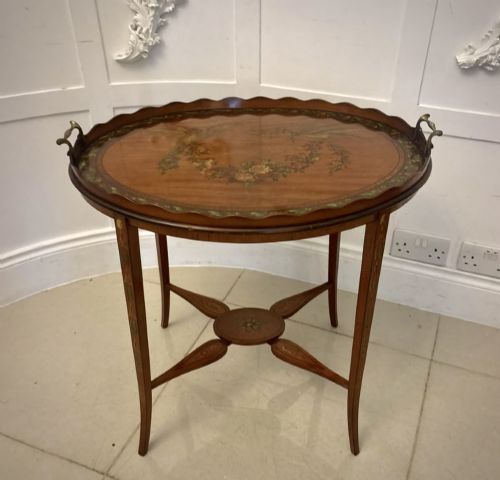
A sheraton revival tray table takes its inspiration from late eighteenth-century classical design, reinterpreted during the late nineteenth and early twentieth centuries. The most common form on this page is the oval tray top occasional table, often raised on slender legs with delicate cross-bracing or tier structures.
Makers of this period favoured light, figured timbers and sophisticated surface decoration over heavy proportions. These tables function equally well as bedside cabinets, multi-tiered étagères, or serving tables in a drawing room.
The style spans from late nineteenth-century examples through the Edwardian era up to the early twentieth century. Buyers seeking this aesthetic will find pieces that balance structural lightness with refined decorative detail.
How they were made
Cabinetmakers constructed these tables primarily from satinwood and mahogany, frequently combining the two timbers to create subtle tonal contrast and borders. Inlays of lighter and darker woods define geometric panels and decorative motifs across the surfaces.
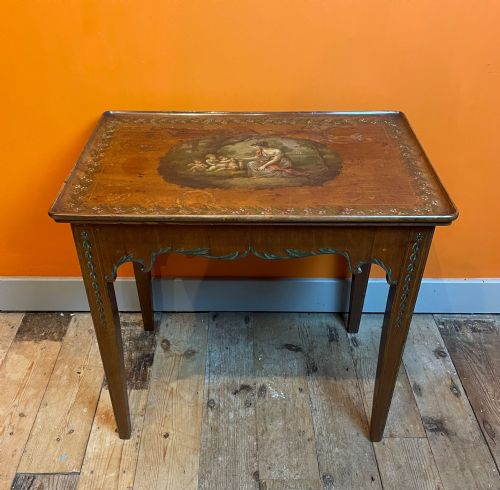
Many examples feature hand-painted detailing and neo-classical scenes directly onto the wood or beneath protective glass. Brass handles and mounts appear on serving tables and tray stands to provide functional contrast to the polished timber.
Sheraton Revival Tray Table Retail Price Guide 2026
Typical asking prices for sheraton revival tray table among the pieces listed under this phrase on Sellingantiques today, from the lower quarter to the upper quarter. They describe what is for sale here now, not the wider market.
Some surfaces were painted with such charming neoclassical scenes that tea was surely secondary to the artwork.
What varies in quality
Quality in a sheraton revival tray table rests on the crispness of the inlay work and the depth of figure in the satinwood veneer. Finer examples display meticulous hand-painted motifs that retain their original pigment and sharp outlines.
The architectural integrity of the frame distinguishes superior pieces from standard production. Slender legs and tiered structures demand precise joinery to remain rigid and stable without heavy bracing.
The Sheraton Revival Tray Table Glossary
- Satinwood
- A lustrous tropical hardwood with a natural golden sheen, prized by cabinetmakers for fine veneering and inlay. It forms the primary visual signature of many late nineteenth-century pieces.
- Étagère
- A piece of furniture consisting of open shelves or tiers for displaying small objects. These tiered tables provide multiple display surfaces within a compact footprint.
- Marquetry
- The art of applying decorative pieces of veneer to a structure to form intricate patterns or pictures. This technique creates the contrasting border designs seen on top surfaces.
- Neo-Classical
- A style reviving classical Roman and Greek motifs, characterised by symmetry, restrained ornamentation, and classical urn or floral themes. Painted scenes on these tables frequently draw upon this design vocabulary.
Sheraton Revival Tray Table: Frequently Asked Questions
What is a sheraton revival tray table?
These tables are decorative occasional pieces produced around the turn of the twentieth century in the style of eighteenth-century neoclassical furniture. They typically feature light satinwood timber and removable or fixed tray tops.
They were designed for light domestic use, often serving tea or holding small decorative objects in formal reception rooms.
How do I date an Edwardian tray table?
Dating relies on the construction methods, timber selection, and decorative style recorded across the piece. Edwardian examples often combine mahogany and satinwood with subtle painted highlights.
Examining the underside and interior joinery helps confirm whether a piece belongs to the late nineteenth or early twentieth-century period.
Can I use these tables daily?
These pieces suit everyday use as bedside cabinets, occasional tables, or serving surfaces provided they are treated with care. Their slender frames and delicate painted surfaces require gentle placement of heavy items.
Using coasters and avoiding excessive moisture protects the polished timber and hand-painted details from wear.
What is the difference between an étagere and an occasional table?
An étagere incorporates multiple tiered shelves designed specifically for display, whereas an occasional table typically offers a single surface with optional tray edges. Both forms share the light construction characteristic of the period.
Tiered tables provide additional vertical space for ornaments while maintaining a small floor footprint.