


Sheraton Revival Drawers
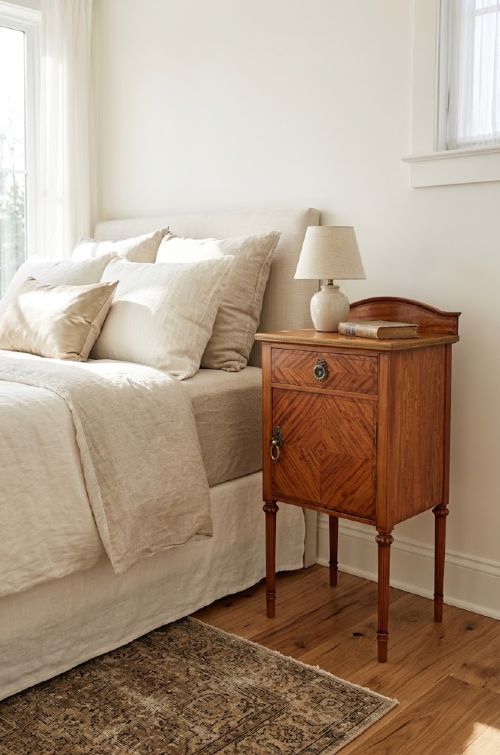
Sheraton revival drawers bring elegance and refined neoclassical inlay to the bedroom and study, echoing eighteenth-century grace.
Sheraton Revival Drawers
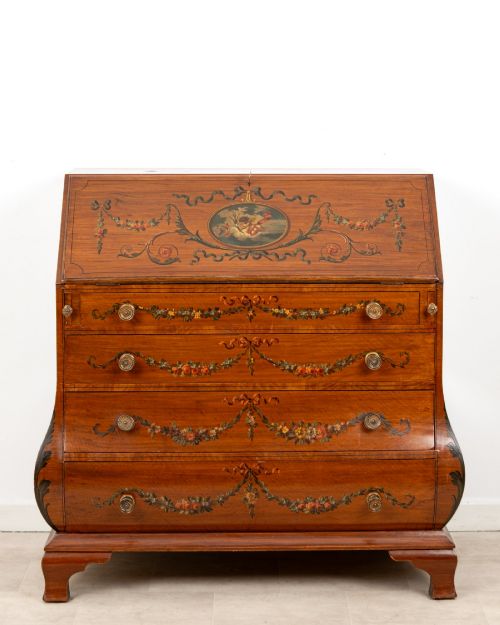
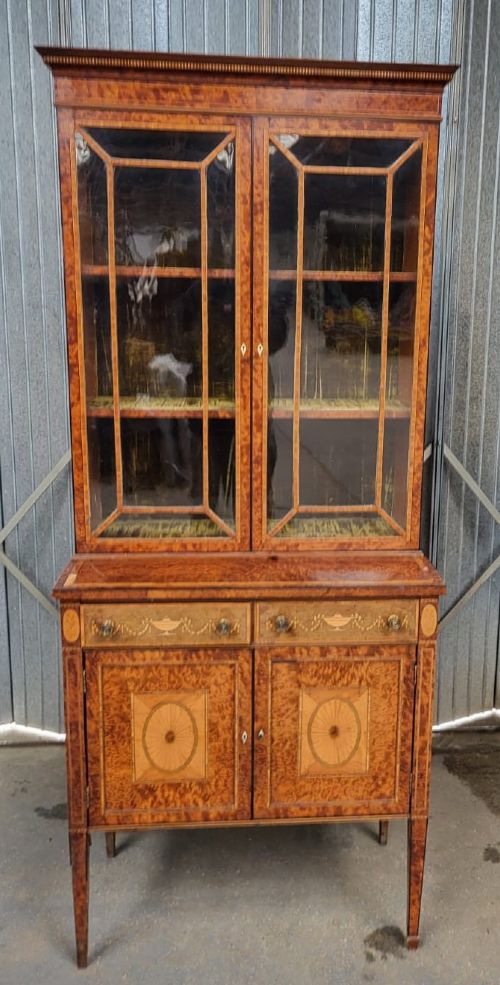
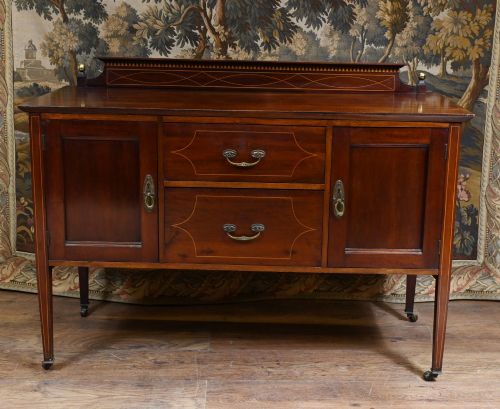
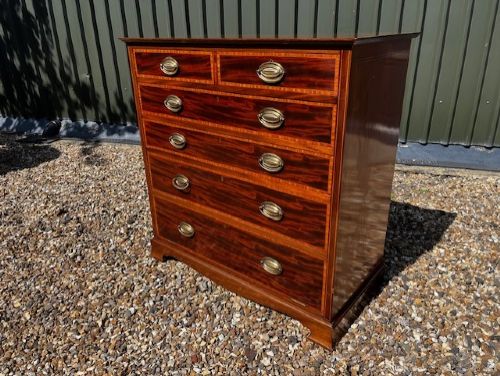
Sheraton revival drawers encompass chests of drawers, writing desks, bureaux, and side tables produced primarily during the Edwardian period and the late nineteenth century. These pieces reflect a sustained taste for lighter proportions and classical symmetry, drawing inspiration from late Georgian design.
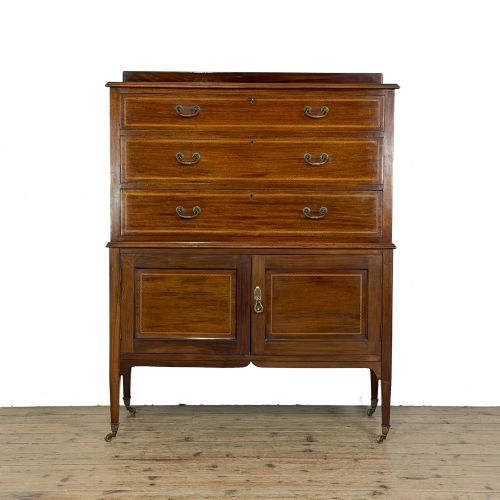
The version most commonly met on this page is the Edwardian mahogany or satinwood chest of drawers, often enhanced with delicate contrasting inlay and brass hardware. Alongside chests, buyers frequently encounter writing desks and bureau bookcases following the same vocabulary of straight lines, tapered legs, and subtle curve fronts.
Materials and Technique
Cabinetmakers constructed these pieces using solid mahogany and satinwood, frequently applying rosewood, walnut, or maple for contrast and decorative impact. Secondary timbers support sturdy carcases while primary veneers display carefully chosen grain patterns.
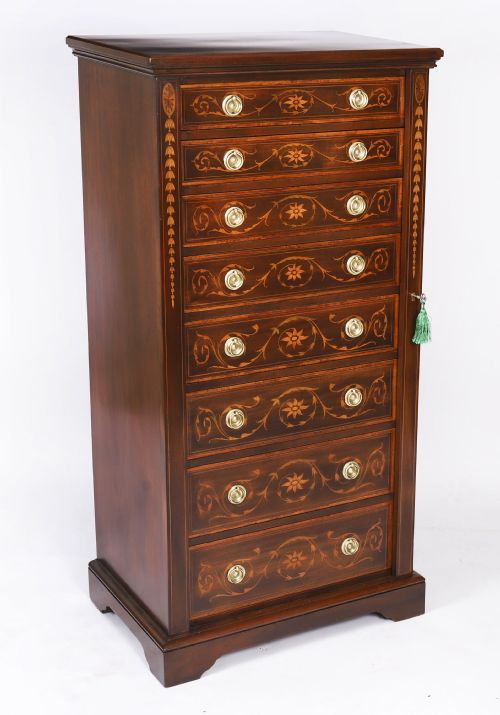
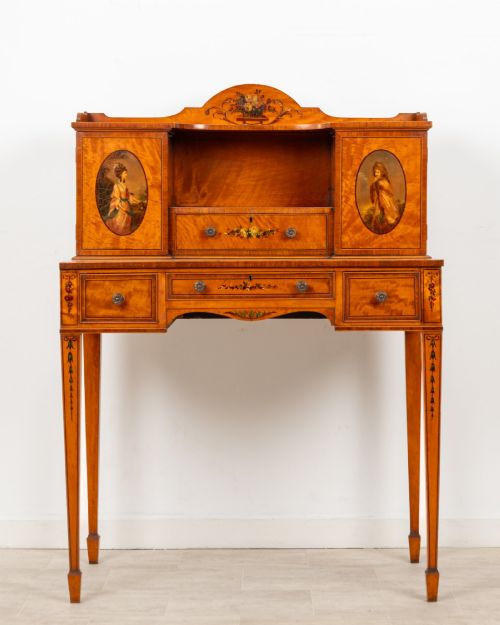
Inlay and marquetry form the defining decorative technique, utilising boxwood, satinwood inlay, and dark stringing to trace geometric borders, urns, and floral motifs. Hand-painted panels appear on select satinwood items, adding pictorial detail above the drawer fronts.
Several pieces conceal tiny internal compartments behind false drawer fronts, designed for hiding secret love letters from prying eyes.
Craftsmanship and Proportion
The distinction between standard production and the top of the range lies in the precision of the cabinetwork and the fineness of the timber. Selected figured satinwood and rich mahogany, matched symmetrically across drawer fronts, elevate a piece above simpler domestic furniture.
Refinement in the execution of the stringing and marquetry separates finer workshops from mass production. Crisp mitres, tight joints, and original brass fittings indicate a higher standard of original manufacture.
J Shoolbred·Maple and Co·Edwards and Roberts·Druce and Co
The Sheraton Revival Drawers Glossary
- Satinwood
- A lustrous timber with a golden sheen, highly favoured by cabinetmakers for decorative veneers and cross-banding during the Sheraton revival. It catches the light differently depending on the grain orientation.
- Inlay
- A technique where contrasting woods or materials are set flush into a recess in the primary surface to create patterns. Boxwood and darker veneers form delicate lines and motifs on drawer fronts.
- Serpentine
- A shape involving a gently undulating front with a convex centre flanked by concave curves, adding movement to chests of drawers and side tables.
- Bureaux
- A writing cabinet featuring a sloping fall-front that opens to reveal internal small drawers and pigeonholes, often positioned above a chest of drawers.
- Cross-banded
- A border technique where thin strips of veneer are laid around the perimeter of a top or drawer front so the grain runs perpendicular to the central panel.
Sheraton Revival Drawers: Frequently Asked Questions
What is a sheraton revival chest?
A sheraton revival chest is a piece of furniture made around the late nineteenth or early Edwardian period that copies the lighter, neoclassical style of late eighteenth-century designer Thomas Sheraton. These chests typically feature straight lines, elegant bracket feet or tapered legs, and decorative contrasting wood inlays.
Cabinetmakers of this era used timbers like mahogany and satinwood to capture the refined aesthetic of the Georgian period while adapting the proportions for contemporary homes.
How do I care for satinwood furniture?
Satinwood requires gentle treatment to preserve its pale golden colour and delicate polished surface. Keep pieces away from direct sunlight and radiators to prevent the timber and veneers from drying out or fading.
Dust regularly with a soft, dry cloth and avoid silicone-based polishes or excessive moisture, which can damage the fine polish and lift the intricate inlay work.
Are these drawers suitable for daily use?
These pieces function well in modern bedrooms and living spaces for storing lighter garments, paperwork, or accessories. The drawer construction is generally robust, though historical joints benefit from sensible handling rather than overloading.
Placing felt pads inside drawers helps protect the internal timber from wear caused by modern items.
How do I tell mahogany from satinwood?
Mahogany is a deep reddish-brown hardwood with a distinct grain that darkens gracefully over time. Satinwood is much paler, displaying a shimmering golden-yellow tone with a natural chatoyancy that reflects light across the surface.
Pieces often combine both woods, using mahogany for the main carcase and satinwood for drawer fronts or decorative banding.