

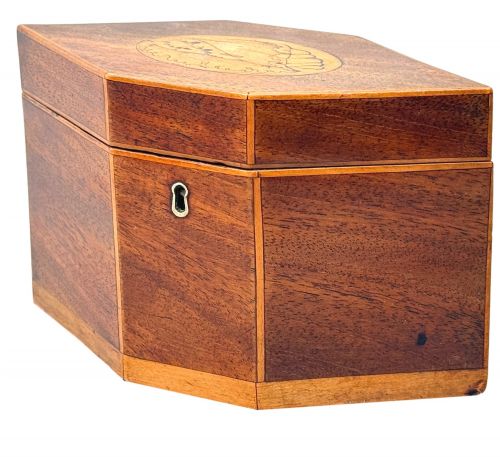


Shell Marquetry Box
These shell marquetry box examples bring together delicate craftsmanship and rich timber from the Georgian and Edwardian periods.
Shell Marquetry Box
A shell marquetry box unites fine woodworking with decorative shell inlay, taking the form of tea caddies, occasional tables, and decorative boxes. These pieces often date from the Georgian era through to the Edwardian period, showcasing classic forms like hexagonal caddies and knife boxes.
Buyers encountering this group will most frequently find satinwood and mahogany containers accented with detailed shell motifs. Examples range from compact tea canisters to larger stationery cabinets and work tables.
The origins span English workshops and French periods such as Napoleon III and Restoration, reflecting diverse cabinet-making traditions. Each form serves a specific domestic function, from storing tea leaves to holding writing materials.
Construction and materials
Cabinet makers utilised dense hardwoods such as mahogany, rosewood, and satinwood as the primary carcase for each box. These timbers provide a stable base for detailed surface decoration.
Inlay work incorporates contrasting materials like boxwood, bone, and brass alongside natural shell to create geometric and pictorial panels. Craftsmen fitted these delicate elements carefully into recessed channels within the timber veneer.
Shell Marquetry Box Retail Price Guide 2026
Typical asking prices for shell marquetry box among the pieces listed under this phrase on Sellingantiques today, from the lower quarter to the upper quarter. They describe what is for sale here now, not the wider market.
Some tea caddies still retain the tiny, original keys needed to unlock compartments where precious dried leaves once rested under lock and key.
Assessing quality
The refinement of the shell inlay and the choice of timber figure determine the standing of an individual piece. Finer examples display precise cutting of the shell and contrasting woods, creating crisp botanical or geometric details.
Structural integrity and the preservation of original internal fittings, such as cannisters or dividers, elevate a piece. Superior boxes maintain their original patination and timber depth without heavy restoration masking the surface.
The Shell Marquetry Box Glossary
- Marquetry
- Decorative veneer work applied to a structure to form intricate patterns or pictures. Craftsmen cut thin slices of wood, shell, and bone to fit together like a puzzle.
- Tea Caddy
- A small container designed to store loose tea leaves securely. They often feature internal lids or compartments to separate different varieties of tea.
- Satinwood
- A durable timber prized for its golden lustre and smooth grain. It provides a bright background that contrasts effectively with darker woods and shell inlay.
- Calamander
- An exotic hardwood with distinct dark brown and yellowish stripes. Cabinet makers used it to create striking borders and panels on luxury furniture and boxes.
- Veneer
- A thin layer of choice wood applied to a coarser timber base. This technique allows makers to utilise expensive grain patterns efficiently.
Shell Marquetry Box: Frequently Asked Questions
What were these boxes originally used for?
Many of these containers served as tea caddies to protect expensive tea leaves from moisture and loss in wealthy households. Other forms functioned as work tables, candle boxes, or stationery cabinets for daily correspondence.
Their secure interiors often included fitted canisters, glass dishes, or partitioned spaces designed for specific domestic tasks. As luxury items, they sat openly in principal rooms for guests to admire.
How do I care for a shell marquetry box?
Keep wooden boxes away from direct sunlight and sudden temperature changes to protect the delicate veneers and natural shell inlay. Stable indoor conditions prevent the timber from shrinking and the adhesive from failing.
Apply a minimal amount of traditional wax polish occasionally to nourish the hardwood surface. Avoid using modern liquid cleaners or harsh chemicals that might damage the antique finish.
How can I tell a Georgian box from an Edwardian one?
Georgian pieces typically exhibit restrained neoclassical proportions, often utilising satinwood or mahogany with subtle butterfly or shell motifs. Construction techniques from this era rely on hand-cut dovetails and older fastening methods.
Edwardian examples often draw inspiration from earlier Sheraton revival styles but generally display a slightly different timber tone and finish. Examining the interior construction and secondary woods helps confirm the period of manufacture.
Are all the shell elements made of the same material?
Inlay components vary depending on the workshop and the specific decorative effect the maker intended to achieve. Some pieces incorporate iridescent marine shell, while others utilise tortoiseshell or bone to create tonal contrast.
These natural materials react differently to age and environment, meaning each box develops a distinct character. Close inspection reveals the subtle variations in texture between the shell and the surrounding wood veneer.