


Sevres Style Lamps
Sevres style lamps bring grand French decorative arts into domestic lighting through painted porcelain mounted in rich metalwork.
Sevres Style Lamps
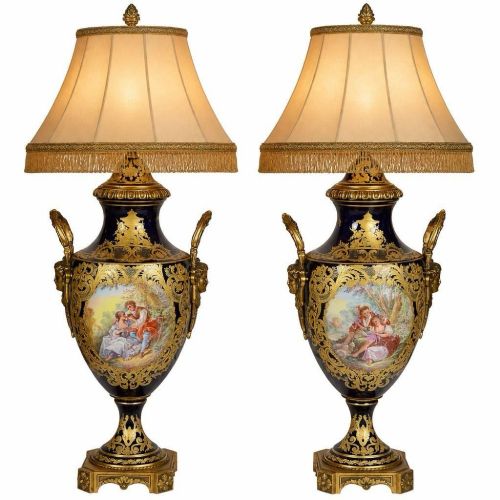
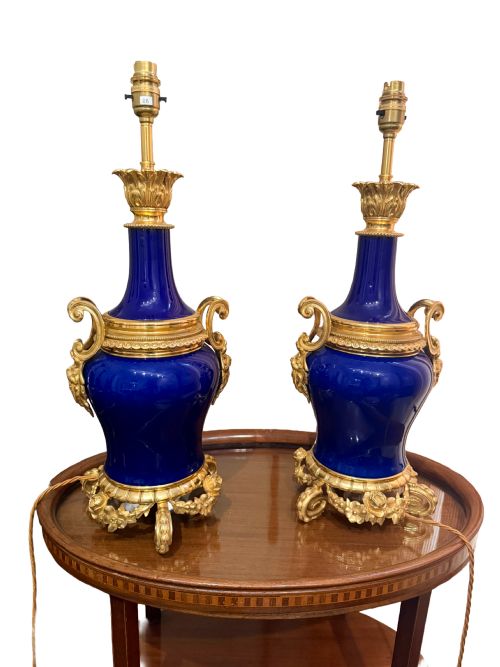
Sevres style lamps combine classic ceramic bodies with ornate metal mounts, drawing inspiration from nineteenth-century French manufacture. Buyers encountering this phrase find table lamps and converted oil lamps originating predominantly from the nineteenth century, spanning decades such as the 1870s, 1880s, 1890s, and 1900.
The aesthetic leans heavily into historicist movements including French Rococo Revival, Louis XVI style, French Neoclassical, and Napoleon III taste. Pieces frequently appear as matched pairs or individual vases adapted for modern electrical use.
Materials and Construction
The primary bodies utilise porcelain, often finished in striking ground colours like cobalt blue, bleu celeste, and bleu royale, alongside delicate pate-sur-pate decoration. Artisans applied hand-painted details directly onto the ceramic surface before glazing and firing.
Mounts and structural elements employ ormolu, gilt bronze, brass, and gilt metal, securely framing the porcelain bodies. Fabric and silk shades often complete the presentation, pairing with glass components where oil lamp reservoirs remain intact.
Listings for sevres style lamps span the nineteenth century, predominantly featuring porcelain paired with ormolu and brass across French decorative styles.
Assessing Quality and Execution
Quality rests heavily on the depth and precision of the hand-painted decoration across the porcelain body, alongside the crispness of the cast metal mounts. Finer examples display intricate brushwork and rich colour saturation, whereas simpler versions rely on more generalised ornamentation.
The weight and finish of the ormolu or gilt bronze mounts also distinguish standard items from superior productions. Heavier, more detailed chasing in the metalwork indicates higher workshop standards during the nineteenth century.
The Sevres Style Lamps Glossary
- Ormolu
- Gilt bronze applied to decorative hardware and mounts. This technique provides a rich golden finish that complements coloured porcelain.
- Pate-sur-pate
- A ceramic decorating method where liquid clay is built up in layers. This creates low-relief cameos with a translucent quality against a contrasting ground colour.
- Bleu celeste
- A bright sky blue glaze colour popular on nineteenth-century French porcelain. It serves as a vibrant background for hand-painted panels.
- Louis XVI style
- A neoclassical design vocabulary marked by symmetry, straight lines, and classical motifs. It influences the formal structure of many nineteenth-century mounts.
Sevres Style Lamps: Frequently Asked Questions
What are sevres style lamps?
These pieces are nineteenth-century French lighting fixtures created from porcelain bodies mounted in gilt metal or ormolu.
They replicate the aesthetic of the royal Sevres factory, utilising rich ground colours and hand-painted scenes.
Were these originally oil lamps?
Many examples began as oil lamps before undergoing conversion to electricity during later periods.
Some retain their original brass or glass reservoirs beneath the porcelain housing.
How do I identify the period?
Dating relies on stylistic clues like neoclassical mounts and the typical manufacturing methods of the nineteenth century.
Specific decades like the 1870s and 1890s often appear in recorded dealer documentation.
How do I style them at home?
These lamps function well as statement pieces on sideboards, mantels, or large tables in traditional interiors.
Their substantial porcelain bodies and gilded mounts demand surrounding space to display the decoration properly.