
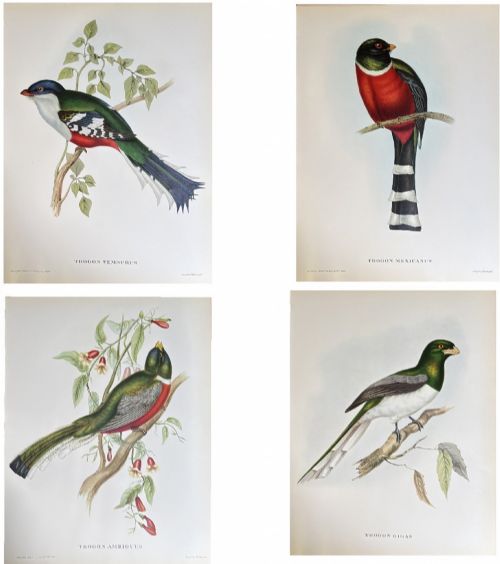
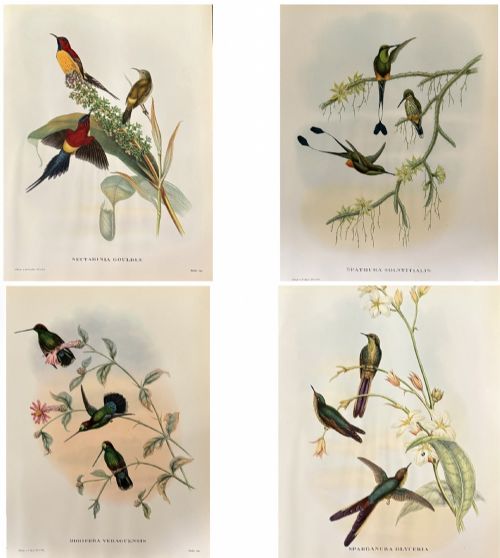
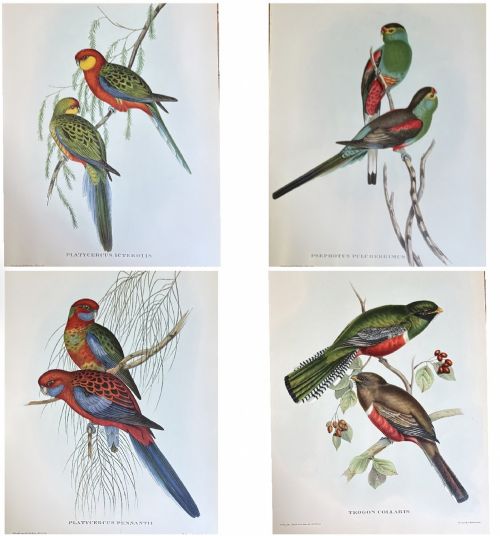
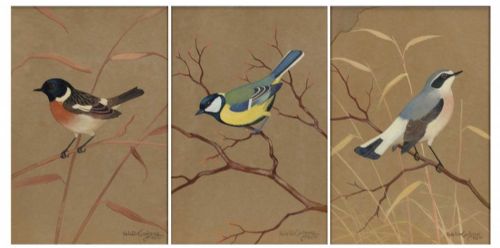


Set of Bird Illustrations
These set of bird illustrations bring the natural world indoors through centuries of paper, ink, and watercolour.
Set of Bird Illustrations
A set of bird illustrations brings together multiple plates or paintings of avian subjects, ranging from framed prints and engravings to bound reference books. When searching for a set of bird illustrations, buyers encounter everything from Georgian hand-coloured ornithological plates to mid-century tropical bird prints.
The materials and formats vary widely across periods, including unframed paper prints, framed engravings with gilt or wood frames, and multi-volume reference books. Common configurations include sets of three, four, six, eight, or ten pieces, often presented in uniform frames or red mounts.
Origins stretch from the eighteenth century through the Victorian era and into the mid-twentieth century, capturing changing scientific and artistic attitudes toward natural history. Buyers find works by notable illustrators alongside anonymous plates produced for early bird enthusiasts.
Materials and technique
These works rely primarily on paper supports combined with ink, watercolour, and gouache to render plumage and habitat with precision. Hand-colouring frequently enhances engraved or printed lines, applying pigment directly to the surface.
Framing materials incorporate wood and glass to protect fragile paper, sometimes accented with gold leaf or gilt details. Bound volumes utilise paper pages and bookbindings to preserve comprehensive studies of avian life.
Early ornithologists occasionally painted ducks with such enthusiasm that their webbed feet required extra layers of gouache.
Assessing the range
Quality rests in the crispness of the original impression and the precision of the hand-applied colour work. Early hand-coloured engravings demonstrate distinct plate marks and subtle tonal gradients absent in later mechanical reproductions.
The survival of complete sets intact with matching mounts, original frames, or uniform paper condition elevates certain groups above assembled collections. The reputation of the original artist or naturalist also shapes the distinction between decorative plates and significant scientific documents.
Alken·George Edwards·William Swainson·Edward Lear·Eleazor Albin·Rev B Morris
The Set of Bird Illustrations Glossary
- Engraving
- A printmaking technique where an artist cuts lines into a metal plate to hold ink for transfer to paper. This method produces fine, sharp details ideal for scientific illustration.
- Hand-coloured
- A process where pigment is applied by brush to a printed or engraved black and white image. This technique adds realistic hues to feathers and foliage.
- Lithograph
- A planographic printmaking method based on the repulsion of oil and water on a stone or metal plate. It allows for softer tonal gradations than traditional engraving.
- Watercolour
- An aqueous paint medium utilising water-soluble pigments on paper. It provides transparent washes suitable for capturing the delicate textures of birds.
- Gouache
- An opaque water-based paint medium containing pigment and a binding agent. It offers denser coverage and brighter highlights than standard watercolour.
Set of Bird Illustrations: Frequently Asked Questions
How should I hang framed bird prints?
Group sets in a balanced arrangement that respects their original configuration, such as a neat grid for four matching frames or a linear sequence for larger series.
Keep them away from direct sunlight to prevent the watercolour pigments and paper supports from fading over time.
Can I separate a bound book into individual plates?
Reference volumes and natural history books are generally best preserved intact to maintain their historical context as complete avian surveys.
Disbinding historical books destroys their integrity as library artefacts, whereas loose prints and engravings are specifically designed for individual display.
How do I identify a hand-coloured print?
Examine the surface under magnification to look for subtle brush strokes and slight pooling of pigment within the printed boundaries. Printed colour appears as a uniform dot matrix or flat screen, while genuine hand-colouring varies slightly across each plate.
What framing is appropriate for antique paper?
Utilise acid-free backing boards and conservation-grade mounts to prevent chemical degradation of the antique paper over the decades.
Ensure the glass does not touch the surface of the print directly, allowing a small gap for air circulation.