

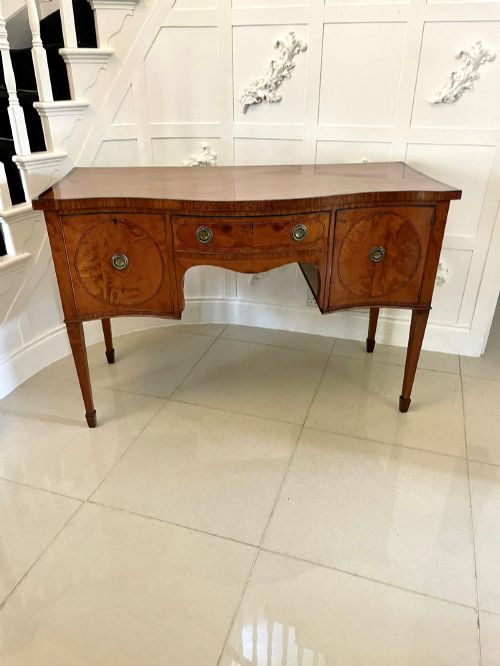
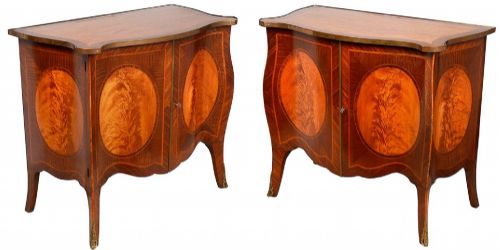


Serpentine Satinwood Sideboard
A serpentine satinwood sideboard brings curving elegance to a dining room, combining rich timber with graceful movement.
Serpentine Satinwood Sideboard
When you search for a serpentine satinwood sideboard, you are looking at sophisticated case furniture defined by a gently undulating front and the distinctive golden sheen of figured timber. These pieces largely emerge from the Victorian, Edwardian, and Sheraton Revival periods, running from the late nineteenth century into the early twentieth century.
The versions you meet on this page range from full-sized sideboards and credenzas down to compact side cabinets and display pieces. Many incorporate mahogany carcases, boxwood stringing, or delicate floral paintwork alongside the primary satinwood veneer.
Makers of these items drew heavily upon earlier eighteenth-century George III aesthetics, reinterpreting classic proportions for later homes. You will encounter both grand dining room sideboards and smaller commodes sharing the characteristic curved profile.
Materials and construction
Cabinet makers constructed these pieces using solid timbers like mahogany as a stable carcase foundation, upon which they applied figured satinwood veneers. This technique allowed workshops to display striking grain patterns across large curved drawer fronts and door panels without risking the splitting associated with solid exotic woods.
Decoration relied upon precise woodworking techniques such as boxwood inlay, contrasting banding, and occasional hand-painted floral motifs. Brass handles and mounts frequently accented the golden timber, while glass panels appeared in the doors of display cabinets.
Serpentine Satinwood Sideboard Retail Price Guide 2026
Typical asking prices for serpentine satinwood sideboard among the pieces listed under this phrase on Sellingantiques today, from the lower quarter to the upper quarter. They describe what is for sale here now, not the wider market.
Listings combine satinwood, mahogany, and boxwood with glass and paint across Victorian, Edwardian, and Sheraton Revival periods.
Judging quality and execution
Quality in these items rests upon the precision of the veneer work and the crispness of the curved serpentine shaping. Superior examples display continuous, book-matched grain patterns that follow the sweeping contours of the front without buckling or lifting.
The refinement of the decorative details also separates standard production from finer pieces. Finely drawn boxwood inlay and carefully executed painted panels demonstrate the hand of a more accomplished workshop during the revival periods.
The Serpentine Satinwood Sideboard Glossary
- Serpentine
- A shaped furniture front that curves outward in the centre and inward at the sides, creating a gentle wave effect.
- Satinwood
- A hard, durable tropical timber with a lustrous golden-yellow appearance that takes a fine polish.
- Sheraton Revival
- A late nineteenth and early twentieth century design movement inspired by the neoclassical furniture of Thomas Sheraton.
- Stringing
- Thin lines of contrasting wood inlay used to outline drawers, panels, and legs on fine cabinetry.
- Carcase
- The main structural body or frame of a piece of case furniture before drawers and doors are fitted.
Serpentine Satinwood Sideboard: Frequently Asked Questions
What periods do these pieces come from?
The items listed span the Victorian era, the Edwardian period, and the Sheraton Revival of the late nineteenth and early twentieth centuries.
A few pieces also reference earlier George III design origins, reflecting how later cabinet makers looked back to eighteenth-century aesthetics.
How do I distinguish satinwood from mahogany?
Satinwood presents a pale, golden-yellow colour with a natural sheen that resembles satin cloth. Mahogany offers a deeper reddish-brown tone, though the two timbers often appear together in banded or inlaid combinations.
Many pieces use mahogany for the main structure while reserving satinwood for the visible veneered surfaces.
Where were these sideboards used?
These items were principally designed for formal dining rooms to store tableware, linen, and serving dishes. Smaller side cabinets and display pieces often found places in drawing rooms and reception spaces.
The curving serpentine shape helped soften the heavy feel of traditional dining furniture in period interiors.
What is boxwood inlay?
Boxwood inlay involves small strips of pale box timber set flush into the darker wood surface to create decorative borders and geometric patterns. It provides a crisp, contrasting line that highlights the drawers and doors.
This technique is particularly characteristic of Sheraton Revival pieces from the Edwardian era.
Are all these pieces full size?
No, while traditional sideboards form a large part of the selection, the category includes related forms such as side cabinets, display cabinets, and commodes.
Some examples feature kneehole configurations or dressing table formats while retaining the same curved aesthetic.